Tax & Financial Services Franchises in 2026: Costs, Growth and Risks

Most franchise buyers picture a storefront, a kitchen or a service van. Fewer picture a quiet office where clients bring a shoebox of receipts and leave with a filed return. Yet tax and financial services franchises are drawing fresh attention in 2026, and the numbers explain why.
Entrepreneur's 2026 Franchise 500 report, which analyzed data from July 2024 to July 2025, named financial services among the categories showing strong growth, alongside children's and personal care businesses. At the same time, overall franchise expansion cooled, which makes any category still gaining ground worth a closer look.
This guide walks through what tax preparation, bookkeeping and related financial services franchises actually cost, how the fee structures differ from typical retail or restaurant models, and which risks deserve attention before you sign. Figures come from VettedBiz franchise profiles and market reports; buyers should still confirm current brand-level terms against each franchisor's Franchise Disclosure Document (FDD).
Why Tax and Financial Services Franchises Are Getting Attention
The franchise industry is still growing, just more slowly. Entrepreneur reported that ranked brands grew units by 2.71% in its latest study period, down from 3.49% the year before. The broader universe of 1,354 brands grew 2.56%, compared with 3.33% previously.
In that environment, buyers are rethinking which categories offer durable demand. Financial services has a built-in argument: clients need tax filings, bookkeeping and compliance support whether the economy is booming or soft.
Compliance complexity drives demand
A market research summary from Verified Market Research points to rising compliance complexity as a major driver of professional tax preparation. As rules become harder to navigate, more households and small businesses may seek professional assistance instead of relying solely on self-filing software. The same report also highlights standardized digital intake and review workflows as tools that can reduce onboarding friction and rework.
Market size estimates
Verified Market Research values the global tax preparation franchise market at roughly $601 million in 2025 and projects it to reach about $1.2 billion by 2033, a compound annual growth rate near 7.2%. The report's FAQ uses a different 2024 to 2032 forecast horizon, so the direction is clearer than the exact end year. This estimate covers the franchised tax preparation market globally, not the broader U.S. tax preparation services industry.
The same market report credits North America with about 42% of the market, attributing that share to tax-system complexity and the scale of large national brands.
Pro Tip: Market-size reports vary widely in what they count. Use them to understand direction, then rely on the FDD, especially Item 19 and Item 20, for brand-level facts.
What Tax and Financial Services Franchises Cost
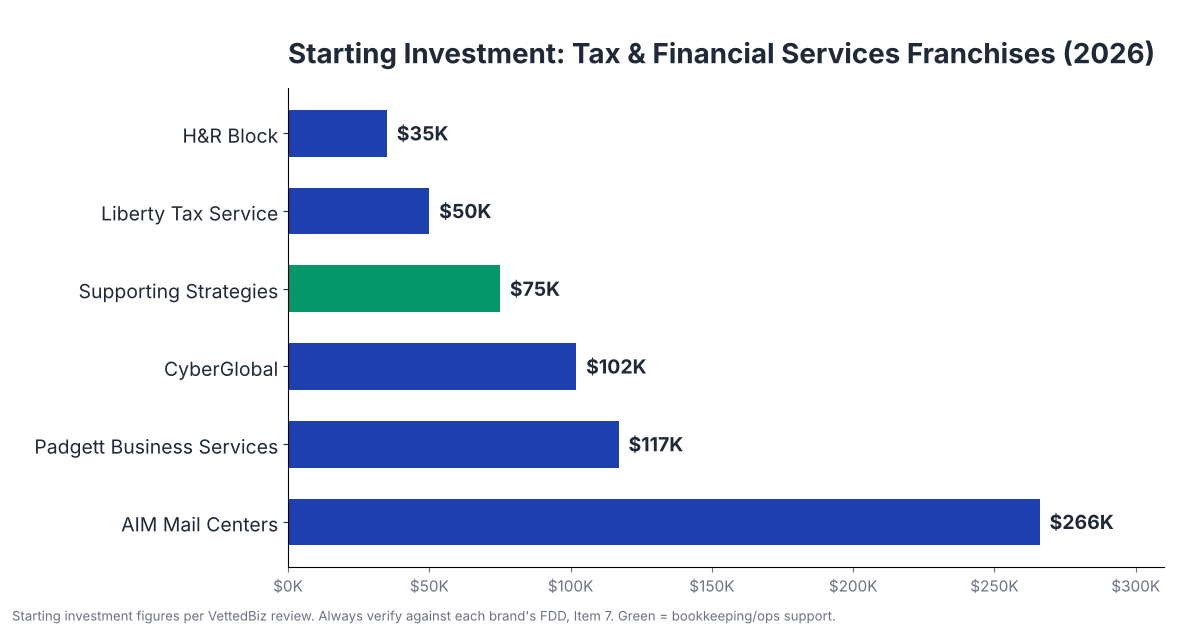
Entry costs vary considerably across the brands in the table. Listed starting investments run from roughly $35,000 for H&R Block to $266,000 for AIM Mail Centers, and the headline starting figure should not be treated as the same thing as a full Item 7 build-out.
Fee structures vary widely
The brands in the table illustrate how different these structures can be. CyberGlobal is listed with a 6% royalty, while H&R Block's listed royalty is much higher at 40%. Tax and financial-services systems may also use per-return, flat or other recurring fees, so buyers should model the actual Item 6 structure for each brand rather than rely on a category-wide benchmark.
That variation is a key difference. A percentage royalty, a per-file fee or another recurring charge can produce very different economics at the same revenue level, so buyers should model the actual fee structure through both a busy season and a slow summer.
The hidden line items
Budget beyond the headline number. Software licenses, e-filing fees, professional liability and errors-and-omissions insurance, background checks, continuing education and seasonal staffing all affect the real cost. Item 7 of the FDD lists estimated initial investment; Item 6 lists recurring fees. Read both together.
Business Models Inside the Category
"Financial services" is a broad label. The brands in the table above fall into at least four different operating models, and each suits a different buyer.
Storefront tax preparation
The classic model serves individuals and families from a retail or office location. Revenue is concentrated in a few months, so cash planning matters. Storefront brands tend to rely on brand recognition, referral traffic and returning clients.
Professional and advisory models
Some systems focus on professional advisory work rather than a traditional tax storefront. These models may carry higher credential requirements, which narrows the pool of eligible owners but can support higher-value services.
Bookkeeping and back-office support
Brands like Supporting Strategies serve small businesses with year-round bookkeeping and operational support. Monthly recurring work smooths revenue compared with filing-season spikes, though sales cycles can be longer and staffing needs different.
Niche advisory services
Entrepreneur's 2026 report also noted emerging niches, from networking groups to indoor air quality services. In the same spirit, cybersecurity advisory franchises such as CyberGlobal show how financial and professional services are broadening. Newer concepts usually have fewer open units to learn from, so validation calls with franchisees become more important.
Earnings Potential and Payback: Read With Caution
Directory and comparison sites sometimes publish payback estimates, but those claims are not guarantees and may not disclose the assumptions behind them. Treat any short payback period as a marketing estimate unless it can be reconciled with the current FDD, Item 19 data when available, and franchisee interviews.
Reliable earnings data lives in Item 19 of the FDD, the financial performance representation. Not every franchisor includes one. If a brand does not, ask why, and ask existing owners directly about revenue, staffing costs and what a typical first season looked like.
Be wary of any projection that skips seasonality. A tax franchise may earn much of its annual revenue in a narrow window, so cash reserves for the off-season belong in your plan.
Risks and Challenges to Weigh
Seasonality and cash flow
Filing deadlines create peaks and valleys. Plan for fixed costs like rent and software during the slow months, and consider whether the brand offers year-round services such as bookkeeping or audit support.
Regulatory and credential requirements
Preparers face licensing, registration and continuing-education rules that vary by state and by service. Confirm what applies in your territory before you commit, and ask the franchisor how it supports compliance.
Competition from software and AI tools
Consumer tax software and automated tools are a real competitive force, particularly for simple returns. Franchises answer with human advice, complexity handling and trust, but that advantage depends on execution.
Data security and liability
Tax work involves highly sensitive client data. Ask about cybersecurity requirements, insurance coverage and how the franchisor handles breaches. These costs and responsibilities should be clear before signing.
Who Is a Good Fit
Tax and financial services franchises tend to suit buyers who are detail oriented, comfortable with regulated work and willing to build local relationships. Some models fit accountants or enrolled agents already holding credentials. Others are designed for owner-operators who hire credentialed staff. A bookkeeping model may suit someone who prefers recurring monthly relationships over filing-season intensity.
If you prefer an operations-light role, ask whether the system allows manager-run ownership and what it costs to hire qualified preparers.
A Due Diligence Checklist
Before committing, work through these steps:
- Request the FDD and review Items 5, 6, 7, 11, 19, 20 and 21 with a franchise attorney.
- Call at least 10 current and former franchisees from the Item 20 list, including at least a few who left the system.
- Model a full 12-month cash flow, including the off-season, using conservative revenue assumptions.
- Confirm licensing, registration and insurance rules in your state.
- Ask how the franchisor handles technology updates, client data security and e-filing support.
- Compare at least three brands across fees, support and track record.
- Confirm financing options, including SBA-backed loans, with a lender who understands franchise financing.
Key Takeaways for Buyers
Financial services is one of the categories Entrepreneur highlighted for growth in its 2026 report, in a year when overall franchise unit growth slowed. In the verified comparison table, listed starting investments range from about $35,000 to $266,000, but actual startup costs still depend on software, insurance, staffing and the operating model.
The category is not one business model. Storefront tax prep, professional advisory services, bookkeeping and broader business services have different revenue rhythms, skill needs and risks. Match the model to your background rather than to the lowest price tag.
Most importantly, verify. Franchise profile data and market forecasts are a starting point; the FDD and franchisee conversations are where decisions are made.
How to Compare Tax and Financial Services Franchise Brands
Because the category mixes very different concepts, a simple price ranking can mislead. A more useful comparison looks at five questions.
How is revenue earned, and when?
Per-return fees, monthly retainers and advisory engagements create different cash patterns. A brand built on monthly bookkeeping contracts behaves more like a subscription business, while a storefront tax brand behaves more like a seasonal retailer. Ask each franchisor to show a typical monthly revenue curve.
What does the royalty structure really cost?
A percentage royalty, a per-file fee and a flat monthly fee can produce very different totals at the same revenue level. Run the same sample revenue scenario through each brand's Item 6 fees, and include technology and marketing contributions.
How strong is franchisee support?
Training, software, compliance updates and marketing help matter more in regulated work than in many other categories. Ask existing owners how quickly the franchisor responds when a filing rule changes or a software issue appears during peak season.
What does the unit trend say?
Item 20 shows openings, closures and transfers over three years. A brand with steady net growth and few terminations tells a different story from one with frequent turnover. This is also where Entrepreneur's note about slower overall growth is useful context: a flat or shrinking system may reflect category-wide conditions or brand-specific problems, and only franchisee calls can tell you which.
Can you finance it?
Lower investment levels do not remove the need for working capital. Lenders will look at your liquid capital, credit and the brand's loan track record. VettedBiz recommends confirming financing before paying a franchise fee.
Frequently Asked Questions
Do I need to be a CPA to own a tax franchise?
Not necessarily. Requirements vary by brand and by state. Some systems expect credentialed owners or staff, while others train owners and hire licensed preparers. Confirm requirements in the FDD and with your state regulator.
Are tax franchises only busy for a few months?
Many storefront models earn most revenue during filing season, which is why year-round services such as bookkeeping, payroll or advisory work can matter. Ask each brand what share of revenue typically falls outside the main season.
How much do these franchises cost to start?
In the comparison table, listed starting investments range from about $35,000 to $266,000. The lowest listed figure rarely equals your total cost, so compare the full Item 7 range and recurring Item 6 fees instead of relying on a headline minimum.
Conclusion
Tax and financial services franchises offer an appealing mix of recurring client needs, comparatively accessible entry costs and a service model less dependent on foot traffic. They also bring seasonality, regulation and technology disruption that newcomers should respect.
If you are exploring the category, start by shortlisting brands that match your credentials and cash position, then request their FDDs and speak with existing owners. VettedBiz can help you compare opportunities side by side. Explore our franchise guides and talk with an advisor to build a shortlist you can verify.
Get insider access to franchise insights
Subscribe to receive expert tips, franchise rankings, and exclusive data straight to your inbox, trusted by thousands of aspiring business owners and investors.
Franchise resources & insights
Explore expert guides, data-driven articles, and tools to help you make smarter franchise decisions, whether you're just starting out or ready to invest.