Pet Retail & Wellness Franchises in 2026: Investing in the $158 Billion Industry's Essentials-Driven Shift
America's pet industry just posted its biggest number yet: $158 billion in consumer spending in 2025, and the American Pet Products Association (APPA) expects that figure to climb to roughly $165 billion in 2026. For franchise investors, the headline isn't the size of the market, it's where the growth is actually concentrated.
Daycare, boarding, and training franchises have dominated the pet-care investment conversation for the past few years. But APPA's 2026 State of the Industry data points to a quieter shift: pet owners are prioritizing essential spending, food, retail supplies, and veterinary access, over discretionary extras, even as their overall budgets grow.
This guide breaks down five franchises capitalizing on that shift, spanning pet specialty retail, fresh-food delivery, grooming-retail hybrids, and walk-in veterinary care, with real investment ranges, average unit volumes (AUV), and the questions investors should be asking before they sign an FDD. None of the five overlap with the daycare, boarding, and training brands VettedBiz has profiled previously, this is a distinct, essentials-driven slice of the pet economy.
The Pet Industry by the Numbers: $158 Billion and Climbing
According to APPA's 2026 State of the Industry report, U.S. pet industry spending reached $158 billion in 2025, up 3.7% year-over-year. The association projects 2026 spending near $165 billion, a roughly 4.4% increase, though APPA notes about half of that growth is attributable to inflation rather than new demand.
The ownership base underpinning that spending is broad and still growing: 95 million U.S. households now own at least one pet, with dog ownership reaching 53% of households (71 million homes) and cat ownership at 39% (53 million homes). APPA President Pete Scott summarized the current consumer mindset directly: pet owners are "prioritizing essential care while still investing in their pets' well-being," even as they become more deliberate about discretionary purchases.
That combination, a growing owner base, steady spending growth, and a tilt toward essentials, is exactly why retail, nutrition, and veterinary-access concepts are drawing franchisee interest right now.
Why Retail, Nutrition & Vet Access, Not Daycare, Are the Segments to Watch
Pet services like daycare, boarding, and training remain solid franchise categories, but they compete for a slice of discretionary pet spending. Retail, nutrition, and veterinary care sit closer to the "essential care" bucket APPA describes, the spending category pet owners are the least likely to cut even when they tighten budgets elsewhere.
That distinction matters for unit economics. Specialty pet retailers benefit from repeat, non-discretionary purchase cycles (food and supplies run out on a predictable schedule, driving built-in foot traffic that doesn't depend on a discretionary "treat yourself" decision). Fresh-food and nutrition brands are riding a broader premiumization trend in how owners feed their pets, the same "pets as family" mindset that has pushed grain-free, subscription, and human-grade pet food from a niche category into a mainstream retail expectation. And walk-in veterinary clinics are addressing a capacity gap: traditional veterinary practices are booked out for weeks in many markets, while the broader veterinary medicine market is projected to surpass $53.47 billion by 2033.
For franchise investors, this reframes the question from "how big is the pet industry" to "which slice of the pet industry is recessionresistant." Essentials-oriented concepts tend to hold up better when household budgets tighten, because pet owners cut vacations and discretionary grooming add-ons before they cut food or medical care for an animal they consider a family member.
5 Pet Franchises Cashing In on the Shift
1. Pet Supplies Plus, Specialty Pet Retail
Pet Supplies Plus is the category's dominant specialty retailer, with more than 720 locations nationwide and an Entrepreneur Franchise 500 pet-franchise ranking it has held for 11-plus consecutive years. The brand's 2025 disclosure data showed an average unit volume of roughly $2.6 million across 385 reporting stores, with newer stores (open one year) averaging $1.6 million and mature locations (open four-plus years) reaching $2.8 million.
- Total investment: $537K-$1.97M
- Franchise fee: $49,900 (discounts available for veterans and first responders)
- Royalty: 2% of monthly gross sales in year one, stepping up to 3% thereafter
- AUV: $2,496,071
2. Woof Gang Bakery & Grooming, Retail + Grooming Hybrid
Woof Gang Bakery & Grooming pairs a boutique pet-supply storefront with an in-house grooming salon, a hybrid model that has fueled the brand's expansion. Unit count grew 64.8% over the past three years, and in June 2026 the company announced a growth investment from private equity firm Great Hill Partners, with a stated target of 450 U.S. locations by 2027.
- Total investment: $191K-$560K
- 3-year unit growth: 70%
- Total Units: 236
3. Wag N' Wash, Natural Pet Food Retail & Self-Wash
Wag N' Wash combines a natural pet food and supply store with self-service dog-wash stations, a recurring-visit model that drives repeat retail traffic. It's a larger-format investment than Woof Gang, positioning it closer to the full specialty-retail category occupied by Pet Supplies Plus.
- Total investment: $521K-$1.36M
- Franchise fee: $49,900
4. Pet Wants, Fresh Pet Food Subscription & Delivery
Pet Wants sells small-batch, fresh pet food through a subscription and local-delivery model, tapping directly into the premiumization trend in pet nutrition. The brand reported 158 locations and a 2025 average gross revenue of $546,633 across its network, though performance varied sharply by quartile, from a top-quartile average of $935,860 down to a bottom-quartile average of $136,390, a spread investors should weigh carefully against local market saturation and delivery-route density.
- Total investment: $148K-$239K
- Franchise fee: $53,500
- AUV: $436,723
- Royalty: greater of a flat monthly fee (roughly $350–$1,000, escalating in year two) or 7% of gross revenue
5. PetWellClinic, Walk-In Veterinary Care
PetWellClinic operates walk-in, no-appointment-needed veterinary clinics, a model built to address the access gap in traditional veterinary care. It's the newest and smallest-footprint concept on this list, with franchising underway since 2019.
- Total investment: $286K-$498K
- Franchise fee: $49,250
- Royalty: 7% of gross sales
- Unit count and per-location earnings: the latest available figures present 27 total U.S. locations.
Investment Comparison Table
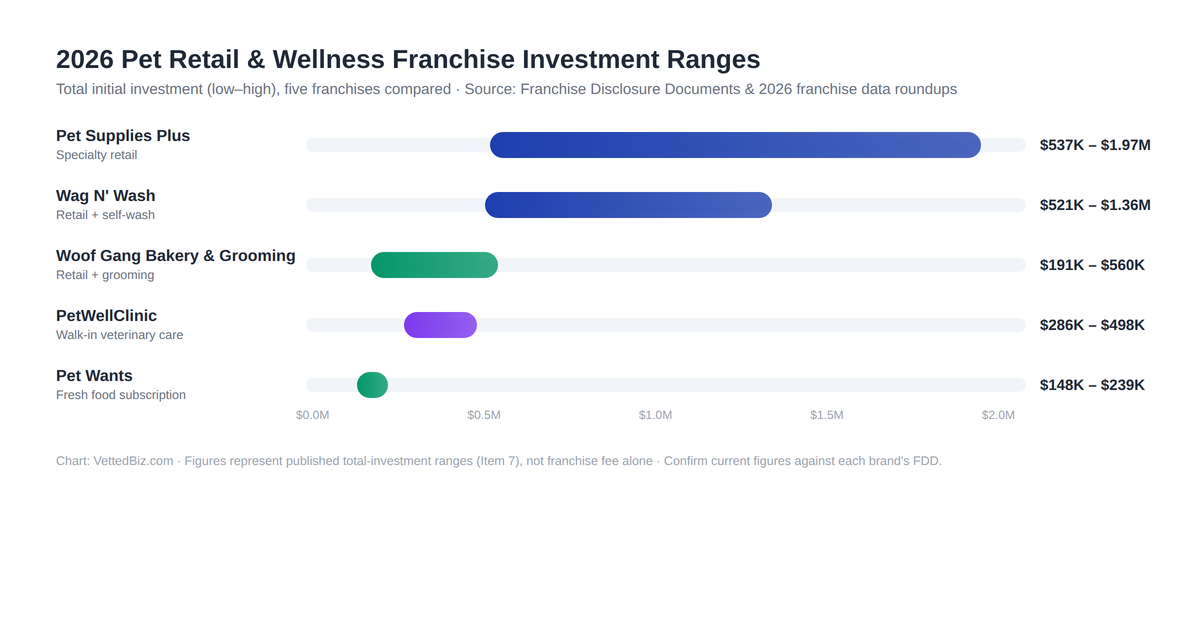
Figures reflect publicly reported franchise disclosure data as of 2025–2026 and are not a substitute for a current FDD. Franchise fee and royalty figures not independently confirmed for Woof Gang Bakery & Grooming and Wag N' Wash are marked with a dash; request Item 5 and Item 6 disclosures directly from the franchisor.
What This Means for Investors
Segment matters more than category size. "Pet care" is broad enough to include a $150K nutrition-delivery route and a $1.8M retail superstore. Match the investment size and operating model, retail hours, staffing, delivery logistics, clinical licensing, to your own capital, time commitment, and risk tolerance, not just the industry's headline growth number.
Ask for a quartile breakdown, not just an average. Pet Wants' 2025 disclosure shows nearly a 7x gap between its top and bottom performance quartiles. An advertised AUV without quartile context can flatter a concept's real earnings distribution, always request the full Item 19 table.
Growth capital can be a positive signal, with caveats. Woof Gang Bakery & Grooming's private-equity investment suggests institutional confidence in the hybrid retail-grooming model, but PE-backed growth targets (like the stated 450-location goal) are aspirational figures, not guarantees, and rapid unit growth can pressure territory availability and franchisor support capacity.
Newer concepts carry data gaps. PetWellClinic's walk-in model addresses a real access problem in veterinary care, but the most recent publicly available unit and earnings data is several years old. That's not disqualifying, but it does mean more diligence work falls on the investor, current franchisee interviews (Item 20 of the FDD), recent unit-count trends, and direct financial performance requests are essential before committing capital.
A Buyer's Checklist Before You Sign
Before moving forward with any of the five concepts above, or any pet-industry franchise, VettedBiz recommends working through this checklist:
- Request the full Item 19 table, not a headline AUV. Ask for the quartile or percentile breakdown, the number of units included, and how many years they've been open. A single average figure can hide wide performance variance, as Pet Wants' own disclosure illustrates.
- Confirm current unit counts directly with the franchisor. Third-party roundups and trade articles can lag a brand's actual footprint by several years, particularly for newer concepts like PetWellClinic.
- Call at least five to ten current franchisees from the Item 20 list. Ask specifically about staffing challenges, real estate costs in your target market, and whether royalty and marketing fees match what's disclosed.
- Check territory protection language in Item 12. Fast-growing hybrid concepts can see nearby territories awarded quickly; understand exactly what geographic exclusivity you're buying.
- Model both a conservative and an optimistic revenue scenario. Use the bottom-quartile figure, not just the average, to stresstest whether the business still covers debt service and a reasonable owner draw.
Risks and Due Diligence Considerations
Inflation-adjusted growth: APPA attributes roughly half of projected 2026 industry growth to inflation. Model your own unit economics against real, not nominal, growth assumptions.
Territory saturation: Specialty retail and grooming-hybrid brands expanding quickly (like Woof Gang Bakery & Grooming) can see territory density increase fast, confirm protected-territory terms in Item 12 of the FDD.
Licensing and regulatory exposure: Veterinary-adjacent concepts like PetWellClinic operate under state veterinary practice regulations that vary significantly by state and can affect ownership structure and staffing requirements.
Verify all third-party statistics: The $53.47 billion veterinary medicine market projection cited in industry roundups should be confirmed against a named primary source before it's used in investor materials.
Conclusion
The pet industry's move toward $165 billion in 2026 spending isn't spread evenly across every pet-care category, it's concentrated in the essentials owners won't cut: food, supplies, and veterinary access. Pet Supplies Plus, Woof Gang Bakery & Grooming, Wag N' Wash, Pet Wants, and PetWellClinic each offer a different entry point into that shift, from a sub-$150,000 nutrition-delivery route to a nearly $1.8 million retail flagship. As with any franchise decision, the published averages are a starting point, a full Item 19 review, current franchisee interviews, and a realistic match to your own capital and operating capacity should decide the rest.
Get insider access to franchise insights
Subscribe to receive expert tips, franchise rankings, and exclusive data straight to your inbox, trusted by thousands of aspiring business owners and investors.
Franchise resources & insights
Explore expert guides, data-driven articles, and tools to help you make smarter franchise decisions, whether you're just starting out or ready to invest.