Multi-Unit Franchise Ownership 2026: Where Scale Wins
If you have been researching franchise opportunities, you have probably noticed that many brands now talk less about "owning a business" and more about "building a portfolio." That shift is not marketing spin. Multi-unit franchise ownership has become the dominant model in American franchising, and the latest data shows the trend accelerating at the top end.
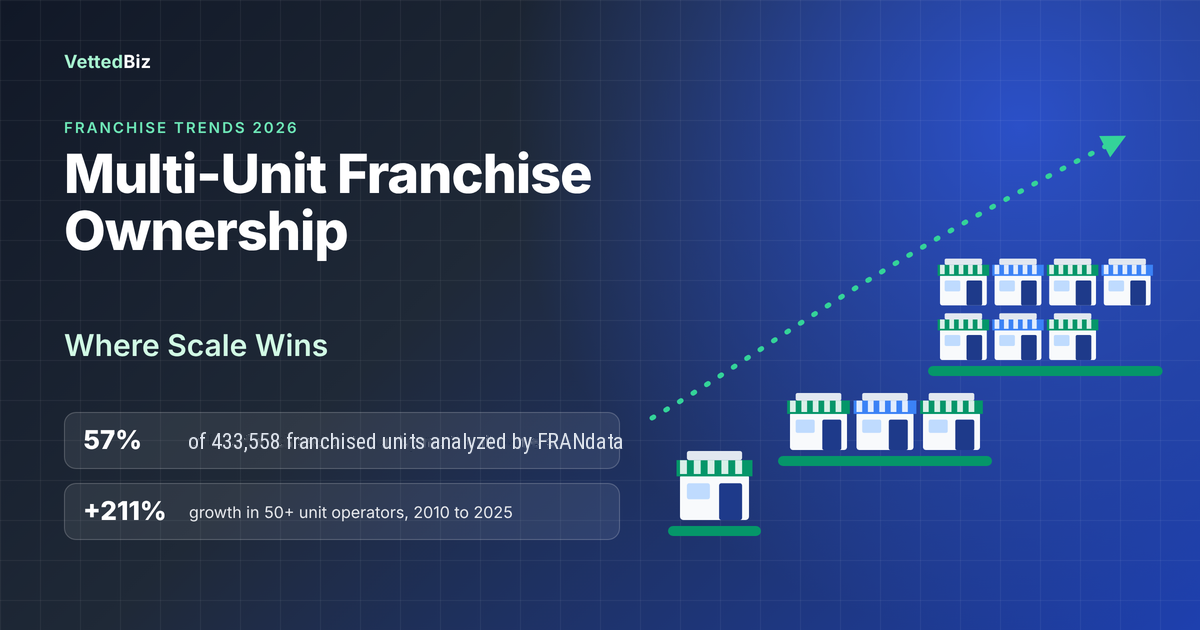
According to FRANdata's 2026 analysis of 433,558 franchised units, 57% are now operated by multi-unit owners. The number of operators running 50 or more locations has roughly tripled since 2010. Meanwhile, the International Franchise Association (IFA) projects that franchise establishments will grow 1.5% in 2026 to about 845,000 units.
For investors, the question is not just whether to own more than one unit. It is where scale actually creates an advantage, and where a single, owner-operated location remains the smarter play. In this guide, we break down multi-unit ownership by industry, highlight the brands where multi-unit is the norm, and walk through the economics, risks, and FDD items to review before you commit to a growth plan.
Multi-Unit Franchise Ownership by the Numbers
A multi-unit franchisee is an operator who owns two or more locations of a franchise brand, and sometimes locations across several brands. The category ranges from a family running three pizza shops to institutional groups with thousands of restaurants.
FRANdata's 2026 Multi-Unit Buyer's Guide data puts the overall picture in perspective. Of the 433,558 franchised units in its analysis, about 247,000 (57%) are run by multi-unit owners, while 43% belong to single-unit operators. In other words, the typical franchised location in the U.S. today is part of a portfolio.
Growth Is Fastest at the Top
FRANdata's 2026 multi-unit landscape report tracks operator counts by size tier from 2010 to 2025. Every tier grew, but the largest operators grew the most:
Two takeaways stand out. First, the 2-5 unit tier is still the largest group by far, so multi-unit ownership is not reserved for private equity-backed mega-operators. Second, concentration at the top is real: the largest U.S. franchisee today, Flynn Group, operates 2,980 units, compared with 1,143 units for the top operator in 2010, NPC International.
The 2026 Backdrop
The broader franchise economy supports continued expansion. The IFA 2026 Franchising Economic Outlook, prepared with FRANdata, projects:
- Establishments growing 1.5% to about 845,000 units, or more than 12,000 net new locations
- Franchise employment rising 1.8% to nearly 8.9 million jobs
- Economic output topping $920 billion
Existing operators are natural candidates to capture much of that growth. They already have operating experience, lender relationships, and a track record that franchisors trust when awarding new territories.
Where Scale Wins: Multi-Unit Share by Industry
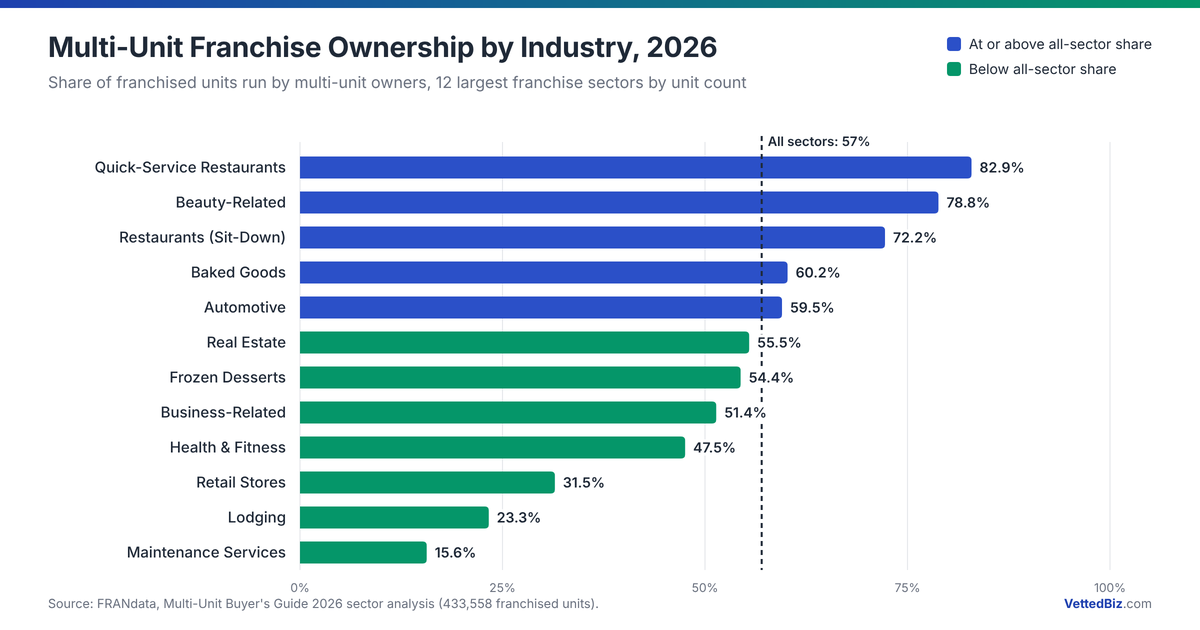
Multi-unit ownership is not evenly distributed. FRANdata's 2026 sector data shows large differences in how much of each industry is controlled by multi-unit operators. Here are the 12 largest franchise sectors by unit count:
High-Concentration Sectors: Restaurants, Beauty, and Automotive
Quick-service restaurants sit at the extreme, with roughly 83% of 142,081 QSR units run by multi-unit owners. Sit-down restaurants (72%), baked goods (60%), and frozen desserts (54%) follow the same pattern. Food concepts reward scale because the playbook is highly standardized, real estate and construction know-how carries over from one site to the next, and a district manager can oversee several stores within a short drive.
Beauty-related franchises (79%) may surprise some readers. Salon and personal care brands typically rely on stylists and staff rather than the owner working behind the chair, which makes it practical for one owner to manage a cluster of locations. Automotive (60%) follows a similar logic: standardized service menus, shared technicians, and regional marketing favor operators who build density in a market.
Owner-Operator Sectors: Services, Lodging, and Retail
At the other end, only 15.6% of maintenance services units are multi-unit operated. Many home and commercial service franchises are territory-based, often launched from a home office or a van, and built around the owner selling and managing jobs personally. Lodging (23%) is a different story: hotels require large amounts of capital per property, so many owners hold a single asset.
Retail stores (31.5%) and child-related concepts (34.6%) also lean toward single-unit owners. FRANdata notes that nearly two-thirds of child-related units are single-unit operated, a sector where local, community-rooted owners compete well.
The Opportunity Gap
Here is where it gets interesting for new investors. Several of the sectors with the lowest multi-unit concentration are among the fastest-growing in the IFA's 2026 forecast. Commercial and residential services are projected to grow establishments by 3.2% and child services by 4.3%, while QSR establishments are forecast to grow just 0.4%.
That gap points in two directions. Mature, highly concentrated sectors like QSR are harder to enter as a newcomer, because experienced operators with deep pockets compete for every new territory. Service sectors, by contrast, still leave room for owners to build the first regional portfolios, as several home repair and maintenance franchises are already showing.
Keep in mind that the IFA and FRANdata use slightly different sector categories, so this is a directional comparison rather than a one-to-one match.
Brands Where Multi-Unit Ownership Is the Norm
FRANdata's 2026 Multi-Unit 50 rankings, published by Franchising.com, show how this plays out at the brand level.
By raw number of multi-unit franchisees, Subway leads with 1,945 (about 35% of its 5,605 franchisees), followed by McDonald's with 1,630 (about 83% of 1,953 franchisees), The UPS Store (883), AFC (822), and Dunkin' (741).
The percentage ranking, which covers brands with at least 25 franchisees, is even more revealing. Note that it counts franchisees, not units, so it measures something different from the sector table above:
A few patterns emerge:
- Emerging brands often scale through multi-unit operators. At Dave's Hot Chicken, 57 of 60 franchisees own more than one unit, a pattern typical of brands that expand through multi-unit development agreements.
- Service brands are catching up. RooterMan, Koala Insulation, and America's Swimming Pool Co. show that home services can be built for multi-territory ownership, even though the sector overall is still dominated by single-unit owners.
- Legacy brands vary widely. Subway's large base of single-unit owners contrasts sharply with McDonald's, where more than four out of five franchisees own multiple restaurants. Brands like Wendy's sit in between.
For an investor, a brand's multi-unit percentage is a useful signal. A very high share may mean the franchisor prefers, or requires, multi-unit commitments, and single-unit applicants could face a harder path. A low share may mean more openings for first-time owners, but also fewer experienced peers to learn from.
Why Multi-Unit Franchise Operators Keep Growing
Why do so many owners keep adding units? The economics of scale in franchising are real, but they usually appear only once the first location is stable.
Shared Overhead and Management Leverage
A single location carries all of its owner's overhead: bookkeeping, payroll administration, recruiting, and the owner's own income. Spread across three or five units, those fixed costs shrink as a share of revenue, and the owner can afford a dedicated operations manager or area supervisor.
Purchasing, Marketing, and Labor Flexibility
Multi-unit owners can negotiate better terms with local vendors, run marketing that covers an entire metro area, and move staff between locations to cover shifts. Density in one market also helps recruiting, because employees can see a career path from crew member to general manager.
Reinvestment as a Health Signal
Many franchise leaders treat existing owners opening more units as one of the clearest signs that a system works, since those owners are betting on real results rather than projections. One franchisor executive made exactly that case in a 2026 Franchising.com column. When you evaluate a brand, ask how many of last year's new units went to existing franchisees.
More Room in SBA Financing
Financing rules have also moved in favor of growth. In May 2026, the SBA announced a rule doubling the cumulative limit across its 7(a) and 504 programs from $5 million to $10 million, effective July 4, 2026. Qualified borrowers who take a 7(a) loan first can access up to $5 million through 7(a) and up to $5 million through 504, while the per-loan 7(a) maximum remains $5 million.
For operators building a portfolio that includes real estate, that additional headroom can matter. Eligibility rules and lender requirements still apply, so confirm the details with an SBA lender and review our breakdown of SBA franchise loan rules for 2026.
The Risks of Scaling Too Fast
Scale magnifies weaknesses as much as strengths. Before signing up for multiple units, weigh these risks:
- Development schedule pressure. Area development agreements usually require you to open a set number of units by specific dates. Missing the schedule can mean losing territory rights and forfeiting development fees.
- Leverage and debt service. Each new unit adds debt before it adds cash flow. A slow ramp-up at one location can strain the whole portfolio.
- Management depth. The skills that make a great single-unit operator, such as being on site and fixing problems personally, do not automatically transfer. Multi-unit success depends on hiring and keeping strong general managers.
- Labor costs. Wage increases hit every location at once, so multi-unit operators feel them across the entire portfolio.
- Encroachment and cannibalization. Clustering units in one market builds efficiency, but poorly defined territories can mean your own locations, or the franchisor's other channels, compete for the same customers.
A common approach is to open and stabilize the first unit before committing to more. Some franchisors offer development agreements with flexible timelines or rights of first refusal on nearby territories, which can create a path to growth without committing to everything on day one.
How to Evaluate a Multi-Unit Franchise Opportunity
The Franchise Disclosure Document (FDD) contains most of what you need to judge whether a brand supports multi-unit growth. If you are new to the document, start with our guide on how to read an FDD before you buy, then focus on these items:
Pro Tip: Use the franchisee list in Item 20 to identify current multi-unit owners and call them. Ask how long each unit took to break even, how they found their general managers, and whether they would sign their development agreement again.
Questions to Ask Yourself
- Do you have the capital for more than one unit, including reserves for slower-than-expected openings?
- Are you ready to manage managers instead of running the location yourself?
- Does the market you are targeting have room for several units without overlapping trade areas?
- Would you rather build density in one brand or diversify across brands over time?
Conclusion
Multi-unit franchise ownership is now the backbone of U.S. franchising: FRANdata's 2026 analysis found 57% of 433,558 franchised units are multi-unit operated, and the largest operator groups are growing fastest. Scale wins most clearly in restaurants, beauty, and automotive, where standardized operations and market density create real efficiencies. In faster-growing service sectors, single-unit ownership still dominates, which leaves room for investors to build the first regional portfolios.
The right path depends on your capital, management style, and appetite for risk. Study how a brand's existing owners have grown, read the FDD closely, and talk to multi-unit franchisees before signing a development agreement. Explore VettedBiz's franchise research and FDD library to compare brands and find the opportunities that match your growth plan.
Get insider access to franchise insights
Subscribe to receive expert tips, franchise rankings, and exclusive data straight to your inbox, trusted by thousands of aspiring business owners and investors.
Franchise resources & insights
Explore expert guides, data-driven articles, and tools to help you make smarter franchise decisions, whether you're just starting out or ready to invest.