Best Insurance Franchises 2026: Cost, Revenue & FDD Guide
Insurance is not the first industry most people think of when they hear "franchise." But in 2026, insurance franchises are among the fastest-growing, most searched, and highest-margin franchise opportunities in the United States, and for good reason.
The U.S. insurance brokers and agencies market is valued at $283.7 billion in 2026, growing at a 4.2% CAGR since 2021. Life insurance searches alone have surged 83% year over year, averaging 301,000 monthly searches. Meanwhile, demand for personalized insurance advice is rising as consumers navigate increasingly complex coverage options for home, auto, health, and business policies.
What makes insurance franchises especially attractive to investors is the business model itself: asset-light operations, no inventory, recurring commission-based revenue, and the ability to run the business from a small office or even from home. Total investments can start as low as $23,000, a fraction of what most franchise categories require.
In this guide, we break down the top insurance franchise opportunities in 2026, compare investment costs and revenue potential, and explain what makes this sector one of the smartest plays for first-time and experienced franchise investors alike.
Why Insurance Franchises Are Surging in 2026
A Recession-Resistant Revenue Model
Insurance is one of the few industries where demand remains stable regardless of economic conditions. People need auto insurance, homeowners insurance, and health coverage in good times and bad. This creates a built-in recession-resistant revenue floor that most franchise categories cannot match.
More importantly, insurance franchise revenue is largely recurring. Once a policy is written, the franchisee earns renewal commissions year after year, often for the life of the policy. This compounding effect means that a well-run insurance franchise builds an increasingly valuable book of business over time, with revenue growing even without aggressive new customer acquisition.
Asset-Light, High-Margin Operations
Unlike restaurant or retail franchises that require expensive buildouts, equipment, and inventory, insurance franchises operate with minimal overhead. A typical agency needs only a small office (or home office), a computer, a phone, and licensing. There are no perishable goods, no supply chain headaches, and no large staff requirements in the early stages.
This asset-light model translates directly into higher margins. While a restaurant franchise might operate on 5-10% net margins, insurance agencies routinely achieve 20-40% net margins once established, driven by recurring commissions and low fixed costs.
The Independent Agency Model Is Winning
The insurance industry is experiencing a structural shift toward independent agencies and franchise models. Consumers increasingly prefer agents who can shop multiple carriers and find the best coverage at the best price, rather than captive agents tied to a single company.
Franchise systems like Goosehead, Brightway, and Freeway capitalize on this trend by giving franchisees access to dozens of carriers through a single platform, combined with technology, training, and back-office support that would take years to build independently.
Top Insurance Franchises in 2026
Goosehead Insurance
Founded: 2003 | Headquarters: Westlake, Texas | Locations: 1,115 | Model: Independent
Goosehead has emerged as one of the most prominent insurance franchise brands in the U.S., operating a large independent insurance franchise network.
Investment: $66,000 to $108,500 total initial investment, including a franchise fee of $50,000.
Revenue: Average yearly gross sales per franchise unit is approximately $248,707, with owner-operator estimated earnings of $44,768 to $62,177.
Royalties: 20% to 50% of commissions.
Brightway Insurance
Founded: 2003 | Headquarters: Jacksonville, Florida | Locations: 341 | Model: Independent
Investment: $23,325 to $136,900 total, including a $10,000 to $25,000 franchise fee. Brightway operates an independent insurance agency model with operational support so franchisees can focus on sales and client service.
Royalties: 20%.
Freeway Insurance
Founded: 2021 | Headquarters: Huntington Beach, California | Locations: 606 | Model: Independent
Investment: $34,950 to $84,000 total, including a $10,000 to $25,000 franchise fee. Freeway focuses on making insurance accessible and affordable, particularly for non-standard insurance customers and underserved communities.
Royalties: 14%.
Keystone Insurers Services Group
Founded: 1983 | Headquarters: Mechanicsburg, Pennsylvania | Locations: 302 | Model: Independent
Investment: $27,250 to $99,200 total, including a $5,000 to $20,000 franchise fee. Keystone Insurers Services Group supports independent insurance agencies with carrier relationships, operational efficiencies, and network resources.
Royalties: N/A.
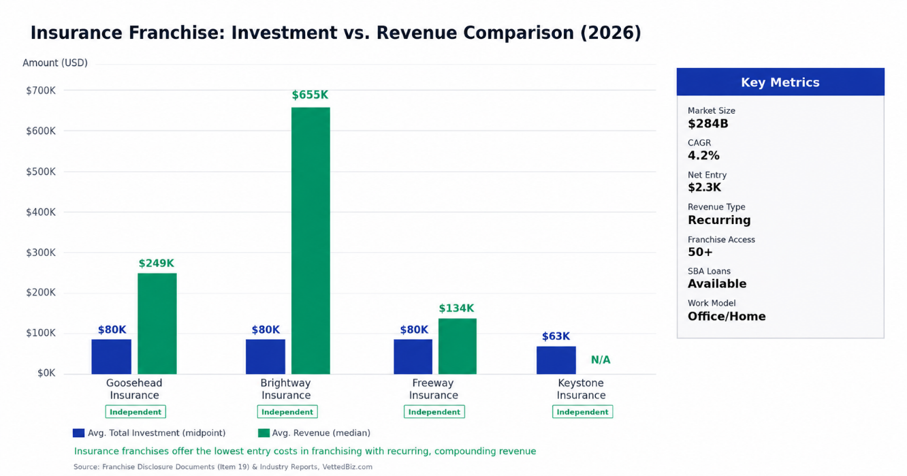
Investment Comparison: Insurance Franchises at a Glance
Independent vs. Captive: Which Model Is Right for You?
Independent agency franchises (Goosehead, Brightway, Freeway) give you access to multiple carriers, sometimes 50 or more. You can shop rates across companies and offer clients the best price and coverage combination. This flexibility drives higher close rates and better client retention.
Captive agency franchises (Allstate, Farmers, State Farm) tie you to a single carrier. You benefit from strong brand recognition and corporate marketing support, but your product options are limited. The industry trend strongly favors independent models, consumers in 2026 expect choice.
What to Examine in the FDD Before You Invest
Item 7, Total Investment
Factor in office setup, licensing costs, E&O insurance, technology fees, and working capital for the ramp-up period before commissions start flowing.
Item 19, Financial Performance
Pay close attention to median revenue and look at how revenue breaks down by agency tenure. Insurance agencies are compounding businesses, first-year revenue is typically modest, with significant growth in years two through five.
Item 20, Franchisee Contacts
Speak with at least 10 current franchisees, including some with three or more years in the system. Ask about profitability timeline, carrier access quality, and lead generation effectiveness.
Pro Tip: Ask franchisees about their renewal commission rate and how their book of business has grown year over year. This is the single most important metric for evaluating long-term insurance franchise profitability.
Technology and the Modern Insurance Franchise
The best franchise systems provide integrated platforms that handle:
- Real-time quoting across multiple carriers
- Automated policy management and renewal tracking
- CRM systems for lead nurturing and client retention
- Digital marketing tools and lead generation
- Compliance and licensing support
Goosehead and Brightway have invested heavily in proprietary platforms that streamline the quoting and binding process.
Who Should Invest in an Insurance Franchise?
Insurance franchises are particularly well-suited for sales-oriented professionals (especially those with experience in real estate, financial services, or B2B sales), career changers seeking a white-collar business with low startup costs, and semi-absentee investors who can build a team of licensed agents.
You do not need an insurance background, most franchisors provide comprehensive training covering licensing, sales techniques, and agency management.
Conclusion: A Compounding Asset at a Fraction of the Cost
Insurance franchises in 2026 represent one of the most compelling investment opportunities in franchising. The combination of a $284 billion addressable market, asset-light operations, recurring revenue that compounds year after year, and total investments starting under $50,000 is difficult to match in any other franchise category.
Start with the FDD, talk to existing franchisees, and model your returns over a five-year horizon, because the real power of an insurance franchise is in the compounding. The book of business you build today pays you for years to come.
Explore insurance franchise opportunities on VettedBiz, compare FDD data, analyze unit economics, and connect directly with franchisors.
Get insider access to franchise insights
Subscribe to receive expert tips, franchise rankings, and exclusive data straight to your inbox, trusted by thousands of aspiring business owners and investors.
Franchise resources & insights
Explore expert guides, data-driven articles, and tools to help you make smarter franchise decisions, whether you're just starting out or ready to invest.