SBA Franchise Loan Rules 2026: What Buyers Must Know
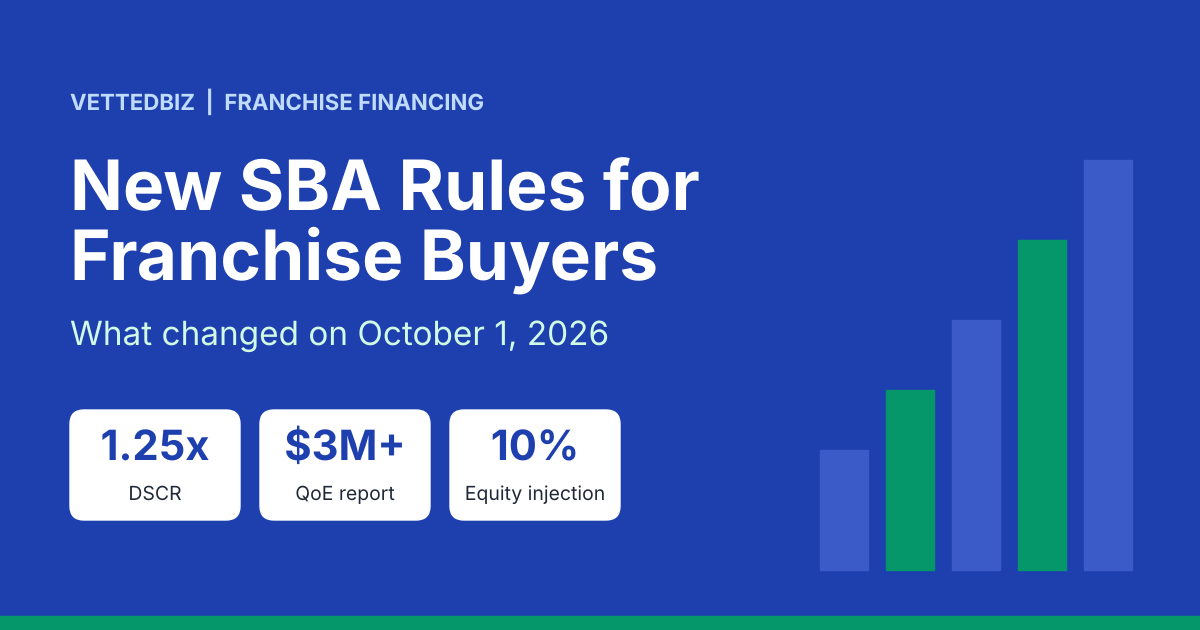
Financing a franchise just got more demanding. On October 1, 2026, the U.S. Small Business Administration began applying a revised Standard Operating Procedure, SOP 50 10 8.1, to new 7(a) loan applications. For anyone using an SBA loan to buy a franchise, resale unit, or additional location, the updated rules change the math on coverage ratios, equity, and paperwork, while separate 2026 eligibility changes also affect who qualifies.
Because 7(a) loans remain one of the most common ways to fund franchise startup costs, lenders, franchisors, and brokers have been discussing the update for weeks. Some lenders reportedly urged clients in September to close pending deals before the deadline. This guide explains what changed, who is affected most, and how to prepare your application so you can keep moving forward.
We cover the debt-service coverage increase, the new quality-of-earnings requirement, equity injection and seller-note limits, the citizenship rule, and practical steps for buyers. We also include a before-and-after chart and a short due-diligence checklist. This is general information, not legal or financial advice; confirm details with an SBA lender and your attorney.
Why the SBA Franchise Loan Rules Matter in 2026
Franchise buyers lean on SBA-guaranteed financing because it offers longer terms and lower down payments than many conventional options. The International Franchise Association's financing materials describe a lending market that is "evolving rapidly," with shifting underwriting standards, a return of the SBA Franchise Directory, and a larger role for franchise brokers and sales organizations.
Earlier in 2026 the SBA also dropped its requirement that lenders prescreen smaller 7(a) loans with the FICO SBSS score, effective March 1, according to a financing explainer from Loan Mantra. Lenders now apply fuller credit analysis, including cash flow and franchise-specific factors. Taken together with the October 1 SOP, the direction is clear: more scrutiny of the borrower and the deal, and less reliance on a single score.
Context matters here. Franchisors typically ask for liquid capital of roughly 20 to 30 percent of total investment and a minimum net worth that can range from $300,000 to $1 million, per the same Loan Mantra overview. SBA down payments typically run 10 to 20 percent. Any tightening on the lender side therefore lands on top of requirements the franchisor already has.
What Changed on October 1, 2026
The revised SOP applies to applications received by the SBA on or after October 1. Existing loans are not affected. Based on summaries from law firm PilieroMazza and franchise-industry outlet L'Express Franchise, the headline changes for acquisitions are below.
Higher Debt-Service Coverage Ratio
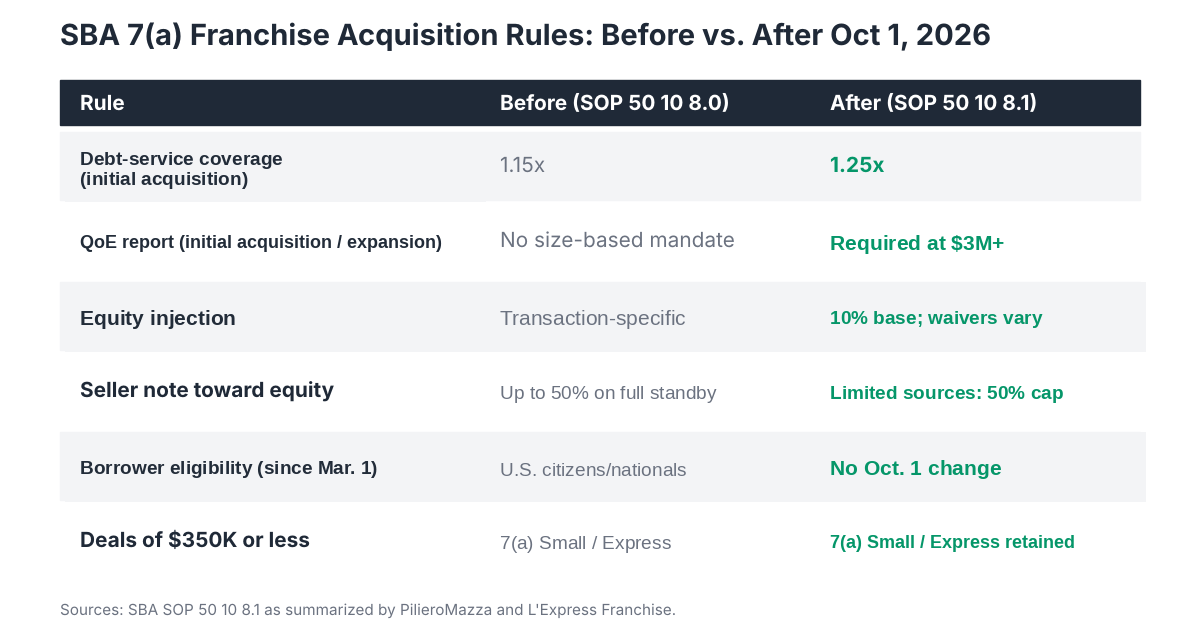
For initial acquisitions and most owner buyouts, the required debt-service coverage ratio (DSCR) rises from 1.15x to 1.25x. In plain terms, the business must show $1.25 of annual cash flow for every $1.00 of annual debt payments. PilieroMazza notes that projections generally cannot offset a weak historical cash-flow record.
That is a meaningful shift for resale purchases. A unit that squeaked past at 1.15x last month may now need a lower loan amount, a bigger down payment, or a different structure. Buyers of well-run units with documented, stable earnings are best positioned.
Quality-of-Earnings Reports for Larger Deals
Initial acquisitions and business expansions with a purchase price of $3 million or more now require a quality-of-earnings (QoE) report in addition to a business valuation. A QoE is an independent review of a seller's reported profits. Reported QoE cost estimates range from $5,000 to $40,000, and timelines can run from weeks to months.
Most single-unit franchise purchases fall below $3 million, so this rule will matter mainly for multi-unit portfolios and large restaurant or service-brand acquisitions. Still, a lender may ask for deeper financial support on smaller deals as well.
Small Deals Retain 7(a) Small and SBA Express Options
Transactions of $350,000 or less may continue to use 7(a) Small and SBA Express processing. Following a September technical update, the SBA confirmed that change-of-ownership loans can use those programs subject to Appendix 15. For a business purchase price of $350,000 or less, lenders may use an internal business valuation. Low-cost, home-based, and service franchise buyers should confirm the applicable process with their lender.
Equity Injection and Seller Notes
Initial acquisitions require an equity injection of at least 10 percent. Business expansions and partner buyouts also start at 10 percent, but qualifying deals may receive a reduction or waiver. Qualifying seller notes, third-party notes, and standby debt can count toward part of that injection without cash, but together they cannot exceed half of the minimum required equity, according to PilieroMazza.
For an existing franchisee adding units, L'Express Franchise adds that the coverage threshold stays at 1.15x for expansion deals, and that lenders may reduce or waive the injection when post-closing liquidity and net worth are strong. Confirm with your lender which category your transaction falls into.
Citizenship and Residency Requirement
Separately, since March 1, SBA financing has been limited to applicants who are U.S. citizens or U.S. nationals with a principal residence in the United States. Lawful permanent residents are not included. Entities owned by other entities must be organized in the U.S., and an ineligible direct or indirect owner or required guarantor can disqualify the loan.
Lending professionals quoted by Forbes have criticized this restriction. Buyers who are not citizens should speak with a qualified immigration attorney and a lender about alternative funding paths. VettedBiz does not provide legal advice.
Owner-Operator and Seller Transition
L'Express Franchise reports that the owner must remain meaningfully involved in management, which discourages absentee ownership, and that sellers may stay on as consultants for up to two years after closing, up from 12 months.
Pro Tip: Ask your lender early which version of the SOP applies to your file. The date your application is received by the SBA, not the date you signed a purchase agreement, drives which rules apply.
Before vs. After: SBA Franchise Acquisition Rules at a Glance
The chart below summarizes the key differences. Some prior-rule entries are described qualitatively because the summaries we reviewed did not quantify the old standards.
How the New Rules Affect Different Franchise Buyers
First-Time Buyers of New Franchise Units
A brand-new franchise unit has no earnings history, so the historical-cash-flow emphasis in the SOP bites hardest on resales and acquisitions. New-unit lenders still focus on borrower credit, liquidity, experience, and the strength of the franchise system. Strong franchisor documentation, including a clear Item 19 financial performance representation, helps lenders underwrite with confidence.
The FRANdata Franchise Registry and its FUND Score, which Loan Mantra notes are used by many lenders, become more important when there is no standardized prescreening score. Ask your franchisor whether it is listed and how recently it was reviewed.
Buyers of Existing Franchise Locations
If you are buying a resale, expect lenders to examine multiple years of tax returns, add-backs, and the owner's real compensation. With a 1.25x target on applicable acquisitions, every add-back gets challenged. Work with an accountant who understands franchise royalties, marketing fund contributions, and one-time expenses. Our earlier coverage of franchise resales explains how to evaluate asking prices.
Multi-Unit Operators
Multi-unit developers may see the QoE threshold on larger portfolio purchases, along with a higher loan ceiling. Separately, Loan Mantra reports that the combined 7(a) and 504 ceiling rose to $10 million from $5 million earlier in 2026. Most franchise loans are well below that, but the headroom matters for high-capital concepts.
Low-Cost and Home-Based Franchises
Buyers of lower-cost concepts, where total investment can start under $100,000, can still use 7(a) Small or SBA Express for qualifying change-of-ownership deals. Appendix 15 coverage and cash-flow requirements still apply, so have your financial and franchise documents ready on day one.
Seven Steps to Prepare Your SBA Franchise Loan Application
- Confirm eligibility early, including citizenship, residency, and ownership structure, before paying for due diligence.
- Request the franchisor's FDD and read Item 7 (initial investment), Item 19 (financial performance), and Item 20 (outlets and franchisee contacts).
- Call at least ten current and former franchisees from Item 20 and ask about cash flow, support, and unit-level profitability.
- Build a conservative cash-flow model using the coverage ratio that applies to your deal.
- Gather three years of personal and business tax returns, a personal financial statement, and proof of liquid funds.
- Ask the lender whether the SBA Franchise Directory or the FRANdata Franchise Registry applies to your brand.
- Budget extra time. Standard underwriting, valuations, and possible QoE reviews can add weeks.
Alternatives If SBA Financing Is Out of Reach
Not every buyer will qualify under the revised rules. Alternatives include conventional bank loans, franchisor or third-party financing programs, equipment financing, self-directed retirement account rollovers (consult a tax professional), home-equity lines, and bringing in a qualifying partner. Each carries its own costs and risks. Loan Mantra notes that alternative loans often ask for 15 to 20 percent down and offer fixed-rate predictability, though terms vary.
Remember that approval is only one question. The more important question is whether the franchise itself can support the debt. A higher coverage ratio is, in a sense, the lender asking the same thing a careful investor should ask: does the business generate enough cash to pay its loan and pay you?
Pending Proposal: Restaurant Size Standard
Separately, L'Express Franchise reports an SBA proposal to define a restaurant small business by an 850-employee maximum rather than the current receipts-based threshold, which it estimates could bring more than 4,000 additional restaurant businesses into eligibility. Public comments are reportedly due November 20, 2026, with no implementation date announced. It is a proposal, not a rule, so do not build your plan around it.
Red Flags Lenders and Advisors Watch For
Underwriters tend to react to the same warning signs again and again. Watch for sellers who cannot produce clean monthly financials, add-backs that make up a large share of reported profit, and royalty or marketing fee payments that appear to be missing from a resale unit's books. Franchisor-side red flags include sparse Item 19 data, high franchisee turnover in Item 20, and litigation patterns in Item 3. None of these automatically kills a deal, but each will extend the lender's review under a stricter SOP.
Also compare what you are told with what you can verify. If a franchisor's sales materials describe average unit volumes, check them against the FDD. If a seller says a unit earns a given profit, match it to tax returns and bank statements. The new rules reward documentation; deals built on verbal claims are the ones most likely to stall.
What This Means for Franchise Investors
The new SBA rules do not make franchise ownership out of reach, but they raise the bar for preparation. Buyers with solid cash flow, documented financials, and clear eligibility should still find SBA financing available, while thinly capitalized or loosely documented deals will face friction. Some transactions may require added documentation, larger ones may need extra reports, and eligibility questions should be settled before you spend money on legal or accounting work.
As an immediate next step, speak with at least two SBA-experienced lenders, compare their view of your deal under SOP 50 10 8.1, and have your accountant stress-test your numbers at the coverage ratio that applies to your deal. Then use VettedBiz's franchise guides to compare costs, fees, and FDD data across brands before you commit.
Sources
Get insider access to franchise insights
Subscribe to receive expert tips, franchise rankings, and exclusive data straight to your inbox, trusted by thousands of aspiring business owners and investors.
Franchise resources & insights
Explore expert guides, data-driven articles, and tools to help you make smarter franchise decisions, whether you're just starting out or ready to invest.