Lawn Care and Landscaping Franchises in 2026: What the FDDs Really Show
Lawn care franchises 2026 are drawing fresh attention from first-time owners because the category pairs a proven recurring-revenue model with relatively modest startup costs. Homeowners keep outsourcing yard work, and the franchisors that serve them are reporting some of the strongest growth in the home services sector. Yet the headline numbers can mislead, and the disclosure documents tell a more nuanced story.
This guide pulls together the latest publicly reported FDD data for nine lawn care and landscaping brands, including investment ranges, royalty structures, and the Item 19 earnings figures that a handful of brands disclose. It also looks at why the category is expanding, where the risks sit, and how to evaluate a lawn care franchise opportunity before you sign anything.
Figures below come from third-party compilations of 2026 franchise disclosure documents and company announcements. Where sources disagree, we flag the number with. Always confirm current values in the franchisor's latest FDD.
Why Lawn Care Franchises Are Gaining Momentum in 2026
Landscaping services in the United States generated an estimated $188.8 billion in revenue in 2025, a 5.8% increase over the prior year, according to IBISWorld figures cited by LawnStarter. That is a large, growing pool of spending, and it is remarkably fragmented. The same compilation, drawing on Census Bureau data, counts roughly 635,000 lawn care businesses, most of them sole proprietors, with no single company holding much more than 5% of the market.
Fragmentation is the franchise opportunity. Independent operators often struggle with marketing, route density, and pricing, while a franchisor can supply brand recognition, customer software, and purchasing power. For buyers, that means a chance to compete against the neighbor with a truck and a mower without starting from zero.
Signs of Real Expansion
Company announcements support the narrative. Weed Man reported record system growth and a 10.67% year-over-year increase in system-wide revenue in early 2026, as covered by Landscape Management. Lawn Squad, part of Authority Brands, says it grew 111% year over year in 2025, with target markets for 2026 that include Atlanta, Austin, Houston, Dallas, Charlotte, Raleigh, Nashville, Orlando, Northern Virginia, and Denver-Boulder.
Consolidation is also visible. Five Star Franchising acquired Decorate With Lights in July 2026, adding landscape lighting to its portfolio, and multi-brand home service platforms continue to absorb lawn and outdoor concepts. For an investor, that signals institutional interest, but it can also change support models after an acquisition.
The Labor Backdrop
Labor is the industry's defining constraint. The Bureau of Labor Statistics counts about 1.3 million grounds maintenance workers, projects 4% employment growth from 2024 to 2034, and reported a mean annual wage of $42,290 for landscaping and groundskeeping workers in May 2025. Franchisees who cannot hire and retain crews will cap their growth regardless of demand.
Lawn Care Franchise Cost: Investment Ranges Compared
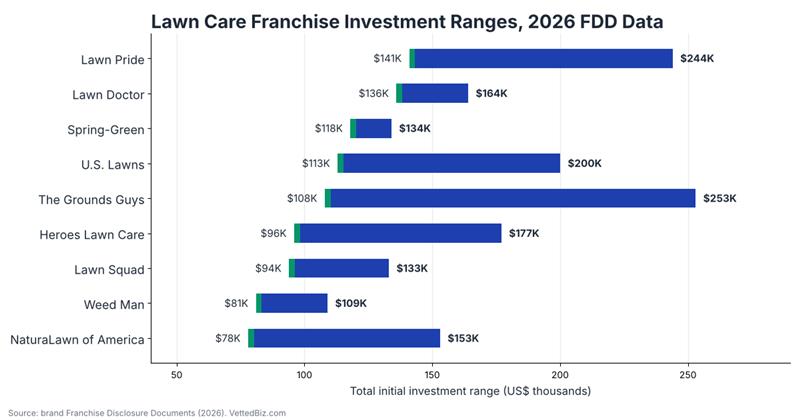
Startup costs vary widely depending on whether a brand focuses on chemical lawn treatment, full-service landscaping, or a mix. Treatment-focused models such as Weed Man and NaturaLawn tend to sit at the lower end, while full-service maintenance brands carry more equipment and vehicle costs. The chart below summarizes the total initial investment ranges reported for 2026.
What the Numbers Mean for Your Budget
Total investment is only part of the picture. Most FDDs also require working capital, and lenders typically expect you to hold liquid cash beyond the startup figure. The lowest-cost brands are not automatically the cheapest to run, because royalty and advertising fees are calculated on revenue for the life of the agreement.
Pro Tip: Compare combined royalty and ad fund percentages, not just the royalty. Lawn Doctor's combined 15% and Weed Man's roughly 8.2% produce very different margins at the same revenue level, although the brands also differ in what they include.
Item 19: Earnings Disclosures Are Uneven
The most recent available data shows meaningful differences in median gross sales across established lawn care and landscaping franchises. System size also varies considerably, from fewer than 100 franchised units to more than 650.
- NaturaLawn of America reports median gross sales of $1,097,125 and has 88 franchised units.
- U.S. Lawns reports median gross sales of $975,915 and has 209 franchised units.
- Lawn Doctor reports median gross sales of $659,073 and has 653 franchised units.
- The Grounds Guys reports median gross sales of $568,201 and has 229 franchised units.
These figures represent gross sales, not owner profit. They also show why system size alone does not determine unit-level revenue: larger franchise networks do not necessarily report higher median sales. Investors should review the full Item 19 disclosure to understand which locations are included, how long they have operated, and how performance varies across the system.
Franchise Models in the Category
Chemical and Turf Treatment Brands
Weed Man, Spring-Green, NaturaLawn, Lawn Doctor, and Lawn Squad center on fertilization, weed control, and aeration. Revenue is seasonal but recurring, because customers sign up for multi-application programs. These models usually need licensed applicators and have lower labor intensity than mowing, but they carry regulatory requirements that vary by state.
Full-Service Maintenance and Landscaping Brands
The Grounds Guys and U.S. Lawns lean toward commercial and residential maintenance, which means more crews, equipment, and vehicles. They also tend to show higher revenue, as the Item 19 data above suggests, with correspondingly more management responsibility. Commercial contracts can add stability, but they are competitively bid.
Adjacent Outdoor Services
Outdoor lighting, fencing, and turf installation are growing alongside lawn care. Waterloo Turf reported expanding its Texas footprint to 27 locations, and 76 Fence launched in Colorado in September 2026. These are different business models, but they show where outdoor service franchisors are heading.
Multi-Unit Ownership and Territory Strategy
Many experienced lawn care franchisees do not stop at one territory. SpringGreen's December 2025 milestone, a multi-unit owner reaching $5 million in annual revenue, shows what scaled operators can reach in this category. It is the highest figure reported for an independently owned SpringGreen franchisee, so treat it as a ceiling rather than a typical result.
Territory design matters more than most first-time buyers expect. Route density, meaning how many customers you can service within a short drive, drives labor efficiency and fuel costs. A smaller territory packed with single-family homes can outperform a larger, scattered one. Ask the franchisor how territories are defined, whether they are exclusive, and what performance requirements apply to keep them.
Technology, Pricing, and Customer Retention
Recurring revenue only stays recurring if customers stay. Most systems provide scheduling and billing software, online quoting, and automated reminders, and the better ones tie them to customer communication. During due diligence, ask owners how often customers cancel after the first season, and what the franchisor does to help win them back.
Pricing discipline is another differentiator. Treatment programs are typically sold as multi-visit packages, while maintenance is sold by the visit or by contract. Franchisors that give owners clear pricing guidance, along with tools to bundle services such as aeration, overseeding, and pest control, tend to help owners lift the average revenue per customer. Ask for sample pricing sheets and compare them to what local independents charge.
Financing and Startup Considerations
Because several lawn care brands fall below roughly $200,000 in total investment, many buyers consider SBA-backed financing. The SBA Franchise Directory lists brands eligible for certain loan programs, and lenders will want to see a realistic cash flow plan, personal credit history, and your own capital contribution. Some third-party profiles show SBA default rates for individual brands, which can be a useful signal, although you should verify them with the lender.
Plan for the gap between launch and steady revenue. New territories need time to build a customer base, and spring is the most important sales window in many regions. Opening in the fall or winter can leave you paying fixed costs before the season starts, so align your launch timeline with the local growing calendar.
Risks and Challenges to Weigh
Seasonality tops the list. In northern markets, revenue can concentrate in roughly eight months, so cash reserves need to cover the off-season. Weather, drought restrictions, and local rules on fertilizers and pesticides can all disrupt service calendars.
Labor is the second risk, as noted above. Third is customer churn, since homeowners can switch providers easily and many price shop each spring. Finally, new-brand risk matters. Lawn Squad's rapid growth is encouraging, but a system with 7 franchised units has a shorter track record than one with several hundred. Check closure and transfer data in Item 20 for every brand you consider.
Pro Tip: Call at least ten current and former franchisees from Item 20, and ask specifically about crew retention, customer cancellation rates, and how long it took to reach break-even.
How to Evaluate a Lawn Care Franchise Opportunity
- Read the full FDD with a franchise attorney, focusing on Items 5, 6, 7, 11, 19, and 20.
- Map your territory: count single-family homes, median home values, and competitors. Density drives route efficiency.
- Decide whether you want a technician-led model or a manager-led model, since that determines your own time commitment.
- Stress-test the numbers with a seasonality-adjusted cash flow that includes the winter months and at least six months of working capital.
- Compare the combined fee load, not the headline franchise fee.
- Confirm financing options, including SBA eligibility through the SBA Franchise Directory.
Who Should Consider This Category
Lawn care suits owners who value recurring revenue and are comfortable managing field crews, scheduling, and seasonal swings. Technician-focused treatment brands can fit owner-operators with moderate capital, while maintenance and landscaping brands fit buyers prepared to build a team and, in some cases, pursue commercial accounts. It is a less natural fit for anyone seeking a fully passive investment.
Conclusion: Do the Homework Before the Mower
Lawn care and landscaping franchises sit on a large, fragmented, growing market, and several brands are expanding quickly. The FDD data shows meaningful differences in cost, fees, and disclosed performance, and some of the most attractive revenue figures come from mature units rather than new ones. Labor, seasonality, and incomplete earnings disclosures are the main issues to pressure-test.
Ready to compare options? Browse VettedBiz's franchise guides, request the FDDs for your shortlist, and speak with current owners before you commit. A disciplined review now is the cheapest protection you will buy.
Disclaimer: This article is for informational purposes only and is not legal, financial, or investment advice. Consult qualified professionals before purchasing a franchise.
Get insider access to franchise insights
Subscribe to receive expert tips, franchise rankings, and exclusive data straight to your inbox, trusted by thousands of aspiring business owners and investors.
Franchise resources & insights
Explore expert guides, data-driven articles, and tools to help you make smarter franchise decisions, whether you're just starting out or ready to invest.