IFA 2026 Franchising Economic Outlook
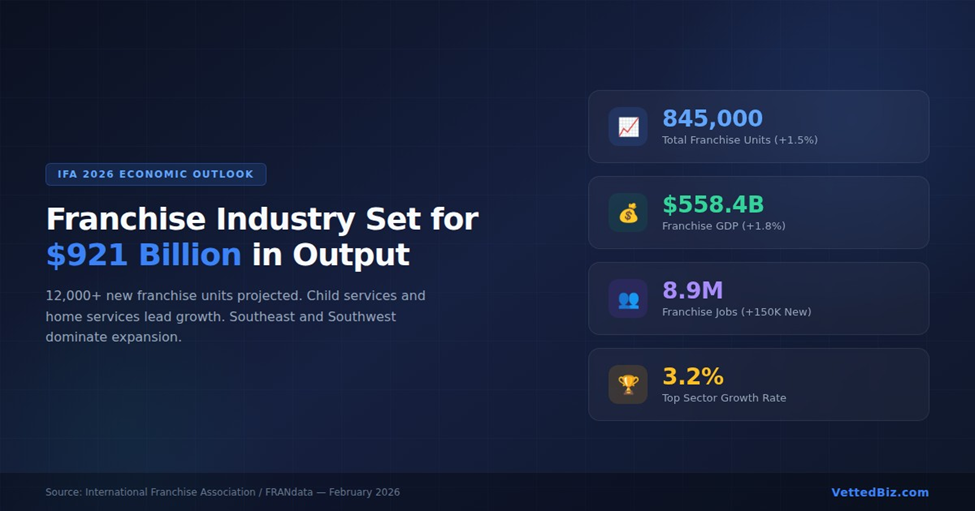
The International Franchise Association (IFA) just dropped its annual Franchising Economic Outlook, and the numbers tell a clear story: franchising is not just surviving; it is accelerating. After a turbulent 2025 marked by macroeconomic headwinds, the franchise sector is projected to add over 12,000 new establishments, push economic output past $921 billion, and create nearly 8.9 million jobs in 2026.
For prospective franchise investors, this report is not just encouraging; it is a roadmap. It reveals which sectors are growing fastest, which states are welcoming new franchise development, and where the smartest money is flowing. Whether you are a first-time buyer evaluating your options or a multi-unit operator looking to expand, here is what the 2026 outlook means for your investment strategy.
Key Findings: Franchising by the Numbers in 2026
The 2026 Franchising Economic Outlook, conducted by FRANdata on behalf of the IFA, paints a picture of steady, broad-based growth across the franchise industry. Here are the headline figures every investor should know.
Franchise establishments are expected to grow from 832,521 to approximately 845,000 units, a 1.5% increase that translates to more than 12,000 new franchise locations opening across the country. Total economic output is projected to rise from $907.3 billion to $921.4 billion, representing a 1.6% year-over-year increase. The franchise sector's contribution to GDP is estimated to climb 1.8%, reaching $558.4 billion, up from $549.9 billion in 2025.
Employment remains a bright spot. The franchise industry is expected to add more than 150,000 new jobs, pushing total franchise employment to nearly 8.9 million workers. With youth unemployment sitting at 10.4% in 2025, franchise businesses continue to play a crucial role in creating entry-level opportunities and supporting overall labor market resilience.
These are not speculative projections. They are built on data from approximately 9,000 franchise brands tracked across all 50 states and Washington, D.C. The message is clear: franchising remains one of the most resilient business models in the American economy.
The Fastest-Growing Franchise Sectors for 2026
Not all franchise sectors are growing at the same rate. The IFA report identifies two categories leading the charge, and both represent compelling opportunities for investors looking for above-average growth.
Child Services: 3.2% Year-Over-Year Growth
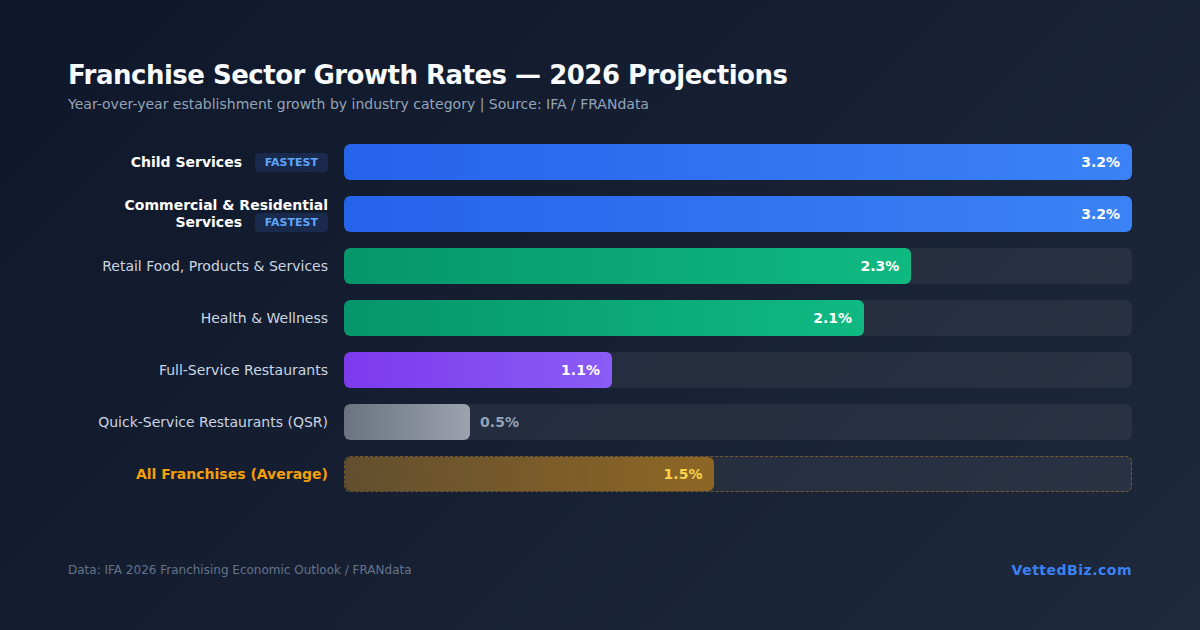
Child-related franchises, encompassing childcare, education, youth fitness, tutoring, and enrichment programs, are expected to grow at a 3.2% clip in 2026, making them the fastest-growing franchise category alongside commercial and residential services.
Several factors are driving this surge. Dual-income households continue to rise, creating sustained demand for reliable, professional childcare. The cost of childcare has become a headline issue, with the average American family spending more than 10% of household income on care. This combination of demand pressure and rising willingness to pay makes child services franchises particularly attractive from a unit economics perspective.
Brands like Lightbridge Academy, Kiddie Academy, and Mathnasium have been expanding aggressively, offering franchise models that combine predictable recurring revenue with strong community demand. For investors, the childcare and education space offers something rare in franchising: recession-resistant demand paired with meaningful growth tailwinds.
Commercial and Residential Services: 3.2% Growth
Matching child services at a 3.2% growth rate, the commercial and residential services sector includes franchises focused on home maintenance, construction and remodeling, decorating and design, cleaning, and property management.
This sector's strength comes from a fundamental truth: homeowners always need their homes maintained. From HVAC and plumbing to cleaning and landscaping, these are largely inelastic services. The franchises that dominate this space benefit from recurring revenue models, large addressable markets, and relatively low sensitivity to economic downturns.
The shift toward subscription-based service models is accelerating this trend. Home services franchises are increasingly bundling seasonal maintenance (lawn care, pest control, gutter cleaning, HVAC tune-ups) into recurring annual contracts. This transformation from episodic transactions to predictable revenue streams makes these franchises even more attractive to both operators and investors.
Retail Food, Products, & Services: 2.3% Growth
Retail food, products, and services franchises are projected to grow by 2.3% in 2026, with total output reaching $71.9 billion. The sector is expected to surpass 76,000 franchise establishments and add more than 10,000 jobs, reflecting steady expansion despite a moderating economic environment.
This growth is supported by resilience in essential retail categories, even as the broader economy slowed in 2025. Consumers have become increasingly value-oriented, favoring brands that balance price, quality, and convenience. This shift has created tailwinds for resale concepts and discount-driven models, while sign and specialty retail businesses are experiencing increased demand from companies investing in advanced branding, promotions, and electronic displays such as LEDs.
Technology adoption is also reshaping the competitive landscape. Social media continues to influence purchasing decisions and create opportunities for agile, digitally native brands. At the same time, AI-powered chatbots are enhancing customer service, and predictive analytics is improving inventory management and demand forecasting.
Health & Wellness: 2.1% Growth
The health and wellness sector is projected to grow 2.1% in 2026, reaching $66.4 billion in output. Total establishments are expected to exceed 99,000 units, adding more than 27,000 jobs and bringing total employment to approximately 367,000. Since the pandemic, heightened awareness of preventive care has propelled the industry to become the third-largest franchise sector, representing 11.8% of total franchise establishments.
Looking ahead, demand remains steady but increasingly value-driven. Growth is expected to be led by home healthcare, mental health services, wellness concepts, and recovery-focused brands, as consumers continue prioritizing long-term health while becoming more selective in their spending.
Child services and commercial/residential services lead all franchise sectors with 3.2% projected growth in 2026.
Top 10 Fastest-Growing States for Franchising in 2026
Location matters in franchising. The IFA report identifies the states where franchise expansion is happening fastest, driven by a combination of business-friendly policies, population growth, and lower operating costs.
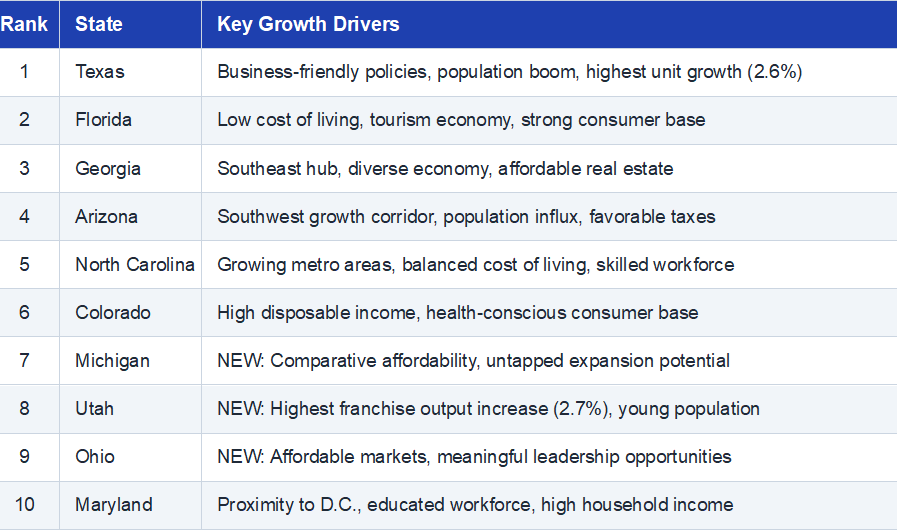
Three newcomers (Michigan, Ohio, and Utah) have entered the top 10 for the first time, largely because of their relative affordability and room for market development. Utah stands out with the highest projected franchise output increase at 2.7%, driven by its young, growing population and business-friendly environment.
Regionally, the Southeast continues to dominate with the largest share of franchise businesses at nearly 30%, with franchise establishments expected to grow 1.7% to more than 252,000 locations. The Southwest is the fastest-growing region at 2.5% establishment growth, fueled by migration patterns and favorable operating conditions.
Tax Tailwinds: How the One Big Beautiful Bill Helps Franchise Investors
The 2026 franchise outlook is further strengthened by favorable tax policy changes stemming from the One Big Beautiful Bill Act, signed into law in July 2025.
Several provisions directly benefit franchise owners and prospective investors. Permanent 100% bonus depreciation allows franchisees to deduct the full cost of qualifying equipment and property improvements in the year they are placed in service, rather than depreciating them over multiple years. For a franchise with $200,000 in buildout costs, this means significant upfront tax savings.
According to the IFA, these provisions impact 73% of franchisors and 98% of franchisees. In 2026 alone, franchise businesses will be able to claim full deductions on approximately $27 billion in capital expenditures. That is not a marginal benefit; it is a material improvement in the economics of franchise ownership.
The Rise of Multi-Unit Operators and Private Equity
One of the most significant structural shifts highlighted in the 2026 outlook is the continued evolution of the franchisee base. Multi-unit and multi-brand operators are expanding their footprints at an accelerating pace.
As of 2025, 19.3% of franchisees operate multiple units, but they collectively own 58.8% of all franchised locations. This concentration is particularly pronounced in service-based industries, where lighter capital requirements make scaling more feasible. The trend is clear: successful single-unit franchisees are increasingly reinvesting in additional locations, leveraging their operational expertise to build portfolio-scale businesses.
Private equity activity is also intensifying. After picking up steam in the third and fourth quarters of 2025, franchise-related mergers and acquisitions are expected to accelerate throughout 2026. Investment firms are not just acquiring multi-unit franchisee operations; they are buying the franchisors themselves, treating the franchise model as a scalable asset class.
For individual investors, this trend has two important implications:
First, it validates the franchise model's ability to generate consistent, scalable returns.
Second, it means that high-performing franchise opportunities face increasing competition from institutional buyers, making early-mover advantage more important than ever.
What This Means for Prospective Franchise Investors
The 2026 Franchising Economic Outlook paints a picture of an industry entering its strongest growth phase since before the pandemic. Here is how to translate these trends into action.
Focus on high-growth sectors. Child services and commercial/residential services are growing at 3.2%, nearly double the overall franchise establishment growth rate of 1.5%. Healthcare franchises, particularly in-home care, offer demographic tailwinds that will only strengthen over the coming decade.
Consider geography strategically. The top 10 growth states, particularly Texas, Florida, and the newer entrants like Utah, Michigan, and Ohio, offer favorable conditions for new franchise development. Lower operating costs, growing populations, and business-friendly policies create a more supportive environment for achieving profitability faster.
Evaluate asset-light models. With capital costs still elevated, franchises that can be launched for under $150,000, particularly home-based and mobile concepts, are positioned to dominate new-unit growth. Look for models with low buildout costs, recurring revenue structures, and scalable operations.
Do your due diligence. With over 9,000 franchise brands operating in the U.S., the range of quality varies enormously. Review Item 19 of the Franchise Disclosure Document (FDD) for financial performance data, speak with current franchisees, and evaluate the franchisor's support infrastructure before committing capital.
The Bottom Line
The IFA's 2026 Franchising Economic Outlook confirms what experienced franchise investors already know: this is a resilient, growing sector with real opportunities for wealth creation. With over 12,000 new franchise units expected to open, economic output surpassing $921 billion, and favorable tax policies creating additional tailwinds, the conditions for franchise investment are as strong as they have been in years.
The smartest investors will focus on the sectors, geographies, and franchise models that align with the data, not just the hype. Whether you are drawn to the explosive growth in child services, the steady demand for home maintenance, or the demographic certainty of senior care, 2026 offers no shortage of compelling opportunities.
Ready to explore your franchise options? Use VettedBiz's franchise analytics tools to compare costs, review FDD data, and find opportunities that match your investment goals.
Get insider access to franchise insights
Subscribe to receive expert tips, franchise rankings, and exclusive data straight to your inbox, trusted by thousands of aspiring business owners and investors.
Franchise resources & insights
Explore expert guides, data-driven articles, and tools to help you make smarter franchise decisions, whether you're just starting out or ready to invest.