Semi-Absentee Franchises in 2026: What Manager-Run Ownership Actually Costs and Returns
Most people who look at a semi-absentee franchise are not looking for a business. They are looking for a way to own one without quitting their job. The pitch is familiar: ten hours a week, a general manager who runs the floor, a dashboard on your phone, and cash flow that shows up whether or not you do.
Some of that is real. Some of it is marketing. The difference between the two is worth roughly the value of your entire investment, so it is worth understanding before you sign anything.
This guide breaks down what semi-absentee franchise ownership looks like in 2026 across the three categories where the model is most defensible, laundromats, vending and micro markets, and property management, using disclosed investment ranges from current Franchise Disclosure Documents. We cover what each category costs to enter, what the labor profile actually is, where the model breaks, and how to evaluate whether a brand marketing itself as "semi-absentee" has the operating structure to back the claim.
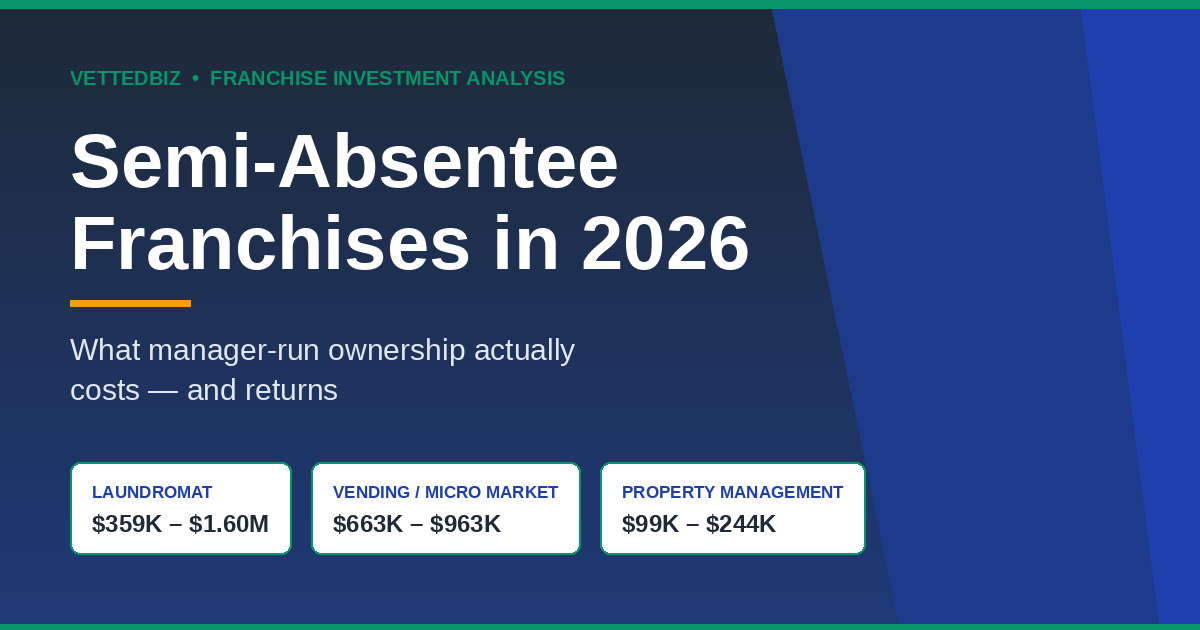
Semi-absentee franchise ownership in 2026 spans three categories with very different capital requirements.
The 2026 Backdrop: Steady Growth, Selective Capital
Franchising is growing in 2026, but not dramatically. FRANdata and the International Franchise Association project franchise establishments rising from 832,521 to roughly 845,000 units, a 1.5% increase representing more than 12,000 new franchised businesses. Franchise employment is forecast to grow by more than 150,000 jobs (1.8%) to nearly 8.9 million, with total franchise GDP climbing 1.8% from $549.9 billion to $558.4 billion.
That is a healthy but unspectacular expansion, and it explains a shift in what buyers are shopping for. In a slower-growth environment with elevated labor costs, capital gravitates toward concepts with fewer employees, predictable demand, and revenue that does not depend on the owner personally being in the building.
Industry reporting on 2026 concept activity points to vending, laundromat, property management, and storage models drawing outsized early interest relative to their size. These are not the categories that dominate franchise headlines. They are the categories that survive a franchisee working a second job.
What "Semi-Absentee" Actually Means
Start with the uncomfortable part: semi-absentee is a marketing term, not a legal or regulatory category. No FDD item defines it. No franchisor is required to disclose whether a concept can be run by a manager. You will not find the phrase standardized anywhere in franchise law.
What practitioners generally mean by it is an ownership structure requiring roughly 10 to 15 hours of weekly owner involvement, with a paid general manager handling daily operations and the owner focused on financial oversight, hiring, local marketing, and vendor relationships.
Two caveats matter enormously.
First, the ramp-up is not semi-absentee. Realistic timelines put the initial period at 12 to 18 months of heavier owner involvement before a meaningful step-back is possible. You are hiring, training, building local demand, and learning where the model leaks money. Owners who plan for ten hours a week starting in month one tend to discover the gap the expensive way.
Second, the model is entirely a bet on one hire. Manager dependency is the single largest risk in this structure. A strong general manager makes a semi-absentee unit look effortless. A weak one produces a business that is losing money in ways the owner does not see until the quarterly statements arrive. There is no version of this model where manager selection is a secondary concern.
Pro Tip: When a franchisor markets semi-absentee ownership, ask Item 20 for the franchisee list and call owners specifically about their manager. Ask what they pay, how long the manager has stayed, and how many managers they have gone through. Turnover in that seat is the leading indicator of whether the model works in that system.
Category 1: Laundromat Franchises
Laundry is the category most often cited as the archetype of low-labor franchise ownership, and the structural logic holds up. Machines generate revenue whether or not staff are present. Demand is tied to renter density rather than discretionary spending, which gives the category genuine recession resistance. Equipment lifecycles are long and predictable.
The market. IBISWorld pegs the U.S. laundromat industry at roughly $7.2 billion in 2026, up from about $6.8 billion in 2025, growing at an average annual rate near 2.3% since 2019. Growth has been supported by commercial and hospitality demand, as restaurants and hotels outsource linen volume.
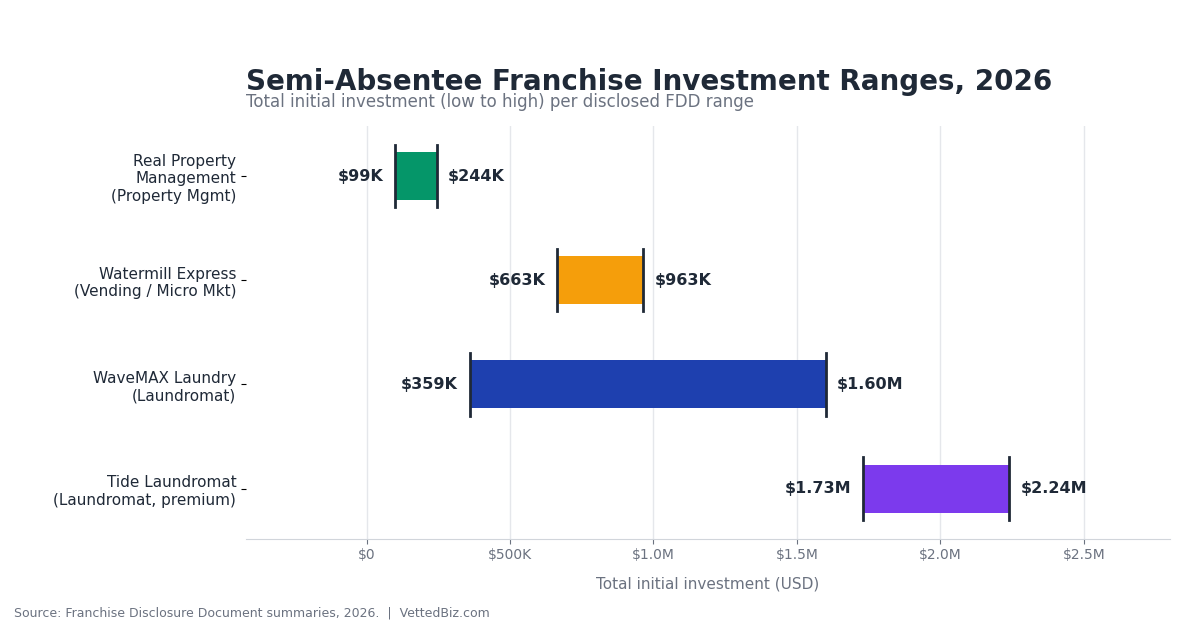
The investment. This is a capital-intensive category, and the spread between brands is wide. WaveMAX Laundry discloses a total investment range of $356,455 to $1,556,350, with a $54,950 franchise fee, a 6% royalty on gross sales, and requirements of roughly $200,000 in liquid capital and $400,000 net worth. Notably, WaveMAX makes no Item 19 financial performance representation, meaning the franchisor discloses no revenue or earnings data at all. Tide Laundromat sits at the higher end, with initial investment reported in the $1.7 million to $2.2 million range against average net sales around $1.2 million.
The returns. Commonly cited operator figures put a single well-sited laundromat at $400,000 to $700,000 in annual gross revenue with 25% to 35% EBITDA margins, translating to roughly $100,000 to $250,000 in annual cash flow per location. Return on investment is frequently quoted at 20% to 35%.
Treat those numbers as a ceiling scenario, not a base case. When a franchisor declines to make an Item 19 representation, the absence is the data point. Third-party revenue estimates are not a substitute for disclosed franchisee performance, and a store's economics live or die on lease terms, demographics within a one-mile radius, and utility costs, three variables that no national average captures.
Category 2: Vending and Micro Markets
Vending is one of the most automation-driven categories on this list and the one that has changed the most technologically. The traditional coin-operated machine has largely given way to cashless, telemetry-connected units and, increasingly, to unattended micro markets, open-shelf retail installations with self-checkout kiosks placed inside offices, warehouses, and apartment buildings.
The economics of the shift matter. Consumers spent roughly 53% more at micro markets than at traditional vending machines in 2024, driven by wider assortment and easier browsing. Operator reporting puts micro market break-even near seven and a half months, materially faster than traditional machine payback. The broader vending operators market is projected to expand from $66.67 billion in 2025 to $101.36 billion by 2029.
The investment. Equipment costs scale with sophistication. New traditional machines run roughly $3,000 to $5,000 each; smart machines with telemetry run $6,000 to $15,000 or more. A micro market installation typically lands in the $15,000 to $50,000 range per location before inventory, while full smart-market builds with computer-vision checkout and 300-plus SKUs can reach $60,000 to $150,000.
At the franchise level, Watermill Express provides a more capital-intensive example of automated vending. The brand operates self-service water and ice dispensing stations and discloses an estimated initial investment of $662,616 to $962,529, including a $75,000 initial franchise fee. VettedBiz lists a minimum cash requirement of $150,000. Unlike a traditional snack or beverage vending route, the Watermill Express model requires significantly more upfront capital for equipment and site development.
Where it breaks. Vending is genuinely low-labor but it is not low-work. Revenue is a function of location contracts, and location contracts are a sales job. Restocking, machine servicing, shrinkage in unattended formats, and product mix optimization are ongoing operational load. The model rewards owners who treat it as a route business with a defined weekly rhythm, which is compatible with a full-time job, but not with indifference.
Category 3: Property Management Franchises
Property management is the least discussed of the three and arguably the best structural fit for manager-run ownership. Revenue is contractual and recurring, a percentage of collected rent across a portfolio of doors, rather than transactional. Once a door is under management, it produces monthly revenue with low marginal servicing cost. The business scales through portfolio growth, not foot traffic.
Entrepreneur's 2026 Franchise 500 ranked Real Property Management #73 overall and first in the property management category, a position the brand has held for three consecutive years. The system reported approximately 450 franchise locations as of December 31, 2025.
The investment. Real Property Management discloses an estimated initial investment of $99,341 to $244,302, with a $69,900 initial franchise fee. The license fee is structured as the greater of 7% of non-maintenance gross sales plus 3% of maintenance revenues, or a minimum license fee that steps up over time, $0 monthly in months 1–4, $250 in months 5–12, $500 in months 13–24, and $1,000 monthly thereafter. Marketing runs 2% of non-maintenance gross sales, with local marketing groups capped at 5%.
The system also offers a 15% VetFran discount for qualifying veterans, 20% to 50% discounts for owners folding an existing property management book into the franchise, and 50% off the franchise fee on qualifying additional territories.
The catch. The stepped minimum license fee is a useful signal. It tells you the franchisor expects a ramp, and that the ramp is measured in years, not months. Property management revenue compounds slowly because doors are won one at a time. This is a patient-capital category, and the semi-absentee framing works better in year three than in year one.
Investment Comparison at a Glance
Figures drawn from current FDD summaries and franchisor disclosures. Always confirm against the FDD you receive directly, terms change annually.
How to Pressure-Test a Semi-Absentee Claim
Before you accept that a concept can be run at ten hours a week, work through five questions.
- Is the revenue recurring or transactional? Recurring revenue, management contracts, memberships, service agreements, survives owner absence. Transactional revenue depends on someone driving demand continuously. Property management passes this test cleanly. A single laundromat passes on the demand side but not on the maintenance side.
- Does the system have a defined manager role? Ask whether the franchisor provides a manager job description, a compensation benchmark, a training track for non-owner managers, and a hiring scorecard. Systems built for semi-absentee ownership have these. Systems retrofitting the pitch do not.
- What does Item 19 actually say? A financial performance representation is the closest thing to disclosed truth in a franchise offering. Where there is no Item 19, as with WaveMAX, you are underwriting on third-party estimates and franchisee interviews alone. That is not disqualifying, but it changes the diligence burden entirely.
- What is the real labor line? Build your pro forma with a fully loaded general manager salary in it from month one, not month twelve. If the unit economics only work when the owner is unpaid labor, the concept is not semi-absentee. It is a job with a franchise fee attached.
- How many units does the average franchisee own? Multi-unit ownership is now the dominant structure in franchising, roughly 19.3% of franchisees control 58.8% of all franchise locations. Concepts where semi-absentee ownership genuinely works tend to show high multi-unit rates, because owners who can step back from one unit buy a second.
A Note for International and Visa-Track Investors
If you are evaluating a franchise in connection with an investor visa, the semi-absentee framing deserves particular scrutiny. Visa categories that require the investor to develop and direct the enterprise sit in tension with an ownership model explicitly marketed as hands-off, and immigration outcomes turn on facts and documentation specific to each case. This is a question for qualified immigration counsel before you select a concept, not after. Nothing in this article is legal advice.
The Bottom Line
Semi-absentee franchise ownership is real in a narrow set of categories and oversold nearly everywhere else. The concepts where it holds up share three traits: recurring or machine-generated revenue, a standardized operating system that does not depend on the owner's specific expertise, and a management layer the franchisor has actually built rather than merely described.
Laundromats offer the strongest low-labor profile at the highest capital cost and, in some systems, the weakest disclosure. Vending and micro markets offer the lowest entry point with the most ongoing operational rhythm. Property management offers the cleanest recurring-revenue structure with the longest ramp.
None of them are passive. All of them are more compatible with an outside job than a restaurant or a fitness studio. If you are evaluating one, request the current FDD, read Item 19 first, build your model with a paid manager in it, and call at least ten franchisees from the Item 20 list before you commit capital.
Get insider access to franchise insights
Subscribe to receive expert tips, franchise rankings, and exclusive data straight to your inbox, trusted by thousands of aspiring business owners and investors.
Franchise resources & insights
Explore expert guides, data-driven articles, and tools to help you make smarter franchise decisions, whether you're just starting out or ready to invest.