The QSR Affordability Crisis: What the Fast-Food Value Wars Mean for Franchise Investors in 2026
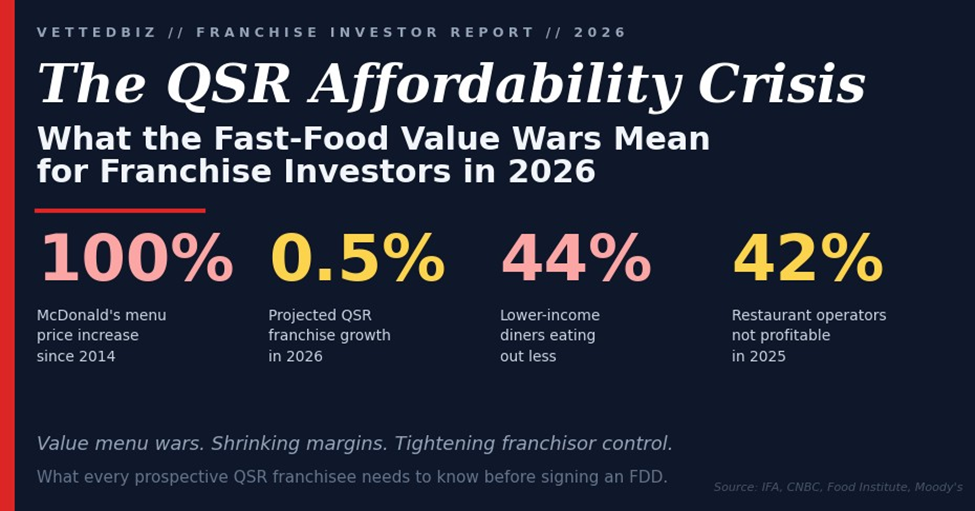
Fast food built its empire on a simple promise: cheap, fast, and convenient. In 2026, that promise is cracking. McDonald's menu prices have doubled (up 100%) since 2014. Popeyes is up 86%. Taco Bell is up 81%. And consumers, especially the lower- and middle-income customers who used to form the backbone of QSR traffic, are walking away.
The result is the most aggressive value war the fast-food industry has seen in a generation. Wendy's rolled out $4, $6, and $8 mix-and-match value menus. KFC launched a $5 offering. Arby's introduced a Meat & 3 box under $8. McDonald's is launching a new menu in April with items priced at $3 or less. But behind the splashy promotions, there's a much harder reality for franchise investors, one that is reshaping the economics of QSR ownership in ways that every prospective buyer needs to understand before signing an FDD.
The Data Behind the Crisis
The International Franchise Association's 2026 Economic Outlook projects QSR franchise establishment growth at just 0.5% this year, a dramatic deceleration from 2.2% in 2025. That translates to roughly 281,000 units employing 5.2 million people, with total sector output forecast to grow only 0.5% to $318.6 billion.
Traffic data tells the same story. According to recent industry surveys, 44% of lower-income consumers are dining out less than they were a year ago. McDonald's, Chipotle, Burger King, and Wendy's have all publicly acknowledged fewer lower-income patrons. BTIG analyst Peter Saleh put it bluntly in his December 2025 forecast: "Restaurants are set for a humbling year."
Meanwhile, 42% of restaurant operators reported they were not profitable in 2025. Moody's has assigned a negative outlook to the overall restaurant industry, citing declining traffic alongside rising labor and commodity costs, particularly beef, which continues to climb.
"This is not a cyclical blip. It is a structural shift.", Dr. Sylvain Charlebois, McGill University
The K-Shaped Economy Is Rewriting QSR Economics
The pricing problem isn't uniform across the consumer base. It's the product of what economists now routinely describe as a K-shaped economy, a split where the top 10% of U.S. households now account for nearly 50% of all consumer spending, while middle- and lower-income households cut back sharply.
For QSR franchises, which historically relied on broad, price-sensitive demand, this split is particularly painful. The customer who once grabbed a Big Mac combo three times a week is now making that trip once, or replacing it with a grocery store sandwich, or, and this is the critical shift, trading up to a sit-down chain like Chili's, where $10–$12 value bundles now compete head-to-head with fast food.
Chili's executed one of the most talked-about restaurant turnarounds in recent memory by leaning hard into a $10 value positioning. Applebee's followed with bundled deals that ended a years-long decline. For the first time since the pandemic, full-service restaurant output is expected to outpace QSR growth in 2026.
McDonald's Is Changing the Franchisor-Franchisee Relationship
One of the most important, and underreported, shifts in 2026 is happening inside the McDonald's system, and it has direct implications for anyone evaluating a QSR franchise purchase.
For more than a year, McDonald's provided corporate subsidies to franchisees to help support value menu pricing. By the end of Q1 2026, that support is ending. In its place, the company is introducing new franchising standards that will assess whether operators' prices are too high, particularly if elevated pricing is affecting traffic or customer satisfaction scores.
Franchisees will still set their own prices. But for the first time at this scale, a major QSR franchisor is formally holding franchisees accountable for maintaining value perception, effectively constraining one of the core levers franchisees use to protect margins.
As TD Cowen analyst Andrew Charles told CNBC: "McDonald's offering subsidies to franchisees is definitely unusual, and [it shows] that they have high conviction that what they're doing is really going to help repair the value perception." For prospective franchisees, the message is clear: the trend across the top QSR systems is toward tighter franchisor control over pricing, menu execution, and technology adoption, and less individual franchisee autonomy.
What Value Menus Actually Do to Franchise Profitability
Here's where many prospective franchisees misread the value wars. Aggressive promotional pricing might drive traffic, but it doesn't necessarily drive franchisee profits. In a widely cited McDonald's franchisee survey by Kalinowski Equity Research, the $5 meal deal improved sales by just 1.3% on average. Analyst Mark Kalinowski characterized it as "an initiative that may help prevent some customers from going elsewhere, as opposed to a big sales builder."
Value menus come with real operational costs. Lower ticket averages require higher unit volume to maintain dollar profits. Food cost percentages rise when promotional items price close to cost. And once customers anchor to value pricing, returning to full menu prices becomes extremely difficult.
The fast-casual segment is already running into this wall. As Stephen Bandy of Goliath Consulting Group noted, "It's getting more difficult for fast casual to show value, because then they're pushing down to QSR prices, and they can't afford to."
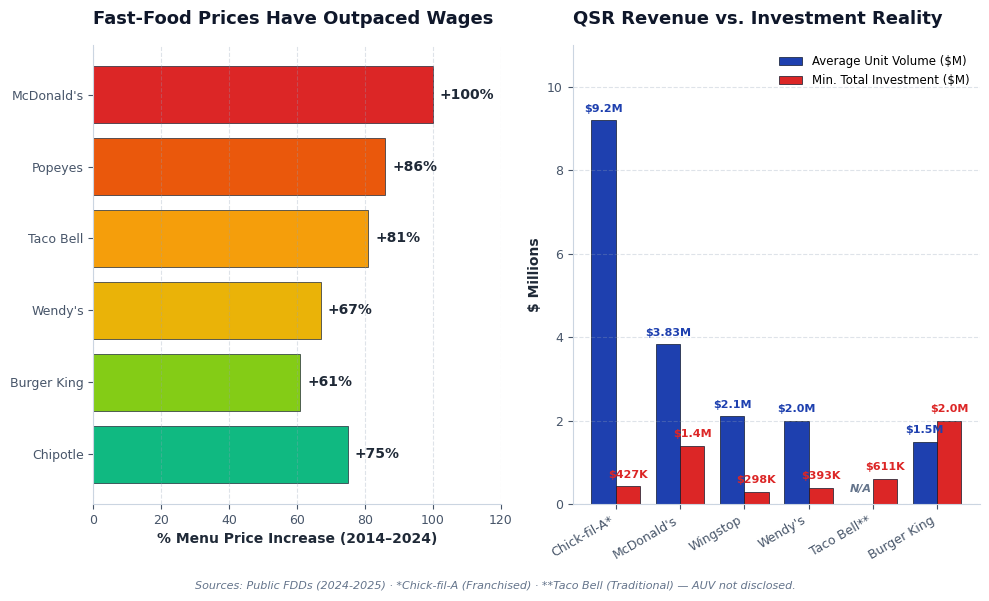
Note that AUV is revenue, not profit. Taco Bell franchisee profit estimates sit around $242,000 per unit. Wendy's franchise operator compensation is often cited near $300,000 per year. But these are averages, and in the current environment, the gap between top-performing and under-performing units is widening significantly.
The Bright Spots: Where QSR Is Still Winning
Despite the sector-wide headwinds, certain QSR categories are still performing strongly in 2026, and understanding why matters for investors.
- Chicken concepts are outperforming burgers. Consumers increasingly perceive chicken as a "better for you" option, and brands like Wingstop (reporting 29% same-store sales growth in Q2 2024), Dave's Hot Chicken, and Raising Cane's are seeing strong unit economics. Chick-fil-A's AUV of $6–$8M remains the highest in the industry, despite a conservative expansion model.
- Taco Bell is executing across every trend. From chicken launches to beverage innovation (targeting $5 billion in annual beverage sales) to loyalty programs, Taco Bell is one of the few traditional QSR brands growing share in 2026.
- Beverage-led concepts continue to attract investment. Non-alcoholic, beverage-based offerings appealing to price-conscious, health-oriented consumers are expanding rapidly.
- Smaller-footprint formats are the path forward. The IFA's 2026 outlook specifically calls out the rise of asset-light QSR formats: drive-thru-only builds, dual-brand concepts, and cloud kitchens. These reduce real estate and buildout costs, accelerate payback periods, and are better positioned for the current margin environment than traditional full-footprint restaurants.
Due Diligence Questions Every QSR Franchise Buyer Should Ask in 2026
Given the structural pressures on the sector, prospective QSR franchisees should approach FDD reviews and franchisor conversations with a sharper, more specific set of questions than they would have needed two years ago.
- What percentage of Item 19 data reflects the current pricing and promotional environment?
FDD financial performance data is historical. If the data reflects pre-value-war conditions, it may overstate realistic 2026 franchisee economics.
- How much discretion do franchisees have over menu pricing, and is that changing?
The McDonald's model of tighter franchisor pricing oversight is likely to spread. Understand where the franchisor is headed, not just where it is today.
- What is the franchisor's position on value menu participation costs?
Aggressive value promotions often require franchisee funding, through reduced margins on promotional items, co-op marketing spend, or mandatory participation. Clarify these before signing.
- What is the state of current franchisee satisfaction?
Beyond the franchisor-provided list, ask for the franchisee association (if one exists), review relevant litigation, and speak with at least 10–15 current operators about franchisor-franchisee dynamics.
- How is the franchisor investing in AI, labor optimization, and technology?
Leading QSR brands are embedding AI into drive-thru ordering (Wendy's FreshAI), back-of-house automation, and data-driven marketing. Brands that lag will struggle with unit economics.
- What is the franchisor's exposure to tariff-sensitive inputs?
Beef, paper goods, packaging, and equipment costs are all affected by the ongoing tariff environment. Franchisors with diversified supply chains are better positioned.
What This Means for Franchise Investors Right Now
The QSR affordability crisis doesn't mean fast-food franchises are uninvestable. It means the era of "buy any brand, any location, and ride the tide" is over. Successful QSR franchise investment in 2026 requires a much sharper approach:
- Focus on category winners, not sector averages. Chicken, beverage-forward, and small-footprint concepts are outperforming traditional burger and pizza models.
- Prioritize asset-light formats. Drive-thru-only and dual-brand builds reduce capital requirements and accelerate payback. If a franchisor only offers the legacy full-footprint model, that's a signal.
- Evaluate franchisor-franchisee alignment carefully. Understand whether the brand treats franchisees as partners or as execution arms, and whether that posture is evolving.
- Model the downside, not just the upside. In a K-shaped economy, traditional broad-demand assumptions no longer hold. Stress-test using more conservative traffic and pricing scenarios.
- Consider adjacent sectors. Commercial/residential services, child services, and healthcare are all growing at ~3.2%, more than six times QSR's projected 0.5%.
The Bottom Line
The fast-food affordability crisis is not a passing phase. QSR operators spent a decade raising prices to offset inflation and labor costs, and in doing so, crossed a psychological threshold with consumers that value menus alone will struggle to repair.
For prospective franchise investors, this is not a reason to avoid QSR, it's a reason to approach it with much sharper due diligence, clearer eyes on category positioning, and realistic expectations about what unit-level economics look like in 2026 and beyond. The winning brands in this environment will be those that combine operational efficiency, technology leadership, smart asset-light formats, and genuine franchisor-franchisee alignment. The rest are going to face a very long value war.
Ready to compare real QSR franchise opportunities?
Use VettedBiz's franchise research tools to review FDD data, compare unit economics, and evaluate franchisor-franchisee dynamics before making one of the biggest investment decisions of your life. Visit www.vettedbiz.com
Get insider access to franchise insights
Subscribe to receive expert tips, franchise rankings, and exclusive data straight to your inbox, trusted by thousands of aspiring business owners and investors.
Franchise resources & insights
Explore expert guides, data-driven articles, and tools to help you make smarter franchise decisions, whether you're just starting out or ready to invest.