Property Management Franchises in 2026: Costs, Item 19 Data and the Single-Family Rental Shift
Most franchise categories ask you to sell a product to a new customer every day. A property management franchise works differently: you sign a rental owner once, then earn a fee every month for as long as you keep that home leased and well maintained. That recurring structure is a big reason property management franchises are drawing more investor attention heading into 2027.
The timing is not accidental. Renter demand for single-family homes is climbing faster than demand for apartments, the industry is still dominated by small independent operators, and the largest franchise systems all filed fresh 2026 Franchise Disclosure Documents (FDDs) with detailed Item 19 data. This fall alone, Keyrenter Property Management announced new franchise owners in Dallas-Fort Worth and South Florida, and franchisees in several systems are growing by acquiring local competitors.
In this guide, we compare the startup costs and ongoing fees of three leading property management franchises, explain what their Item 19 numbers really measure, and walk through the risks investors should weigh before signing.
Why Property Management Franchises Are Trending in 2026
Renters are choosing houses
According to Zillow's November 2026 Rental Market Report, overall rental demand is up 22.1% year over year, and demand for single-family rentals is up 24.3%, roughly double the 12.1% increase for multifamily units. Zillow attributes much of the shift to the gap between renting and owning: households say they would need a raise of about $14,400 a year to cover the monthly cost of owning a comparable home.
The supply of rented houses is growing too. Census-based estimates cited by CRE Daily put U.S. single-family rental households at about 14.6 million in 2025, the highest level since 2016. Many of those homes belong to individual investors who own one to ten properties and do not want to handle tenant screening, repairs and rent collection themselves. That is the core customer of a residential property management franchise.
A large, fragmented market
Mordor Intelligence estimates the U.S. property management services market at about $88 billion in 2026, with a projected path to roughly $106.6 billion by 2031, a compound annual growth rate near 3.9%. Most of that revenue still flows to local independent firms. Franchise systems pitch brand recognition, standardized software, trust accounting processes and national marketing as the tools that let a newer operator compete against established local players.
The broader franchise forecast points the same way. The International Franchise Association's 2026 Franchising Economic Outlook, produced with FRANdata, named commercial and residential services among the fastest-growing franchise industries, at a projected 3.2% annual rate.
Momentum inside the franchise systems
- Keyrenter reported passing its 100th location in August 2026 after awarding 14 new territories in the first part of the year, then added Dallas-Fort Worth and South Florida franchisees in November, with both offices targeting a Q1 2027 launch.
- Acquisitions are accelerating growth. In October 2026, Keyrenter Indianapolis North acquired a family-owned local firm and added 25 management agreements in one transaction.
- Real Property Management, part of Neighborly, says its network manages more than 68,000 rental homes and ranked No. 1 in its category on the 2026 Entrepreneur Franchise 500.
How a Property Management Franchise Makes Money
Before comparing brands, it helps to understand the revenue model. A residential property management office typically earns:
- Monthly management fees, usually a percentage of collected rent, which make up the recurring base of the business.
- Leasing and placement fees when a new tenant moves in, plus lease renewal fees.
- Maintenance coordination, where the office schedules and oversees vendors and may earn a margin or coordination fee.
- Ancillary services such as inspections, owner reporting and, in some systems, real estate brokerage for clients who buy or sell.
The two numbers that matter most are doors under management (how many rental units you manage) and revenue per door (how much each unit generates per year). Franchisors report both in Item 19, and growth in this business comes mainly from adding doors, either one owner at a time or by acquiring another manager's portfolio.
Property Management Franchise Costs Compared
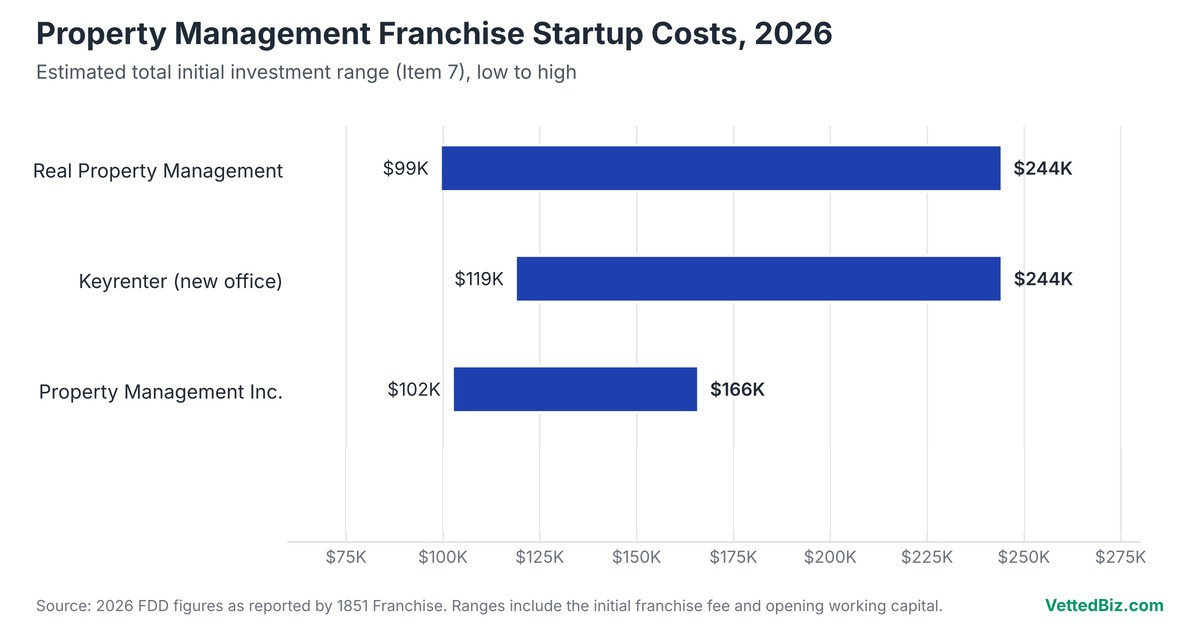
All three systems below are office-based or home-based service models with no retail build-out, which keeps startup costs well below most food or fitness concepts. The figures come from each brand's 2026 FDD as summarized by 1851 Franchise.
Real Property Management
Real Property Management focuses almost entirely on single-family and small residential rentals and sits inside the Neighborly family of home service brands. The 2026 FDD lists a $69,900 initial franchise fee, up from the $59,900 shown in earlier disclosures, with discounts that include 15% for qualifying veterans, 20% to 50% for owners converting an existing property management business and 50% for qualifying additional territories. The license fee applies only to non-maintenance revenue, which matters because maintenance coordination can be a meaningful share of an office's gross sales. Monthly technology and bookkeeping support fees apply on top.
Property Management Inc. (PMI)
PMI is built around multiple "pillars": residential, commercial, association (HOA), short-term rental and realty. Owners usually start with residential and add pillars over time. Its royalty steps down as monthly revenue grows, from 7% on the first $35,000 to 5% above $75,000. PMI also runs a conversion program that can reduce the franchise fee to as little as $0 for existing managers with more than $5,000 in monthly third-party management revenue. Notably for VettedBiz readers, the FDD lists a separate fee range of $69,900 to $90,000 for franchisees using the E-2 investor visa route, plus a required reserve. Investors in that situation should review those terms with their attorney.
Keyrenter Property Management
Keyrenter concentrates on long-term single-family rentals and positions itself strongly toward real estate investors who already own a rental portfolio. The pitch: rather than paying a third party to manage your own homes, you own the management company, generate revenue from day one with your own doors, and gain early visibility into owners who may want to sell.
The system reports more than 100 offices and over 14,000 homes under management.
Risks and Realities to Weigh
Rent growth is cooling
Demand is rising, but rents are not. Rentometer's mid-year 2026 report found the national median rent for three-bedroom single-family homes at $2,100, down 1.6% year over year, with single-family vacancy at 6.1% in the first quarter. Cotality's index showed single-family rents up just 1.8% year over year in July 2026. Because management fees are usually a percentage of rent, flat rents mean revenue growth has to come from adding doors rather than from rising rents.
A slow ramp
Real Property Management's own data shows offices in their first three years manage a median of 57 doors. Building a portfolio large enough to cover staff and overhead often takes several years, so working capital and patience matter. The high end of Real Property Management's Item 7 range includes up to $100,000 in additional funds for the first 12 months for that reason.
Licensing and trust accounting
Many states treat leasing and rent collection as real estate activity that requires a licensed broker, and handling tenant deposits requires strict trust accounting. Requirements vary by state, so prospective owners should confirm the rules for their market with the franchisor and a local professional before committing.
Client concentration and competition
Losing one investor client with 30 homes can erase months of growth. Offices also compete with independent managers, real estate brokerages and large institutional operators that self-manage. Ask current franchisees how they retain owners and how much of their portfolio sits with their five largest clients.
Who Is a Good Fit for a Property Management Franchise?
- Real estate investors with existing rentals, who can seed the business with their own doors from day one (the Keyrenter model).
- Independent property managers looking for systems, software and brand support, who can use conversion discounts offered by all three brands.
- Relationship-driven operators comfortable with networking, sales and service recovery, since growth depends on winning owner trust.
- Semi-absentee investors who plan to hire an experienced manager, provided they budget for that salary during the ramp.
It is a weaker fit for buyers who need fast cash flow, dislike handling conflict, or want a business that runs without hands-on oversight in the first years.
Due Diligence Checklist Before You Buy
- Read Item 19 footnotes carefully and confirm how "unit" and "revenue" are defined.
- Compare Item 7 working capital to your personal runway for a 24 to 36 month ramp.
- Model fees on maintenance and non-maintenance revenue separately.
- Check Item 20 for closures, transfers and terminations over the last three years.
- Confirm your state's broker licensing and trust account requirements.
- Ask how the franchisor supports acquisitions of local portfolios.
Pro Tip: Call at least ten current franchisees from the Item 20 list, including some in their first three years. Ask how many doors they had at month 12, month 24 and month 36, and what their biggest source of new owners has been.
Conclusion
Property management franchises offer something rare in franchising: recurring revenue, modest startup costs between roughly $99,000 and $244,000, and a demand tailwind from Americans who increasingly rent houses instead of buying them. The trade-off is time. Item 19 data from Real Property Management shows that scale, not revenue per door, separates mature offices from new ones, and flat rents in 2026 make door growth even more important.
If you are weighing Real Property Management, PMI, Keyrenter or another property management franchise, VettedBiz can help you compare FDDs, review Item 19 disclosures and find the model that fits your capital and goals. Explore our franchise search tools or speak with a VettedBiz specialist to start your evaluation.
Get insider access to franchise insights
Subscribe to receive expert tips, franchise rankings, and exclusive data straight to your inbox, trusted by thousands of aspiring business owners and investors.
Franchise resources & insights
Explore expert guides, data-driven articles, and tools to help you make smarter franchise decisions, whether you're just starting out or ready to invest.