Best Food and Beverage Franchises to Own in 2026: A Data-Driven Investment Guide
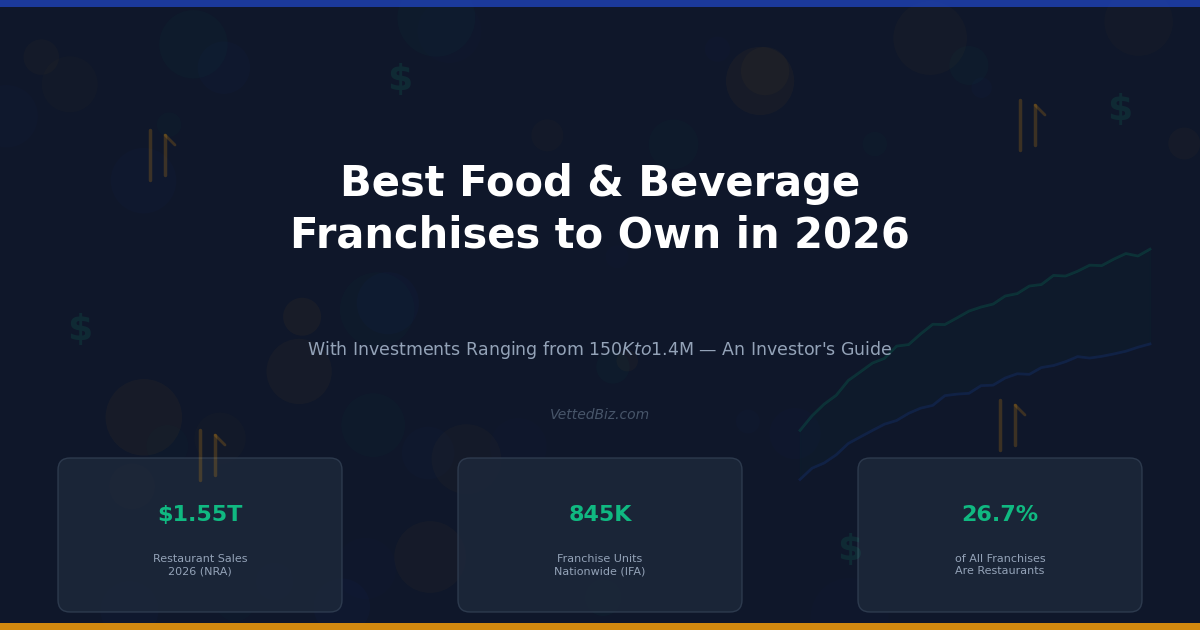
The restaurant and food service industry in the United States is on pace to generate $1.55 trillion in sales during 2026, according to projections from the National Restaurant Association. That represents a 4.8 percent increase over 2025 and underscores why food and beverage continues to be the single largest category in franchising, accounting for 26.7 percent of all franchise businesses nationwide per the International Franchise Association.
But not all food franchises are created equal. The brands attracting the most investor interest in 2026 share three traits: capital-efficient build-outs, alignment with health-conscious consumer preferences, and technology-forward operations that reduce labor dependency. Meanwhile, the impact of GLP-1 weight-loss medications is reshaping menus toward smaller portions and vegetable-forward options, creating fresh opportunities for brands that were already positioned in the health-conscious space.
In this guide, we profile five food and beverage franchises across different sub-sectors and investment tiers, each backed by FDD data so you can compare them on their merits. Whether you have $100,000 or $800,000 to deploy, the right food franchise opportunity may be closer than you think.
Why Food and Beverage Franchises Remain the Top Choice for Investors
The Scale Advantage
With the IFA projecting franchise establishments to grow to 845,000 units in 2026, and more than a quarter of those being restaurants, the food and beverage sector benefits from unmatched brand recognition and consumer demand. Americans spend more than half of their food budget on eating out or ordering delivery, a structural shift that has only accelerated since the pandemic.
Operational Innovation Is Lowering Barriers
The most successful food franchises in 2026 are the ones rethinking the traditional restaurant model. Automation-driven kitchens reduce the labor crisis by using pre-programmed equipment instead of large skilled crews. Streamlined build-outs eliminate complex hood systems and heavy back-of-house infrastructure, cutting construction timelines and capital requirements. For investors, this means faster ramp-up times and lower breakeven thresholds.
Health-Forward Menus Drive Growth
Consumer demand for healthier dining options is not a passing trend. Health-conscious fast-casual concepts are expanding by an estimated $84.5 billion through 2029. Brands that offer bowls, smoothies, poke, and fresh ingredients are capturing share from traditional QSR operators. The rise of GLP-1 medications has further amplified demand for smaller, nutrient-dense meals, and franchise brands aligned with this shift are seeing outsized unit growth.
Pro Tip: When evaluating food franchises, look beyond the franchise fee. Total investment, ongoing royalty burden, and average unit volume (AUV) together determine your real payback timeline. A brand with a low franchise fee but 11% combined royalties eats into margins faster than one with a higher fee but lower ongoing costs.
Top 5 Food and Beverage Franchises for Investors in 2026
1. Jersey Mike's Subs, Quick-Service Sandwiches
Jersey Mike's earned the No. 1 ranking on the 2026 Entrepreneur Franchise 500. The Blackstone-backed chain (acquired for $8 billion) combines a premium sub sandwich concept with strong unit economics and aggressive expansion plans. Jersey Mike's differentiates itself through its fresh-sliced, made-to-order model, a positioning that commands higher average tickets than competitors in the sandwich segment.
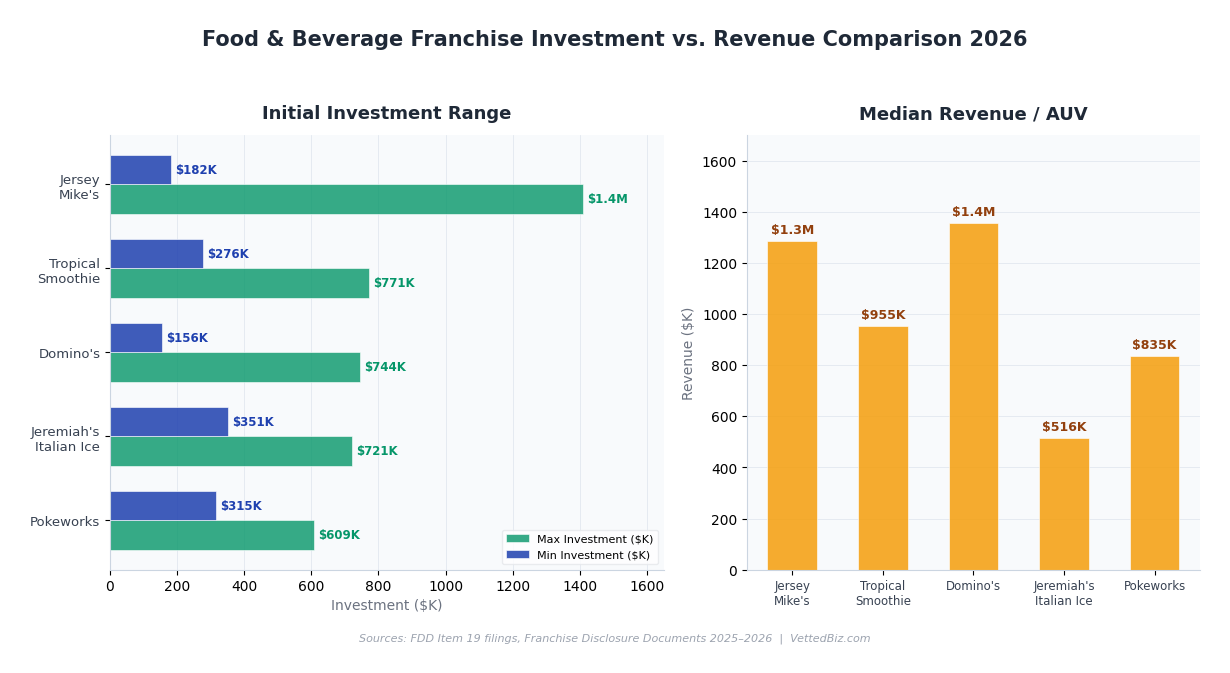
Jersey Mike's strength lies in the consistency between its median revenue, at $1.2 million, which signals that the typical franchisee is performing close to the system average rather than being pulled up by a handful of outliers. The $18,500 franchise fee is notably low for a brand of this caliber, though the 6.5% royalty plus 1% marketing fee should be factored into your unit economics model.
2. Tropical Smoothie Cafe, Health-Focused Smoothies and Food
Tropical Smoothie Cafe has surpassed 1,500 locations across 44 states, with 161 new cafes opened in 2024 alone, over 70 percent of which were driven by existing franchisees reinvesting. That re-investment rate is one of the strongest signals of franchisee satisfaction in the industry.
The 12% combined royalty-plus-marketing fee is on the higher end for the segment, but Tropical Smoothie offsets this with strong national marketing support and a brand that resonates with the growing health-conscious consumer base. Investors should pay particular attention to traffic patterns and proximity to gyms, colleges, and office parks when evaluating territories.
Investment range vs. average revenue for five leading food and beverage franchises (Source: FDD filings 2025–2026)
3. Domino's Pizza, Technology-Led Pizza Delivery
Domino's has transformed itself from a pizza chain into a technology company that happens to sell pizza. With an AUV of approximately $1.35 million and one of the lowest investment-to-revenue ratios in all of QSR, Domino's remains the capital-efficiency benchmark for food franchise investors. The brand's proprietary ordering platform, GPS delivery tracking, and AI-powered demand forecasting give franchisees an operational edge that independents cannot match.
Domino's investment-to-revenue ratio of roughly 0.1x, meaning total investment is about one-tenth of annual revenue, is among the best in the industry. The trade-off is a delivery-heavy model that requires careful labor management and a territory strategy that accounts for cannibalization risk in densely franchised markets. The marketing fee range depends on local co-op requirements and should be clarified in your FDD review.
4. Jeremiah's Italian Ice, Dessert and Frozen Treats
Jeremiah's Italian Ice is one of the fastest-growing food franchises in the country. The brand targets the experiential dessert market with a product that drives high foot traffic and social media engagement, a powerful combination for location-based businesses.
Jeremiah's lower entry point makes it accessible to first-time franchise investors, but the $515K median net sales figure means unit economics are thinner compared to the QSR brands in this guide. The brand's appeal is in its growth trajectory and relatively simple operations, no hood systems, no complex cooking equipment. Investors should model seasonal revenue fluctuations carefully, as frozen dessert concepts typically see 60-70% of annual revenue during warmer months.
5. Pokeworks, Fast-Casual Poke Bowls
Pokeworks operates around 70 locations across 20 U.S. states, positioning itself at the intersection of two powerful trends: health-forward dining and customizable bowl concepts. The brand's compact store designs generate approximately $835K in annual sales per location, with a menu that appeals to the growing segment of consumers seeking protein-rich, low-carb meal options.
Pokeworks represents the emerging brand opportunity in this guide. With fewer than 100 locations, territory availability is significantly wider than more established brands like Jersey Mike's or Domino's. The poke bowl category is still in early growth, which means both higher upside potential and higher brand-awareness risk compared to household names. Investors comfortable with earlier-stage franchise concepts and strong local marketing should evaluate this brand closely.
Pro Tip: Always compare a franchise's median revenue to its average revenue. When these numbers are close together (as with Jersey Mike's at $1.2M for both), the system performs consistently. When the average is significantly higher than the median, top performers are skewing the data and the typical franchisee experience may be less impressive.
How to Evaluate a Food and Beverage Franchise Investment
1. Calculate the True Royalty Burden
Add the royalty fee and marketing fee together to understand your total ongoing cost as a percentage of gross revenue. In this guide, the combined burden ranges from 10.5% (Domino's at the low end) to 11% (Tropical Smoothie). A single percentage point difference on $1 million in revenue is $10,000 per year, real money that compounds over the life of a franchise agreement.
2. Stress-Test the Payback Period
The industry-standard payback target for QSR franchises is 3 to 5 years. Jersey Mike's estimated 4.6-year payback and Domino's strong capital efficiency both fall within this range. But these are system averages, your actual payback depends on rent, labor costs, and local market dynamics.
Build a financial model using the FDD's Item 19 data and stress-test it with 15-20% revenue variance.
3. Assess the Labor Model
Food franchises live and die by their ability to staff and retain workers. Brands that have invested in automation, simplified menus, or counter-service-only models (no table service) tend to operate with lower labor cost ratios. Ask the franchisor what their target labor cost percentage is and how it has trended over the past three years.
4. Understand the Real Estate Commitment
Most food franchises require commercial leases of 5 to 10 years with personal guarantees. Confirm whether the franchisor provides site selection support, negotiates lease terms, or offers approved real estate brokers. The quality of your location will be the single biggest determinant of your franchise's success, more so than the brand itself in many cases.
Conclusion: Finding the Right Food Franchise for Your Investment Goals
The food and beverage franchise sector offers investors the rare combination of massive consumer demand, proven operating models, and a wide range of investment entry points. From Jersey Mike's No. 1 Franchise 500 ranking and $1.2 million median AUV to Jeremiah's Italian Ice explosive growth at a fraction of the cost, the options span every risk tolerance and capital level.
The brands succeeding in 2026 share a common thread: they have modernized operations, aligned with health-conscious consumer trends, and invested in technology that makes franchisees more efficient. Before committing to any concept, request the current FDD, speak with at least 10 existing franchisees at different tenure levels, and work with a franchise attorney to review the agreement.
Explore franchise opportunities with verified data at VettedBiz.com, where you can compare brands side by side, review FDD-based financial metrics, and connect with franchise advisors who can guide your investment decision.
Get insider access to franchise insights
Subscribe to receive expert tips, franchise rankings, and exclusive data straight to your inbox, trusted by thousands of aspiring business owners and investors.
Franchise resources & insights
Explore expert guides, data-driven articles, and tools to help you make smarter franchise decisions, whether you're just starting out or ready to invest.