Pest and Mosquito Control Franchises in 2026: What the FDDs Show About Costs and Seasonality
Few service businesses sell something customers feel as urgently as relief from pests. That urgency, plus a recurring-service model, is why pest control franchises and especially mosquito control brands keep appearing on lists of fast-moving home service concepts. But the category looks very different once you open the Franchise Disclosure Documents (FDDs).
The International Franchise Association's 2026 outlook names commercial and residential services among the fastest-growing franchise segments, projected at about 3.2% growth, and lists pest control among the services in demand. Within that segment, mosquito control brands have multiplied, each with a different cost structure, royalty model and disclosed revenue.
This guide compares what several brands report about investment, fees and Item 19 revenue, explains why seasonality shapes the whole business, and lists the questions to ask before you shortlist a brand. It is a research starting point drawn largely from third-party FDD summaries, so verify every figure in the current FDD.
Why Pest and Mosquito Control Is on Investors' Radar
Recurring Service Without a Storefront
Most pest control franchises are service-route businesses. You or your technicians visit homes and small businesses on a schedule, so the model does not depend on retail rent or large inventory. Many brands sell seasonal or annual service plans, which can make revenue more predictable than one-off repairs, though plan renewal rates differ by brand and are rarely independently verified.
A Category With Many Entry Points
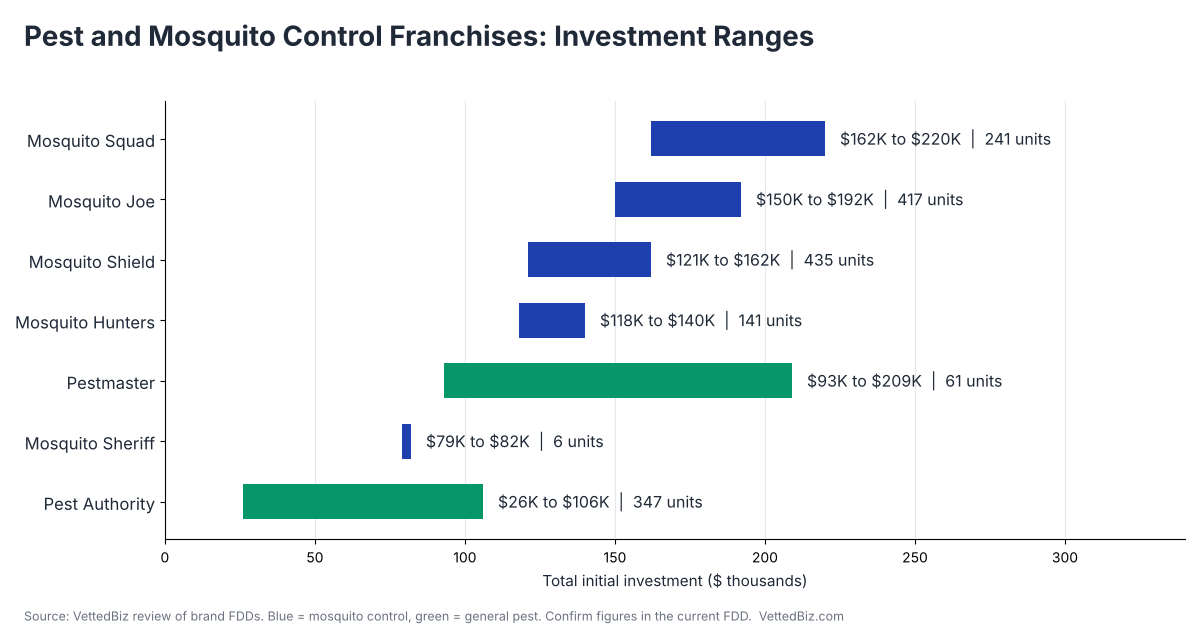
The category covers general pest control, termite work, rodent control and outdoor-focused services such as mosquito and tick treatments. Entry costs range from roughly $30,000 at the low end to more than $200,000, depending on the brand and the territory. Entrepreneur's 2026 Franchise 500 ranked several brands in the category, including Pest Authority at No. 250 and Mosquito Shield around No. 269, according to a trade-press summary.
Why Mosquito Brands in Particular
Mosquito control has become its own sub-category. Third-party FDD summaries list at least six active mosquito franchisors, with unit counts ranging from single digits to roughly 400. The appeal is a relatively low cost of entry and a repeat-visit pattern during the warm season. The risk is that weather and geography strongly influence results.
Pro Tip: Compare brands on the same basis. A median across hundreds of franchised units tells you more than an average from a handful of company-owned locations.
Pest and Mosquito Control Franchise Snapshot
The table below summarizes investment and fee figures reported by third-party FDD summaries for selected brands. Franchise fees and royalties vary by territory and agreement, and some summaries conflict, so treat these as a starting point
A few patterns stand out. Most brands charge a royalty between 7% and 10% of revenue, and many add a marketing fund contribution of about 2% to 3%. Several use a minimum monthly royalty, which means you owe a baseline even in slow months. Franchise fees mostly fall between $25,000 and $55,000, though total investment depends more on vehicles, equipment, licensing and working capital.
Seasonality: The Biggest Operating Difference
Mosquito and vector-control brands earn most of their revenue from spring through fall. In northern markets, the active window may be only five to seven months, yet fixed costs such as vehicles, insurance and software continue through winter. Southern markets can operate year-round, which changes the economics substantially.
General pest control brands tend to bill throughout the year because pests such as ants, rodents and spiders are not limited to warm months. That can smooth cash flow, but it may also mean a different competitive set, including large regional and national providers.
Planning for Slow Months
- Ask each franchisor for monthly revenue patterns in your region, not only annual figures.
- Understand whether your royalty has a monthly minimum during the off-season.
- Plan for fixed costs and working capital through the first winter.
- Ask whether the brand supports add-on services such as tick control, lawn pest treatments or holiday lighting to fill gaps.
How the Operating Model Works
Most pest and mosquito franchises start with a small team: an owner-operator, a technician or two, and a scheduling system. Route density is a major driver of efficiency. When customers are clustered in one neighborhood, technicians spend less time driving and more time treating.
Franchisors typically supply training in treatments, safety and customer service, along with branded vehicles, marketing support and software. Pesticide application is regulated by state agencies, and many states require licensing or certification for technicians and sometimes for the business. Confirm what your state requires and how the franchisor helps you meet it.
Customer Acquisition
Growth usually comes from local marketing, door-to-door neighborhood campaigns, referrals from existing customers and online search. Marketing fund contributions pay for national support, but local effort still matters. Ask existing owners how many customers they gained from each channel and what a new customer costs to acquire.
What the First Year Often Looks Like
Because most revenue depends on building a customer base, the first season is usually about density rather than profit. New owners typically spend the opening weeks on training, licensing, vehicle setup and local marketing, then build routes neighborhood by neighborhood. The Item 19 gap between median and top-quartile units suggests that some operators ramp far faster than others.
Ask franchisees what their first 12 months looked like: how many customers they had by the end of the first season, how many service plans renewed the next year, and when they hired their first technician. Owners who opened in the last two years will give you a more current picture than those who started a decade ago.
Signals of a Healthy System
- Franchisees describe consistent, specific marketing support rather than general encouragement.
- Item 20 shows few closures or transfers relative to the number of units.
- The franchisor can explain how it supports technician training and state licensing.
- Owners in different climates report workable results, not only those in the brand's strongest regions.
These signals do not guarantee results, but they help separate brands with durable systems from those growing mainly through franchise sales. Take notes on every call, compare answers across owners and follow up on anything that sounds inconsistent with the FDD.
Who Tends to Fit This Category
- Hands-on owner-operators: Comfortable with sales, scheduling and, early on, field work.
- Local marketers: People who enjoy neighborhood outreach and building relationships.
- Multi-territory builders: Owners who plan to add vehicles and territories over time, once routes are dense.
- Career changers from service trades: Experience with route-based or technical work can shorten the learning curve.
Pest control rewards consistency and reliability more than glamour. If you prefer a business where you can see recurring customers and build local density, it may fit. If you want a business with steady year-round revenue from day one, a general pest brand may fit better than a mosquito-only one.
Risks and Questions to Ask Before You Shortlist
- Weather and geography: Mosquito demand varies by climate, and availability of good territories varies.
- Brand size and support: Some brands have only a handful of units, which limits the data available for your due diligence.
- Mixed Item 19 samples: Check whether figures come from franchisees, company stores or projections.
- Minimum royalties and ad fund: These can weigh on slow months, especially in year one.
- Regulation and safety: Licensing, insurance and handling of treatment products need attention.
- Competition: Large national providers and independent local companies both compete for the same customers.
Pro Tip: Call at least 10 current franchisees from FDD Item 20, including some in a climate like yours. Ask for their first-year monthly revenue and how many of their customers renewed.
How to Compare Brands: A Short Checklist
- Request the current FDD and read Items 5, 6, 7, 19 and 20.
- Compare franchisee-level Item 19 medians, not just averages.
- Check the minimum royalty and ad fund requirements.
- Review the number of closures, transfers and terminations for the last three years.
- Confirm which services you may offer and whether the territory is exclusive.
- Visit a territory or ride along with an operator if the brand allows it.
Frequently Asked Questions About Pest Control Franchises
How much does a pest control franchise cost?
Reported total investments range from roughly $40,000 to more than $200,000, depending on the brand. Mosquito control brands in the sources reviewed clustered between about $79,000 and $220,000. Confirm exact costs in FDD Item 7.
Is a mosquito control franchise seasonal?
Yes, in many regions. Northern markets may run mainly from April through October, while southern markets can operate year-round. General pest brands generally bill throughout the year.
Do I need a license to start a pest control franchise?
Most states regulate pesticide application and may require certification or licensing. Requirements differ by state and by service type, so ask the franchisor and your state agriculture or environmental department.
Conclusion: Is a Pest or Mosquito Control Franchise Right for You?
Pest and mosquito control franchises offer recurring service routes, relatively accessible entry costs and no storefront, in a segment the IFA identifies as growing. They also come with seasonality, licensing requirements and wide differences in disclosed results between brands.
Start by deciding whether you want year-round general pest or seasonal mosquito focus, then shortlist two or three brands, request their FDDs and talk with owners in climates like yours. VettedBiz can help you compare franchise opportunities side by side; explore our franchise guides to continue your research. This article is for informational purposes only.
Get insider access to franchise insights
Subscribe to receive expert tips, franchise rankings, and exclusive data straight to your inbox, trusted by thousands of aspiring business owners and investors.
Franchise resources & insights
Explore expert guides, data-driven articles, and tools to help you make smarter franchise decisions, whether you're just starting out or ready to invest.