Holiday and Permanent Lighting Franchises in 2026: Costs, Revenue and the Shift to Year-Round Work
Every November, the same scene plays out in neighborhoods across the U.S.: crews on ladders, rooflines lit up by Thanksgiving, and homeowners happy to pay someone else to handle the cold, the height and the tangled cords. What has changed is what happens after New Year's Day. A holiday lighting franchise used to be a six-week sprint that many lawn care and landscaping owners bolted on to keep crews busy in winter. In 2026, the category looks more like a year-round outdoor lighting business with a strong holiday season attached.
That shift is attracting franchisor capital. Five Star Franchising added a specialty lighting brand to its portfolio this summer, multi-brand platforms are pushing holiday lighting service lines into their lawn and pest systems, and the most established brand in the segment just disclosed record system revenue in its 2026 FDD.
In this guide, we compare four of the most visible outdoor and holiday lighting franchises, review what their Franchise Disclosure Documents (FDDs) actually disclose about costs and revenue, and walk through the seasonality and labor risks every prospective owner should model before signing.
Why Holiday Lighting Franchises Are Trending Right Now
Three developments from the past few months explain why this niche deserves a closer look heading into the 2026 holiday season.
1. New franchisor entrants and platform backing
In July 2026, Five Star Franchising announced the national franchise launch of Decorate With Lights, a Utah-based company founded in 2016 that offers holiday, permanent roofline, landscape and event lighting from a single protected territory. In its announcement, the franchisor said professional holiday lighting has been growing at double-digit annual rates as homeowners move away from do-it-yourself decorating. That is a franchisor claim rather than an independent market figure, but it signals where platform operators see demand.
Other platforms are moving the same way. Happinest Brands has rolled holiday lighting lines (Holiday Lighting Heroes and Humbug Holiday Lighting) into brands such as Lawn Doctor and Pest Hunters-Mosquito Hunters, positioning the service as a way to smooth the winter revenue gap for seasonal home service owners.
2. Permanent lighting is changing the economics
Trade publication LightNOW described the sector in mid-2026 as moving from a seasonal add-on to a year-round service category. The driver is permanent roofline lighting: app-controlled, color-changing LED systems that a homeowner can switch from a holiday theme to a game-day or everyday look without a reinstall. A customer who starts with a December display can later buy permanent roofline lighting, then landscape lighting, then event lighting, which turns a one-time job into a multi-year relationship.
3. Home services remain one of franchising's growth leaders
The International Franchise Association's 2026 Franchising Economic Outlook lists commercial and residential services, together with child services, as the fastest-growing franchise industries this year, each projected to expand about 3.2%. Outdoor lighting sits inside that home services bucket and benefits from the same tailwinds: homeowners with less time and more willingness to outsource exterior work.
On the consumer side, the global holiday lighting and decoration market was estimated at $7.2 billion in 2021 and projected to reach about $10.7 billion by 2030, a compound annual growth rate near 4.1%. Professional installation is a slice of that total, but it is the slice franchise brands are built to capture.
How the Holiday Lighting Franchise Model Works
Most brands in this space now sell the same four service lines. The mix matters because each line has a different ticket size, sales cycle and season.
Seasonal holiday installs
The traditional core: design, installation, takedown and off-season storage of holiday lighting for homes, HOAs and commercial properties. Many customers rent the product rather than buy it, which creates natural annual renewals. According to the Outdoor Lighting Perspectives (OLP) 2026 FDD, the average retail price of a holiday lighting project across reporting franchisees was about $1,900.
Permanent roofline lighting
Track-mounted LED systems that stay on the house all year. This is the fastest-moving line in the category and the one with the highest ticket in OLP's disclosure, averaging roughly $5,666 per permanent lighting install.
Landscape and architectural lighting
Low-voltage path, uplighting and accent systems that are sold year-round and often come with annual maintenance plans. OLP reports an average of about $4,649 per new residential landscape lighting project.
Event and commercial lighting
Weddings, parties, municipal displays and storefront branding. Commercial clients tend to pay on longer terms, so this line adds volume but also adds working capital needs.
Holiday Lighting Franchise Costs Compared
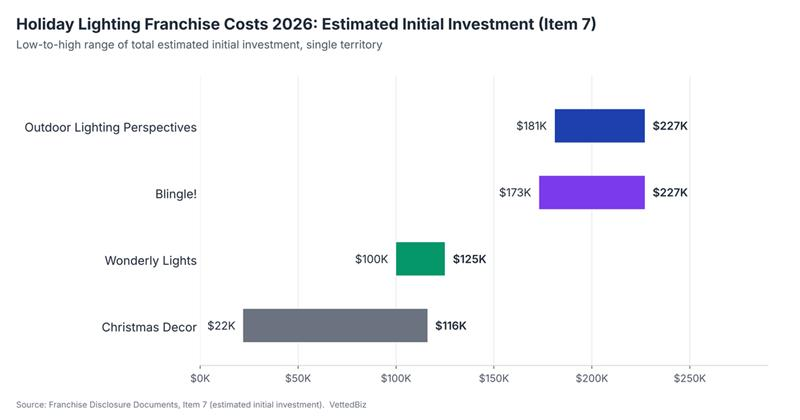
The table below summarizes the most recent disclosed figures we could find for four brands.
Reading the cost differences
The investment gap is mostly a story about scope. Christmas Decor, part of The Decor Group, sells a holiday-only package that is frequently added to an existing landscaping or lawn business, so the low end assumes you already have trucks, crews and an office. Its full Decor Group package, which adds landscape and permanent lighting, moves toward the top of its range.
Wonderly Lights, launched in 2022, sits in the middle. Its earlier FDD separated a lower-cost seasonal format from a year-round format, which makes it one of the few brands that lets a buyer choose how seasonal to be from day one.
Outdoor Lighting Perspectives and Blingle! are full-service outdoor lighting businesses. A large share of the investment goes to a work vehicle, inventory and an aggressive launch marketing budget. In OLP's case, the 2026 FDD budgets $25,000 to $55,000 for start-up marketing in the first 90 days and requires a minimum local advertising spend of $55,000 per year for a single territory, a fixed commitment worth building into any pro forma.
What the FDDs Show About Holiday Lighting Franchise Revenue
Item 19 financial performance representations are the most useful data point in this category, and they are uneven. OLP provides the most complete disclosure, so we use it as the benchmark.
Margins and revenue mix
OLP's voluntary benchmarking study covered 55 franchisees in operation for at least two full years. On average revenue of $818,812, labor and materials consumed about 42% of sales, leaving a gross margin near 57.9%. After royalties, marketing, office staff, vehicles, insurance and a handful of other listed costs, the remaining amount averaged $172,902, or 21.1% of revenue. That figure is not net profit; it excludes owner compensation, debt service and other expenses the FDD does not list.
The revenue mix is the most interesting signal for this trend. Of OLP's $59.9 million in system gross revenue for fiscal 2025, residential landscape and permanent work made up 79.6%, holiday lighting 12.8% and commercial 7.6%. System revenue has grown from about $24.9 million in 2018 to $59.9 million in 2025. In other words, the most mature brand in this space earns most of its money outside of December.
Other brands
Third-party FDD aggregators list an average gross revenue of about $516,000 for Blingle! and about $199,600 for Wonderly Lights, but the figures vary by source and reporting year. For Christmas Decor, sources disagree on whether the current FDD includes an Item 19 at all.
In each case, buyers should read the actual Item 19 footnotes and call franchisees listed in Item 20 before relying on any average.
Seasonality: The Biggest Operational Risk
Holiday lighting is concentrated in a narrow window, roughly October through mid-January, and that compression creates specific pressures:
- Labor spikes. Owners need trained installers for a few intense weeks, often competing with retailers and delivery companies for the same seasonal workers.
- Working capital. Inventory is bought before the season, while commercial clients may pay on 30- to 60-day terms.
- Weather and safety. Roof work in cold, wet or windy conditions raises injury risk and insurance costs.
- Storage and logistics. Takedown and storage of customer displays require space and tracking systems.
- The off-season gap. A holiday-only business can sit idle for much of the year unless it sells permanent, landscape or event work.
This is exactly why franchisors are leaning into permanent and landscape lighting. A system where holiday work is closer to 13% of revenue, as in OLP's disclosure, is a very different business from one where it is closer to 100%.
Who a Holiday Lighting Franchise Fits Best
The add-on owner
Lawn care, landscaping, pest control and exterior cleaning owners already have trucks, crews and a residential customer list that goes quiet in winter. For them, a lower-cost holiday package can monetize slow months without building a new customer base from scratch.
The standalone outdoor lighting operator
Buyers starting fresh are usually better served by a full-service model with permanent and landscape lines, since those generate year-round revenue. Expect a higher entry cost, meaningful required marketing spend, and a sales-driven role rather than a semi-absentee one.
The multi-territory builder
Scaling across territories can spread overhead, but it also multiplies marketing minimums.
Due Diligence Checklist for Holiday Lighting Franchise Buyers
Before you sign: request the current FDD directly from the franchisor and confirm every figure in this article against it. Then work through the points below with at least 8 to 10 current owners from Item 20.
- What share of revenue comes from holiday versus permanent, landscape and commercial work in your market?
- How many installers do owners hire at peak, and where do they recruit them?
- What are the required local advertising minimums, and how do they scale with additional territories?
- Is product sold or rented to customers, and who owns the inventory at renewal?
- How long did it take owners to reach a stable year-round schedule?
- Which territories nearby are already sold, and how is territory size defined (households, ZIP codes, population)?
Conclusion
Holiday lighting franchises are no longer just a winter side business. The strongest brands in the category are building year-round outdoor lighting companies, and the FDD data, especially OLP's revenue mix, backs that up. Entry costs range from about $22,000 for a holiday-only add-on to roughly $227,000 for a full-service territory, and results vary widely by operator.
If you are evaluating this segment, start with the Item 19 footnotes, model the off-season honestly, and talk to franchisees in markets that resemble yours. Explore the franchise profiles and FDD data on VettedBiz to compare lighting brands side by side with other home services opportunities.
Get insider access to franchise insights
Subscribe to receive expert tips, franchise rankings, and exclusive data straight to your inbox, trusted by thousands of aspiring business owners and investors.
Franchise resources & insights
Explore expert guides, data-driven articles, and tools to help you make smarter franchise decisions, whether you're just starting out or ready to invest.