Best Health & Wellness Franchises to Own in 2026: Inside the $66.4B Hyper-Wellness Boom
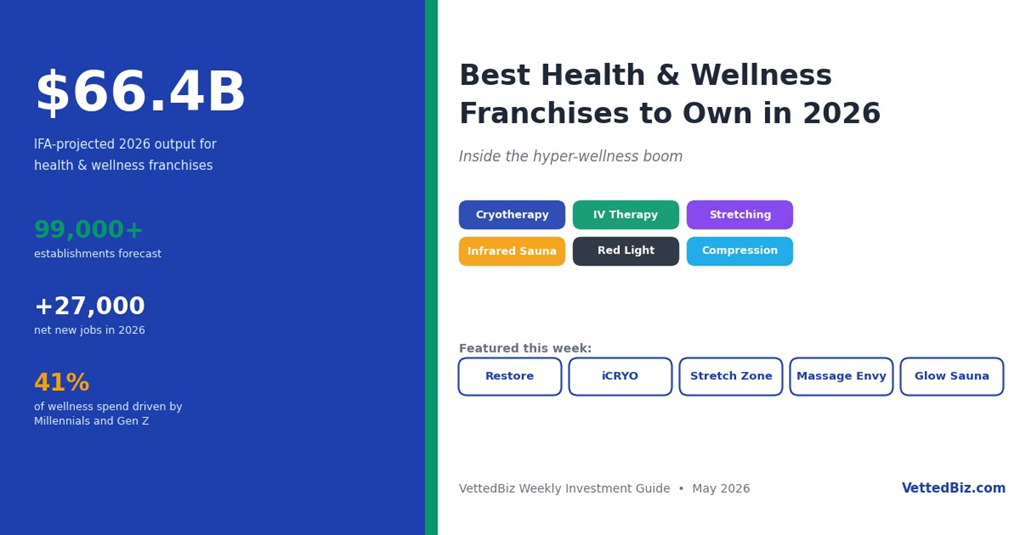
The health and wellness franchise sector is no longer a niche. In its 2026 Economic Outlook, the International Franchise Association projects this category will reach $66.4 billion in economic output, support more than 99,000 establishments, and add roughly 27,000 new jobs by year-end. That makes it the third-largest franchised industry in the United States, and one of the most active hunting grounds for new investors.
Consumer behavior is driving the shift. Americans plan to spend an estimated $60 billion on health, fitness, and exercise goals in 2026, with Millennials and Gen Z together contributing more than 41% of the annual wellness spend. The result: a wave of "hyper-wellness" concepts, cryotherapy, IV vitamin therapy, infrared sauna, assisted stretching, red light therapy, compression, that are scaling faster than any traditional gym franchise did in the last two decades.
This guide breaks down the five most relevant health and wellness franchises to evaluate in 2026, the macro trends pushing capital into the category, and the due diligence questions every investor should bring to the table before signing an FDD.
Why Health & Wellness Is the Story of 2026
The IFA's May 2026 Industry Spotlight pegged health and wellness as the sector with the most durable consumer demand heading into the second half of the year. Three signals stand out.
Demand is shifting from aesthetic to outcome-based
Franchisors describe a steady migration away from indulgent or purely cosmetic services and toward measurable health outcomes: body composition tracking, athletic performance, weight management, women's health, and recovery. Brands that can show data, heart rate variability, range-of-motion gains, dexa-style metrics, are commanding stronger retention and pricing power.
Smaller footprints, leaner unit economics
The new wave of wellness studios runs in 1,000–2,500 square foot suites with comparatively low buildout cost and equipment-driven labor models. Compared with full-service gyms or traditional spas, the staffing footprint is lighter, fewer certifications are required, and the recurring membership model resembles a subscription business more than a hospitality one.
Tech is now table stakes
Booking apps, performance dashboards, AI-driven retention prompts, and member-data analytics are no longer differentiators, franchisors are integrating them as baseline platform features. Brands without them are losing ground in franchisee development pipelines.
The 2026 Wellness Franchise Landscape: Five Brands to Watch
The following five brands span the price range, from sub-$350K studios to seven-figure flagship concepts, and capture distinct slices of the hyper-wellness category. All figures below come from each brand's most recent FDD or franchisor disclosure and should be re-verified against the latest Item 7 and Item 19 numbers before any investment decision.
1. Restore Hyper Wellness
Restore Hyper Wellness is the flagship operator in the "hyper-wellness" category, stacking cryotherapy, IV drips, red light therapy, infrared sauna, and mild hyperbaric oxygen under a single roof.
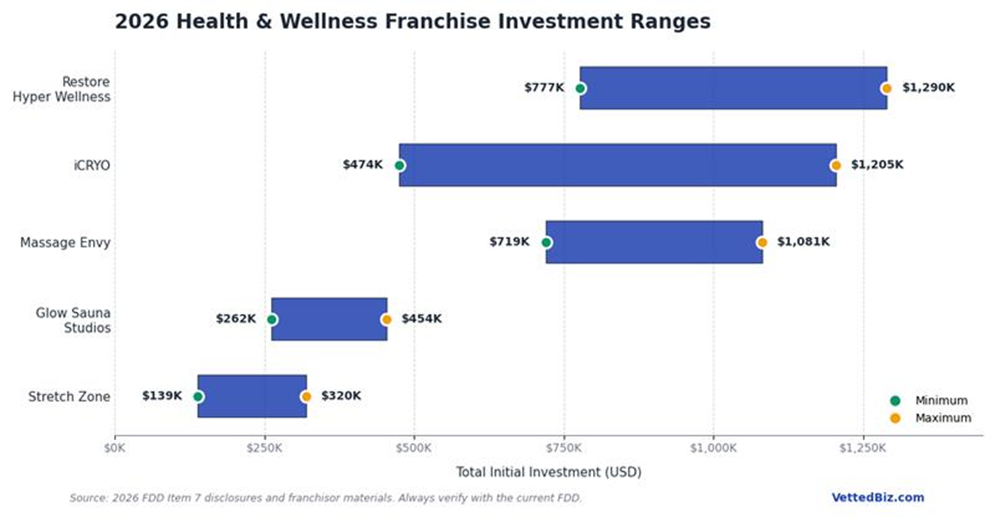
- Total initial investment: $777,174 – $1,289,925
- Franchise fee: $44,500
- Concept: Multi-modality recovery and wellness studio
- Best for: Investors with $400K+ liquidity who want a flagship anchor in a prime suburban trade area
Restore's pitch leans heavily on the multi-service model, average ticket sizes climb when members layer two or three modalities per visit, and the brand has spent the last two years pushing data-driven personalization through its app.
2. iCRYO
iCRYO competes directly with Restore but operates with a tighter equipment stack and slightly lower entry costs. Cryotherapy is the anchor service, with IV therapy, infrared sauna, and compression as adjacent revenue lines.
- Total initial investment: $474,500 – $1,205,000
- Franchise fee: $49,500
- Concept: Cryotherapy-led wellness studio
- Best for: Multi-unit operators looking for a recovery-first concept with strong unit economics in the mid-range
iCRYO's franchise development team has been aggressive in 2025–2026, particularly in the Southeast and Texas markets. Investors should pay close attention to Item 19 average unit volume relative to the brand's older locations versus newer cohorts.
3. Stretch Zone
Stretch Zone is the largest assisted-stretching franchise in North America and arguably the cleanest unit economics story in the category. Buildouts are smaller, equipment cost is lower, and labor is "stretch practitioner" rather than licensed clinician.
- Total initial investment: $138,745 – $320,099
- Franchise fee: $59,500
- Royalty / brand fund: 7% / 2%
- Best for: First-time franchisees and investors who want a sub-$350K entry point with proven member-retention dynamics
Stretch Zone's lower capex and recurring membership model make it the entry-level pick of the five, though prospective owners should validate territory availability in the metros they're targeting, the brand is approaching saturation in several urban cores.
Bar chart comparing minimum and maximum total investment across the five featured 2026 health & wellness franchises. Source: 2026 FDD Item 7 disclosures.
4. Massage Envy
The category veteran. Massage Envy is still the most recognized wellness membership brand in North America, with 1,187 U.S. locations reporting a median Average Unit Volume of approximately $1.1 million per location.
- Total initial investment: $719,350 – $1,081,000 (Item 7 range varies by market and reporter)
- Franchise fee: $45,000
- Royalty / marketing: 6% / 2%
- Best for: Operators looking for a mature, well-documented brand with strong AUV benchmarks and a national membership network
Massage Envy's strengths are scale, brand recognition, and an established member base. Its challenge is operational: turnover among licensed massage therapists has been an industry-wide pain point, and franchisees report needing strong HR systems to keep utilization rates healthy.
5. Glow Sauna Studios
Glow Sauna Studios is the emerging-brand pick of the group, built around infrared sauna and red light therapy in a boutique footprint.
- Total initial investment (turnkey buildout): $262,000 – $454,000
- Franchise fee: $49,000
- Concept: Infrared sauna + red light therapy boutique
- Best for: Investors seeking a single-modality, lower-capex concept in a category still in white-space mode
Glow's appeal is the low complexity, fewer SKUs, simpler labor model, and a clear recurring-revenue ladder. The trade-off is brand maturity: investors should request the most recent unit-economics data directly from the franchisor and validate Item 19 disclosures carefully.
Investment Snapshot at a Glance
What Investors Should Pay Attention To
Hyper-wellness is one of the most exciting franchise categories in 2026, and one of the most risk-laden if investors skip standard franchise diligence. Five themes deserve special attention.
1. Item 19 vs. real-world unit performance
Franchise Disclosure Documents are the foundation, but Item 19 figures often present averages skewed by top-quartile units. Speak with at least ten current franchisees, Item 20 contains the complete list, and ask about ramp times, member churn, and EBITDA at the unit level.
2. Regulatory exposure on IV therapy and medical-adjacent services
IV vitamin infusions, peptide programs, hormone-related services, and other medical-adjacent modalities sit in an evolving regulatory environment. State medical boards are increasingly active. Confirm exactly which services your unit can offer in your target state, who must administer them, and whether a medical director relationship is required.
3. Clinical evidence and marketing claims
Several hyper-wellness modalities, cryotherapy, red light therapy, certain stretching protocols, have limited peer-reviewed clinical evidence behind their performance claims. The FTC has signaled continued attention to wellness-industry marketing. Brands that train franchisees in compliant, outcome-language marketing reduce risk; brands that don't transfer that risk to the operator.
4. Saturation and territory protection
Stretch Zone, Massage Envy, and Restore Hyper Wellness have all built out significant footprints. Confirm territory protections, encroachment policies, and the franchisor's planned development pace within a 10-mile radius of your target site.
5. Membership math
The economics of every franchise on this list assume a recurring membership engine. Validate the brand's member retention curves, freeze-rate behavior, and average revenue per member (ARPM).
These three numbers matter more than headline AUV.
Who Should Invest in a Wellness Franchise in 2026
The hyper-wellness category rewards two operator profiles. The first is the single-unit, hands-on owner who can build local community, drive retention, and run a tight P&L, typically a strong fit for Stretch Zone or Glow Sauna Studios. The second is the multi-unit, semi-passive operator with $1M+ in deployable capital who can build a regional cluster across two or three Restore, iCRYO, or Massage Envy locations and benefit from operational leverage.
Capital alone is not enough. The brands with the best unit economics are also the most disciplined about awarding territories to operators who can demonstrate hospitality background, membership-business experience, or strong local-marketing capability. Investors should plan to spend three to six months in franchise development conversations before signing an FDD.
Conclusion: A Category Built for the Decade Ahead
Health and wellness has graduated from a trend category to a foundational pillar of franchised retail. The IFA forecasts the segment will continue to grow at 2.1% in 2026 with 27,000 net new jobs and steady consumer spending. The brands leading that growth, Restore Hyper Wellness, iCRYO, Stretch Zone, Massage Envy, and emerging boutiques like Glow Sauna Studios, share common traits: small-footprint studios, recurring membership models, tech-enabled operations, and outcome-driven service menus.
For investors weighing entries in 2026, the opportunity is real, but so is the diligence required. Compare Item 19 disclosures carefully, validate regulatory exposure in your state, and prioritize brands with verifiable retention data. Done right, a wellness franchise in 2026 can be one of the more durable cash-flow assets in the franchise universe.
Get insider access to franchise insights
Subscribe to receive expert tips, franchise rankings, and exclusive data straight to your inbox, trusted by thousands of aspiring business owners and investors.
Franchise resources & insights
Explore expert guides, data-driven articles, and tools to help you make smarter franchise decisions, whether you're just starting out or ready to invest.