Best Children's Enrichment & Youth Sports Franchises to Own in 2026: From Flag Football to STEM Programs
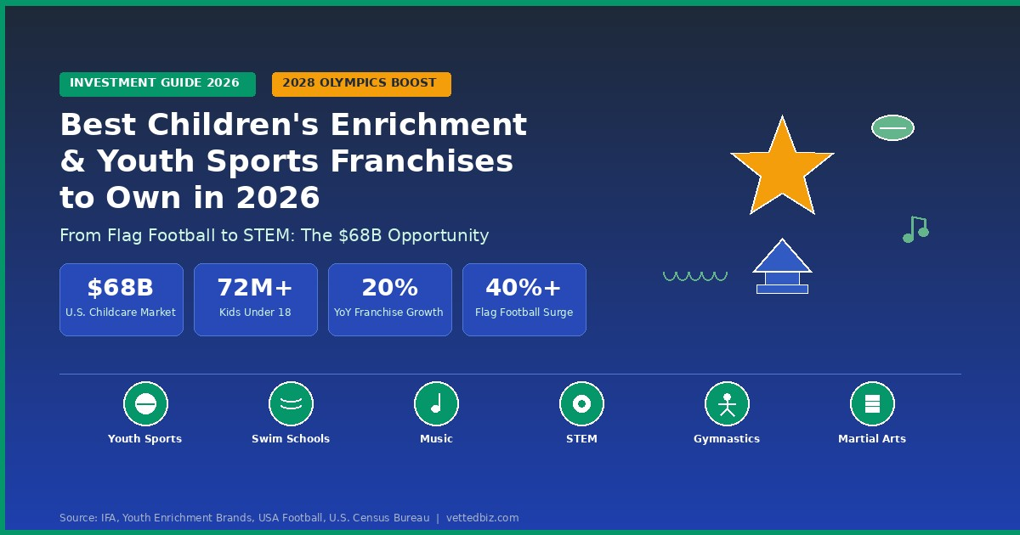
Girls' flag football participation surged past 270,000 players in 2024 and is still climbing, fueled by the sport's inclusion in the 2028 Los Angeles Olympics and the NFL's plan to launch professional men's and women's flag football leagues in the coming years. Meanwhile, Youth Enrichment Brands, the nation's leading youth activities franchisor, reported a 20% year-over-year jump in new franchise agreements in 2025 and plans to open more than 100 new franchise units, the highest annual number in company history.
These are not isolated data points. The U.S. childcare market approaches $68 billion in 2026, and children's enrichment is the fastest-growing franchise segment at 3.2% annual growth. With more than 72 million children under 18 in the country, parent-driven spending on sports leagues, swim schools, music education, STEM programs, and developmental fitness shows no signs of slowing. In this guide, we break down the top franchise opportunities in children's enrichment and youth sports, compare investment costs and revenue potential, and explain why this category deserves a closer look from franchise investors.
Why Children's Enrichment Franchises Are Booming in 2026
The Olympic Catalyst: Flag Football and Beyond
The inclusion of flag football in the 2028 Olympics has created a ripple effect across youth sports. According to USA Football, nearly 270,000 girls aged 6 to 17 played flag football in 2024, and the NFL's Flag program now has close to 600,000 players in more than 1,800 leagues nationwide. Girls' flag football is already a varsity high school sport in more than 20 states, and the number continues to grow as schools respond to surging demand.
For franchise investors, this translates directly into enrollment growth. i9 Sports, the nation's largest youth sports franchise, reported a more than 40% increase in flag football registrations year-to-date in 2026, along with a more than 20% increase in girls signing up for volleyball programs. The Olympic effect extends well beyond flag football, it raises the profile of organized youth sports in general, driving parents to seek structured, professionally managed leagues for their children across all sports.
Parents Are Spending More on Holistic Development
Today's parents are looking beyond traditional sports leagues and tutoring centers. They want programs built around defined developmental frameworks, measurable progress, and expert-designed curricula, programs that help children become stronger, more confident, and more capable across physical, cognitive, and social dimensions. This shift toward holistic development is driving demand for franchise concepts like KidStrong, which focuses on brain, physical, and character development for kids ages 1 to 11, and Snapology, which teaches STEM concepts through hands-on building and robotics.
The data supports this trend: the children's fitness center franchise market is expected to grow from $2.73 billion in 2025 to $5.5 billion by 2035, reflecting a compound annual growth rate that outpaces most other franchise categories. Parents who grew up with limited extracurricular options are now willing to invest significantly more in their own children's development, and franchised programs offer the consistency, safety standards, and progressive curricula that independent operators often cannot match.
Recurring Revenue and Community-Based Marketing
Children's enrichment franchises benefit from a powerful business model advantage: recurring enrollment. Parents typically commit to semester-long or year-long programs, producing predictable revenue streams. The community-based nature of these businesses, rooted in schools, neighborhoods, and local sports fields, creates natural word-of-mouth marketing and high retention rates. Once a family enrolls one child, siblings and friends often follow. Birthday parties, summer camps, and special events provide additional revenue channels that fill seasonal gaps and deepen customer relationships.
Top Children's Enrichment & Youth Sports Franchises to Consider
i9 Sports, Youth Leagues for Ages 3 to 14
i9 Sports is the first and largest multi-sport youth franchise in the United States, offering leagues, camps, and clinics in flag football, soccer, basketball, baseball, and volleyball. Total investment ranges from $60,000 to $70,000, with a $25,000 franchise fee and an 8% royalty. Median gross sales are $360,398. The model remains one of the most accessible franchise investments in the children's enrichment category.
The model is owner-operator friendly and does not require a brick-and-mortar location, games and practices take place at local parks and school fields, keeping overhead minimal. Franchisees manage schedules, recruit volunteer coaches, and handle enrollment marketing while the franchisor provides the technology platform, branded equipment, and operational systems. Estimated annual revenue ranges from $150,000 to $400,000 depending on territory size and sport mix, with the highest-performing territories combining multiple sports across overlapping seasons.
KidStrong, Developmental Fitness for Kids 1 to 11
KidStrong has emerged as a standout in the children's fitness category, growing to 121 units since its founding. The franchise focuses on brain, physical, and character development through a proprietary curriculum delivered in dedicated studio spaces. Total investment ranges from $476,000 to $671,000, with a $45,000 franchise fee and an 8% royalty.
KidStrong reports median gross sales of $716,374. The rapid unit growth and strong sales performance suggest a concept that resonates with both parents and franchise investors.
$1.02 million per location, with estimated owner earnings of $100,293 to $128,948. The Royalty fee is set at 8%, with an additional 2% allocated to advertising. The rapid unit growth and strong AUV suggest a concept that resonates with both parents and franchise investors.
Goldfish Swim School, Premium Swim Education
Goldfish Swim School occupies the premium end of the children's enrichment spectrum, with 172 units and a total investment range of $1.66 million to $3.75 million. The franchise fee ranges from $40,000 to $50,000, and the royalty rate is 6%. This is a facility-intensive concept, each location features a custom-built, tropical-themed indoor pool facility, which explains the higher investment. Median gross sales are $1,473,513, driven by year-round enrollment in swim lessons, swim team programs, birthday parties, and family swim events.
School of Rock, Music Education and Performance
School of Rock, part of Youth Enrichment Brands, has built a loyal following since 1998, growing to approximately 254 franchise units. The concept offers individual music lessons, group rehearsals, and live performance experiences in a band-based format that keeps students engaged for years. Total investment ranges from $378,000 to $756,000, with a $59,900 franchise fee and an 8% royalty. The music education market benefits from high parental engagement and strong retention, students often stay enrolled for three to five years, creating reliable long-term revenue. Median gross sales are $640,486.
The Little Gym, Gymnastics and Motor Skill Development
The Little Gym has been a fixture in children's fitness since 1976, offering gymnastics, dance, sports skills, and parent-child classes for children ages 4 months to 12 years. Total investment ranges from $519,000 to $757,000, with a $113,050 franchise fee and an 8% royalty. The franchise's multi-decade track record and structured curriculum appeal to investors who value proven systems and brand recognition. Median gross sales are $677,201, with strong retention driven by progressive skill-level programs that keep families enrolled as children advance through defined stages.
Snapology, STEM and Robotics Programs
Snapology offers one of the most accessible entry points in the children's enrichment space, with total investment ranging from $75,000 to $106,000. The franchise fee is $40,000, the royalty is 7%, and median gross sales are $106,927. Snapology delivers STEM education through hands-on building programs using LEGO bricks, robotics kits, and coding platforms. Programs run in schools, community centers, and dedicated locations, providing flexible operating models that can start lean and scale over time. The low overhead and growing parental demand for STEM education make this an attractive option for first-time franchisees.
Investment vs. Revenue Comparison at a Glance
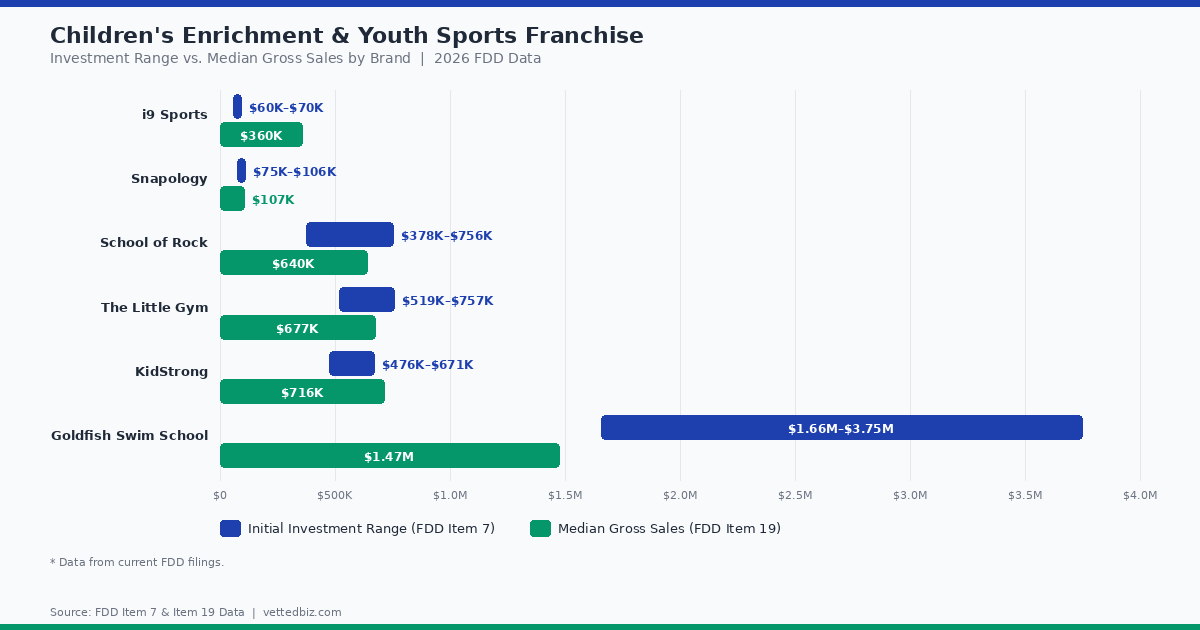
Note: Ranges are approximate and based on publicly available FDD data and industry reports. Revenue estimates reflect system-wide averages and vary by location, territory, and maturity. Always review the specific FDD (Items 5, 6, 7, and 19) before making an investment decision.
What to Look for When Evaluating a Children's Franchise
Curriculum and Developmental Framework
The strongest children's enrichment franchises differentiate themselves through proprietary, research-backed curricula. When evaluating a concept, ask how the program is designed, whether developmental milestones are tracked, and how the curriculum evolves as children age. Franchises with structured progression systems, where children advance through defined levels, tend to produce higher retention rates and longer average enrollment periods, which directly impacts unit economics.
Staffing and Instructor Quality
Children's enrichment franchises live or die by their instructors and coaches. Parents are paying for expert-led experiences, which means your ability to recruit, train, and retain qualified staff is critical. Ask the franchisor what training programs, certification requirements, and ongoing support they provide for instructors. Franchises that invest heavily in instructor development, including background checks, ongoing education, and competitive compensation guidance, tend to outperform those that treat staffing as an afterthought.
Seasonality and Year-Round Revenue
Some children's concepts, particularly outdoor sports leagues, face significant seasonal fluctuations. Indoor concepts like swim schools, gymnastics centers, and music programs operate year-round, which smooths revenue and reduces the feast-or-famine dynamic. When comparing franchises, look at how revenue distributes across the calendar year and whether the franchisor offers summer camps, birthday parties, or special events to fill seasonal gaps and maintain cash flow during slower periods.
Facility Requirements and Real Estate
The real estate model varies dramatically across children's franchises. i9 Sports requires no dedicated facility at all, while Goldfish Swim School needs a purpose-built pool complex. Consider what your local commercial real estate market looks like, what lease terms are realistic in your area, and whether the franchisor provides site selection support. Facility-intensive concepts offer higher revenue ceilings but also carry higher fixed costs and longer build-out timelines, typically 9 to 18 months from lease signing to opening day.
Pro Tip: Ask for a list of all current franchisees from Item 20 of the FDD, and contact at least 10. Ask specifically about enrollment retention rates, staffing challenges, and how long it took to reach break-even. These conversations reveal more than any financial projection.
Financing Your Children's Franchise Investment
Financing options for children's franchises mirror the broader franchise lending landscape. SBA 7(a) loans remain the most common vehicle for investments under $5 million, with most lenders financing up to 80% of the total project cost for qualified borrowers. For lower-investment concepts like i9 Sports or Snapology, personal savings or a home equity line of credit may be sufficient.
Higher-investment concepts like Goldfish Swim School or KidStrong typically require a combination of SBA financing, personal capital, and sometimes landlord tenant improvement allowances for the build-out. ROBS (Rollover for Business Startups) programs allow qualifying investors to use retirement funds without early withdrawal penalties, though this strategy carries risk and should be evaluated with a qualified financial advisor. Many franchisors also maintain relationships with preferred lenders who understand their specific business model and can streamline the approval process.
The Bottom Line
Children's enrichment and youth sports franchises sit at the intersection of strong demographics, shifting parental priorities, and catalytic moments like the 2028 Olympics. With more than 72 million children under 18 in the U.S. and parents increasingly willing to invest in structured developmental programs, the category offers franchise investors a combination of recurring revenue, community-rooted marketing, and genuine mission-driven work.
Investment entry points range from $60,000 for a youth sports franchise to $3.75 million for a premium swim school facility, so there is a concept for a wide range of capital levels. The key is matching your skills, market, and capital to the right brand, then validating everything through the FDD and franchisee conversations. The growth trajectory in this sector is strong, the demand is durable, and the right franchise can deliver both financial returns and meaningful impact in your community.
Get insider access to franchise insights
Subscribe to receive expert tips, franchise rankings, and exclusive data straight to your inbox, trusted by thousands of aspiring business owners and investors.
Franchise resources & insights
Explore expert guides, data-driven articles, and tools to help you make smarter franchise decisions, whether you're just starting out or ready to invest.