Wellness & Recovery Franchises 2026: The Rising Category
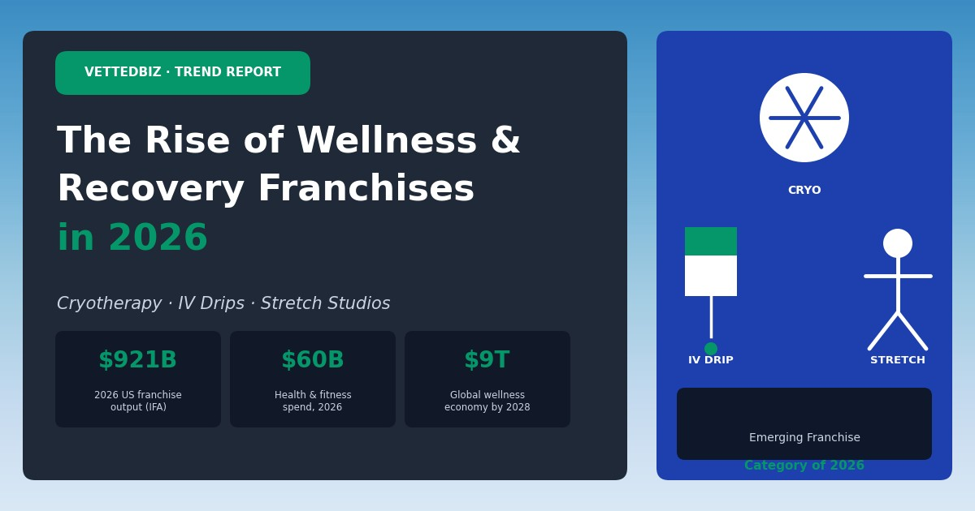
Recovery used to be an afterthought at the gym, a foam roller in the corner, maybe a sauna next to the locker room. In 2026, it is the business. Assisted-stretching studios, cryotherapy chambers, IV drip bars, red light rooms, and infrared saunas are opening at a pace traditional fitness concepts have not seen in two decades, and franchise investors are paying attention.
According to the International Franchise Association's 2026 Franchising Economic Outlook, the U.S. franchise sector is projected to reach $921.4 billion in economic output this year, a 1.6% increase driven disproportionately by service-based categories. Health, wellness, and recovery concepts are among the fastest-moving pieces of that growth. Americans are expected to spend roughly $60 billion on health, fitness, and exercise goals in 2026, with Millennials and Gen Z contributing more than 41% of the total wellness spend.
This guide unpacks why wellness and recovery franchises are outperforming, which sub-categories and brands are leading, what a realistic investment looks like, and the questions investors should ask before signing an FDD.
Why Wellness & Recovery Is the Category to Watch in 2026
The shift is structural, not seasonal. Three forces are converging.
Consumer behavior has changed.
Recovery is no longer positioned as post-injury care, it is being marketed and consumed as preventative healthcare. Cryotherapy, IV hydration, and assisted stretching all sit in that "feel better, perform better, age better" space that resonates with Millennial and Gen Z consumers who are treating wellness as non-discretionary spending.
The unit economics look different from traditional fitness.
Recovery studios typically operate with smaller footprints (1,200–2,500 sq ft is common), leaner staffing models, and higher per-visit tickets than a big-box gym. Membership models paired with per-service upsells create predictable recurring revenue.
Category tailwinds are stacking.
The global wellness economy is on pace to hit $9 trillion by 2028, according to Global Wellness Institute forecasts referenced throughout the industry. Within franchising, "wellness and recovery" was called out in several 2026 outlooks as the emerging category attracting both franchisee applications and private-equity investor capital.
The IFA also projects the sector will add roughly 15,000 new franchise establishments in 2026, with service-based concepts, including personal wellness, capturing an outsized share of that unit growth.
The Four Sub-Categories Investors Are Chasing
Not all "wellness" franchises are created equal. In 2026, four sub-verticals are getting the most investor attention.
1. Assisted Stretching Studios
Assisted-stretching studios (one-on-one, appointment-based flexibility sessions delivered by trained "flexologists") have quietly become one of the most talked-about categories in franchising. Two brands anchor the space.
StretchLab operates 485 studios system-wide, with a $530,000 median studio revenue regarding the records. As part of the Xponential Fitness portfolio, StretchLab benefits from a mature franchisor infrastructure covering site selection, marketing, and technology.
Stretch Zone runs over 370 units as of 2026 and uses a proprietary strapping system. Their Median Gross Sales can be set at around $307,000. Investors should read Item 19 carefully and speak to franchisees across territory sizes.
2. Cryotherapy and Hyper-Wellness
Cryotherapy, brief, whole-body exposure to sub-zero temperatures, moved from novelty to mainstream between 2020 and 2025. In 2026, the leading brands have added modalities and rebranded as "hyper-wellness" studios.
Restore Hyper Wellness stacks cryotherapy, IV drips, red light therapy, infrared sauna, and mild hyperbaric oxygen chambers under a single roof. That multi-modality model creates several revenue lines from one lease.
iCRYO was named to the Inc. 5000 list of America's Fastest-Growing Private Companies for the third consecutive year, reflecting sustained demand for its cryotherapy + IV + red light model.
Industry sources indicate that a cryotherapy or infrared sauna studio located in a market with 100,000+ households and median household income above $75,000 can typically reach profitability within roughly 12 months. Investors should validate this specifically against the franchisor's Item 19 disclosures, not marketing materials.
3. IV Therapy and Drip Bars
Standalone IV therapy franchises have carved out their own niche, distinct from the multi-modal hyper-wellness concept.
Hydrate IV Bar has earned recognition on both the Denver Fast 50 and Entrepreneur's Top New and Emerging Franchises rankings, signals that the concept is scaling beyond its home market.
Thrive Drip Spa blends IV therapy and cryotherapy in a spa-like environment.
Key considerations for IV franchises include state-by-state medical licensing requirements, medical director costs, and the need for nurse or paramedic staffing, factors that materially change unit economics compared to non-medical recovery concepts.
4. Recovery Adjacencies: Infrared Sauna, Red Light, Compression
Beyond the headline categories, single-modality studios are finding investors too. Infrared sauna studios, red light therapy rooms, and compression therapy lounges typically require lower build-out costs than full hyper-wellness concepts and can be operated with 1–2 employees per shift, making them attractive to first-time franchisees or investors adding a "wellness" line to an existing services portfolio.
What Does It Cost to Open a Wellness & Recovery Franchise?
Investment levels vary widely across the category. The table below summarizes representative ranges based on publicly available 2026 FDDs and franchisor disclosures. Investors should confirm current figures directly with each franchisor.
Figures are directional and drawn from 2026 franchise disclosures and industry reporting; investors must verify against each brand's most recent FDD Item 7 before making a decision.
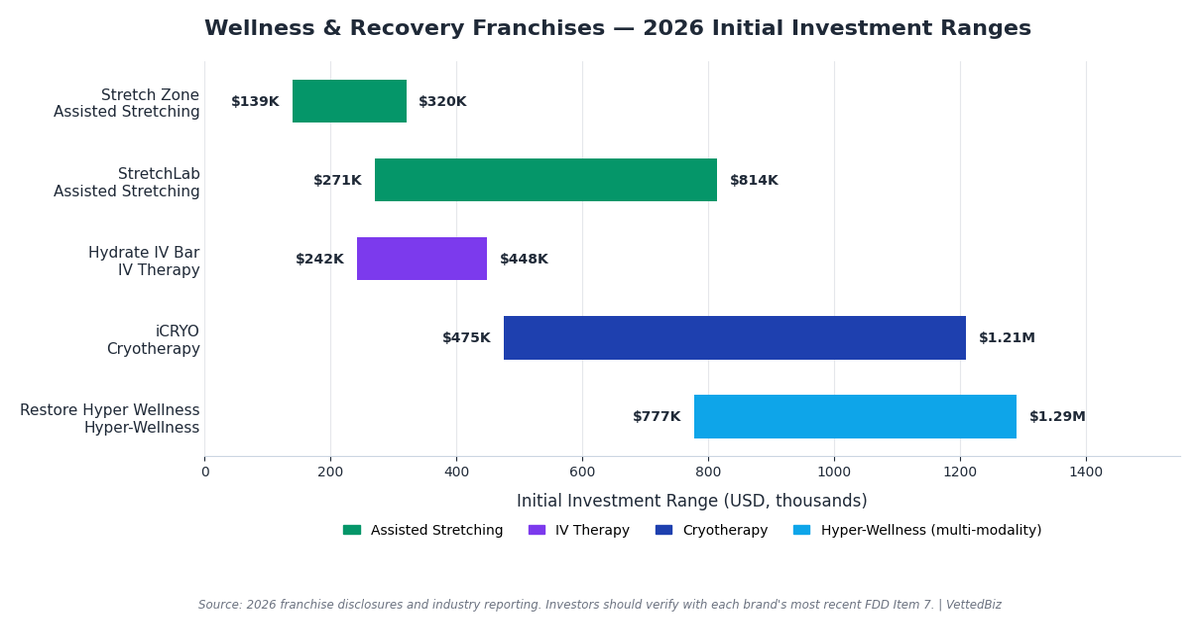
Representative initial investment ranges for leading wellness and recovery franchise brands, 2026.
The Numbers Behind the Category
To put the category in context against total franchise industry activity:
- $921.4 billion, projected 2026 U.S. franchise economic output (IFA 2026 Franchising Economic Outlook)
- ~15,000, new franchise establishments expected in 2026
- $60 billion, projected 2026 U.S. consumer spend on health, fitness, and exercise
- 41%+, share of wellness spend attributable to Millennials and Gen Z combined
- $9 trillion, projected size of the global wellness economy by 2028
- ~4.3%, 2025-to-2026 unit growth in the adjacent pet services category, another service-based bright spot
Together these numbers describe a category with structural demand, real capital formation, and franchisor infrastructure mature enough to support first-time investors.
Marketing, Memberships, and the Real First-Year P&L
One number gets underweighted in almost every first-time wellness-franchise investment memo: member acquisition cost. Because most wellness and recovery concepts run on a monthly membership model, the entire first-year P&L pivots on how quickly the studio can build an active, retained membership base, typically in the range of 250 to 800 members depending on concept and market.
That means paid social, local partnerships, and in-market activation budgets are not optional line items. Well-run wellness studios often allocate 8–12% of gross revenue to marketing during the ramp period, dropping to a steady-state 4–6% once the membership base matures. Investors evaluating an FDD should specifically ask franchisees how many months it took to hit membership breakeven and what their cost per acquired member looked like across the first three quarters.
The corollary is that churn matters as much as new sign-ups. A 5-percentage-point difference in monthly member retention compounds into materially different unit economics over a 24-month window. Franchisors with strong CRM tooling, structured retention playbooks, and a track record of member NPS above 60 tend to outperform on this dimension.
Regulatory and Insurance Considerations
Wellness and recovery concepts sit on a regulatory spectrum. Non-medical modalities, assisted stretching, infrared sauna, compression therapy, generally face lighter regulation and can be operated with standard commercial insurance and trained (non-medical) staff.
Medical or medical-adjacent modalities, IV therapy, injectables, hyperbaric oxygen, trigger materially different requirements. State medical boards, corporate practice of medicine (CPOM) doctrines, medical director agreements, and nurse or paramedic staffing standards all become live diligence items. Insurance premiums for IV-based concepts can be 2–4x higher than for non-medical recovery studios.
Cryotherapy occupies a middle ground: not regulated as a medical device at the federal level in most cases, but subject to state and local operational rules, liability waivers, and specific insurance riders. Investors should confirm with a local franchise attorney before signing and should not rely on the franchisor's national counsel alone.
Who Should (and Should Not) Consider a Recovery Franchise
Wellness and recovery franchises fit best for investors who meet several criteria.
Good fit if you have: liquid capital in the $150K–$500K range for a single unit (multi-unit deals push this higher), interest in operating in a service business with recurring memberships, a market with dense, higher-income households, and either operating experience or willingness to hire a strong general manager. Investors who already run wellness-adjacent businesses (medspa, fitness studio, physical therapy clinic) often find the sales cycle familiar.
Less good fit if: you want a semi-absentee operation from day one (most concepts require hands-on ownership through year one), you are underweight on marketing budget (member acquisition costs are real and drive first-year P&L), or your target market has limited household density above the income thresholds these concepts typically require.
Questions to Ask Before Signing an FDD
For any wellness or recovery franchise on your shortlist, focus your due diligence on the following:
- Item 7 total investment ranges and whether they include working capital assumptions.
- Item 19 financial performance representations, median vs. average, and how many units are represented.
- Item 20 franchisee counts and turnover: opens, closes, transfers, and non-renewals over the last three years.
- Medical staffing and state regulatory requirements (particularly for IV and any medical-adjacent modalities).
- Real estate and build-out benchmarks in your specific target market.
- Marketing fund contribution rates and how those dollars are deployed nationally vs. locally.
Finally, use Item 20 to identify 10+ current franchisees, ideally from studios that opened in the last 24 months, and validate the numbers directly. No franchisor pitch replaces a candid conversation with someone operating the model in a comparable market.
Conclusion: Recovery Is a Category, Not a Trend
The wellness and recovery franchise category has crossed the line from emerging to established. Assisted-stretching studios like StretchLab and Stretch Zone have hundreds of open units. Hyper-wellness brands like Restore have proven the multi-modality model. Cryotherapy and IV therapy have franchisors with the operational depth to scale. And behind all of it sits a $9 trillion global wellness economy with structurally growing consumer demand.
For franchise investors, the question in 2026 is no longer whether wellness and recovery is a real category, it is which sub-vertical and which brand fits your capital, your market, and your operating style. As always, the FDD tells the truth: read Item 19 carefully, validate with existing franchisees, and let the numbers, not the marketing, drive the decision.
Ready to compare specific wellness and recovery brands side-by-side? Explore VettedBiz's franchise data to pull FDD-level detail, unit counts, and financial performance representations before your next investment call.
Get insider access to franchise insights
Subscribe to receive expert tips, franchise rankings, and exclusive data straight to your inbox, trusted by thousands of aspiring business owners and investors.
Franchise resources & insights
Explore expert guides, data-driven articles, and tools to help you make smarter franchise decisions, whether you're just starting out or ready to invest.