Pickleball Franchises in 2026: Inside the $3 Billion Indoor Court Boom
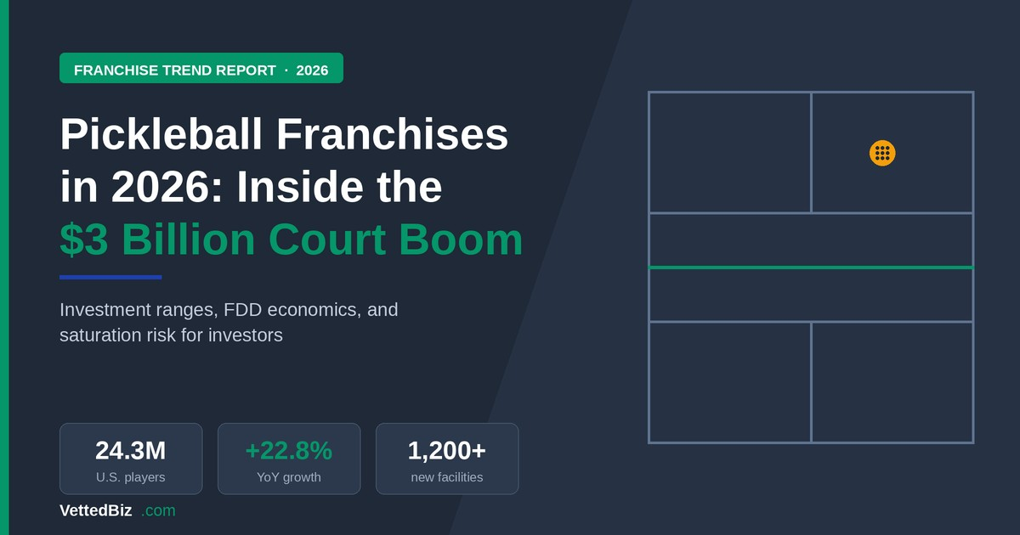
Pickleball is America’s fastest-growing sport for a fifth straight year, and now one of its fastest-growing franchise categories.
America's fastest-growing sport has become one of its fastest-growing franchise categories, and the capital requirements are nothing like a typical service brand. A single indoor pickleball club can cost more than a million dollars to open, yet franchisees are signing multi-unit development deals at a pace the category has never seen.
That combination, explosive demand, heavy build-out costs, and a very short operating history, makes the pickleball franchise sector one of the most interesting and most misunderstood opportunities of 2026. Some brands are reporting average unit volumes above $1.3 million. Others are still proving whether a membership base can carry a 30,000-square-foot lease.
This guide breaks down what a pickleball franchise actually costs, how the two dominant business models differ, which brands are scaling right now, and the specific risks investors should press on before signing a development agreement.
Why Pickleball Became a Franchise Category
Participation growth is the engine behind the entire sector.
According to the Sports & Fitness Industry Association's 2026 Pickleball Single Sport Report, pickleball participation reached 24.3 million Americans in 2025, a 22.8% year-over-year increase and a fifth consecutive year as the country's fastest-growing sport. The player base has expanded more than fivefold since 2020, when SFIA counted roughly 4.2 million participants.
Two details in that data matter more to franchise investors than the headline number:
Core players are growing faster than casual ones. SFIA splits the total into approximately 16.8 million casual players (one to seven sessions per year) and 7.48 million core players (eight or more sessions per year). The core group grew 20.4% year over year. Core players are the ones who buy memberships, book courts at 6:00 a.m., and generate recurring revenue.
The demographic has broadened. Teens and young adults aged 13 to 24 now post the highest participation rates of any age segment, and women represented 42.9% of players in 2025, up from 38.6% in 2020. A category that started as a retiree activity now has the age mix a membership business needs.
That demand has pulled real estate and capital into the space quickly. Industry estimates put more than 1,200 new indoor pickleball facilities opened across the U.S. in roughly the past two years, with the combined market, counting operating revenue plus capital investment, pushing past $3 billion.
Pro Tip: Participation growth is not the same as facility demand in your specific market. Ask any franchisor for the play-hours-per-court assumptions behind their pro forma, then compare that to the number of competing courts already open or permitted within a 20-minute drive.
The Two Business Models: Courts vs. Eatertainment
Pickleball franchises fall into two structurally different models, and conflating them is the most common mistake investors make.
The Membership Club Model
This is the dominant franchised format. Revenue comes primarily from monthly memberships, court reservations, leagues, clinics, and pro-shop retail. Facilities typically run 20,000 to 40,000 square feet with 8 to 14 indoor courts, minimal kitchen infrastructure, and a lean staffing model.
The economics resemble a boutique fitness club more than a restaurant: high fixed occupancy cost, low variable cost per member, and profitability that hinges almost entirely on membership density and off-peak court utilization.
Brands operating this model include The Picklr, Ace Pickleball Club, and Pickleball Kingdom.
The Eatertainment Model
The second format bolts a full restaurant and bar onto the court footprint. Guests come for a social outing, not a workout. Revenue skews toward food and beverage, events, and corporate bookings, with court time functioning as the draw rather than the product.
Industry reporting suggests average unit volume for the entertainment model runs roughly three to four times that of the court-focused model, but so does the complexity. You are underwriting a full-service restaurant with a sports facility attached, including kitchen labor, liquor licensing, and food cost management.
Chicken N Pickle is the most visible operator here, running 13 locations as of late 2025 with additional units in Texas, Indiana, Nebraska, and Colorado, and backing from NFL athletes Patrick Mahomes and Travis Kelce. The brand has grown primarily through corporate locations with franchising signaled as a next step. Crush Yard, out of Charleston, South Carolina, is preparing a national franchise rollout of a similar dining-plus-courts concept.
For a first-time franchisee without restaurant operating experience, the eatertainment model is materially harder to execute.
Pickleball Franchise Costs: What the FDDs Show
Here is where pickleball diverges sharply from most emerging franchise categories. This is not a $150,000 home-services investment.
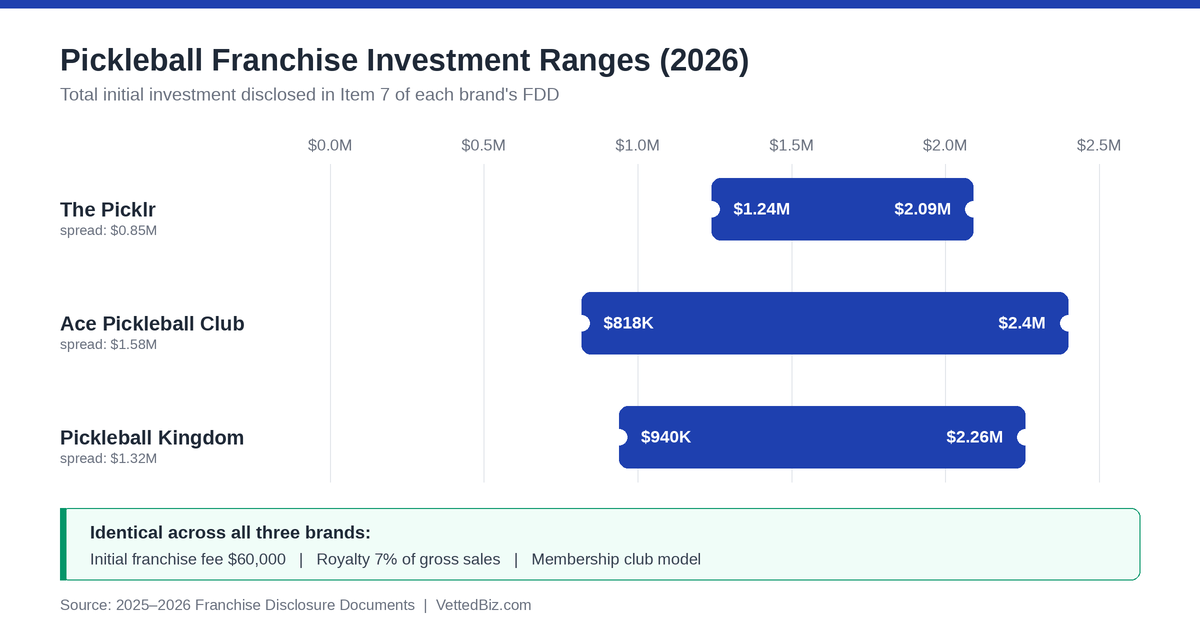
Total investment for a single indoor pickleball club ranges from roughly $818,000 to $2.4 million, with a $60,000 franchise fee common across the three leading membership-club brands.
What Drives the Range
The spread between low-end and high-end investment is enormous, Ace Pickleball Club's published range spans nearly $1.6 million. The variables:
- Landlord contribution. A tenant-improvement allowance can shift several hundred thousand dollars of build-out cost off the franchisee's balance sheet. Deals with generous TI packages sit at the low end of the range; second-generation space with no allowance sits at the high end.
- Court surfacing and ceiling height. Indoor pickleball requires a minimum clear height and specialized flooring. Retrofitting a warehouse with inadequate clearance is expensive or impossible.
- Market rent. A 30,000-square-foot lease priced at $12 per square foot versus $28 per square foot changes the entire model.
- Court count. More courts raise both build cost and revenue ceiling.
The Multi-Unit Structure
The Picklr's FDD discloses that a three-unit Multi-Unit Development Agreement carries a total investment of $1,312,900 to $2,164,300 to begin operation of the first unit, a structure that commits the franchisee to a development schedule well before the first location has proven itself.
Multi-unit commitments are standard across the category. Ace Pickleball Club has reportedly signed 24 franchisees for 86 locations, an average of more than three units per franchisee. Several of those franchisees came from established systems including Hand & Stone, Orangetheory Fitness, and Papa Johns, experienced multi-unit operators, not first-time owners.
That is a meaningful signal about who this category is actually built for.
Growth Trajectories: Who Is Scaling
The Picklr has expanded from 2 units to 24 units in roughly 2 years. That is aggressive growth by any standard.
The pace itself is the risk. Rapid buildouts in any growing category tend to outrun demand in specific markets before they outrun it nationally. Industry analysts are already watching for overbuilt metros where multiple large facilities compete for the same membership base, a dynamic that squeezes weaker operators even while national participation keeps climbing.
Pro Tip: Before signing, pull the SBA Franchise Directory listing for any brand you are considering. Following the June 30, 2026 recertification deadline, some brands were removed, and an active directory listing is required for SBA 7(a) eligibility. For a $1M+ investment, financing eligibility is not a detail.
Financing a Pickleball Franchise
At $800,000 to $2.4 million in total investment, financing structure matters more than in almost any other emerging category.
SBA 7(a) loans remain the most common path, offering up to $5 million with longer amortization than conventional debt. In 2026, variable rates on 7(a) loans above $350,000 have reached the high single digits to roughly 9.75%, with fixed rates higher.
Because much of a pickleball build-out is leasehold improvement rather than acquirable collateral, lenders scrutinize the lease term, the landlord's TI contribution, and the personal guarantee closely. Expect to demonstrate substantial liquidity beyond the equity injection.
Investors evaluating this category should also weigh the alternative: an existing, cash-flowing business at a comparable price point. A $1.2 million resale with three years of tax returns carries a very different risk profile than a $1.2 million ground-up build in a category with limited operating history.
Pros and Cons for Franchise Investors
Advantages
✅ Genuine demand tailwind. 22.8% annual participation growth is not a marketing claim; it is SFIA survey data.
✅ Recurring revenue. Membership models generate predictable monthly cash flow once density is achieved.
✅ Broadening demographics. Growth among ages 13–24 and among women extends the runway well beyond the original retiree base.
✅ Real estate leverage. Large-format industrial and second-generation retail space remains available in many markets at workable rents.
Challenges
❌ High capital requirement. Entry starts around $800,000 and commonly exceeds $1.5 million.
❌ Thin operating history. Most franchised brands have fewer than five years of franchisee-level performance data. Item 19 disclosures are limited and not uniformly comparable.
❌ Saturation risk. More than 1,200 facilities opened in two years. Some metros are already crowded.
❌ Long ramp to breakeven. Membership businesses build slowly; working capital assumptions in the pro forma deserve stress-testing.
❌ Fad exposure. Participation growth is real, but no one can yet demonstrate what a mature, saturated pickleball market looks like at the unit level.
Who This Category Is Right For
Pickleball franchising suits a specific investor profile: someone with $300,000 to $500,000 in liquid capital, prior multi-unit or real estate experience, and the appetite to operate a facility business rather than a passive investment.
It is a poor fit for first-time franchisees seeking a lower-risk entry into ownership, for investors who need cash flow within the first 12 months, or for anyone underwriting the opportunity on national participation statistics rather than a market-level court-supply analysis.
If the capital requirement is out of range, adjacent categories with similar demographic tailwinds, health and wellness, recovery studios, and youth sports programs, offer comparable exposure at a fraction of the entry cost.
Conclusion
Pickleball has cleared the bar that separates a trend from a franchise category: sustained double-digit participation growth, a broadening demographic, and multiple brands with real unit counts and disclosed FDD economics. The Picklr's climb from 7 to 59 units and Ace's 86 signed locations are not speculative, those are committed franchisees.
But this is a capital-intensive, real-estate-dependent business in a category young enough that no one has yet operated through a downturn or a saturated market. The brands are growing faster than the performance data.
If you are evaluating a pickleball franchise, the work is local, not national: count the courts already open and permitted in your trade area, validate the membership assumptions against real operators, and confirm SBA directory eligibility before you underwrite the financing.
Next step: Review current FDD data, investment ranges, and unit-level disclosures for pickleball and other emerging franchise brands on VettedBiz before you request information from any franchisor.
Get insider access to franchise insights
Subscribe to receive expert tips, franchise rankings, and exclusive data straight to your inbox, trusted by thousands of aspiring business owners and investors.
Franchise resources & insights
Explore expert guides, data-driven articles, and tools to help you make smarter franchise decisions, whether you're just starting out or ready to invest.