Best Moving and Junk Removal Franchises to Own in 2026: A Complete Investment Guide
Americans are moving, downsizing, renovating, and decluttering at record rates, and they're increasingly willing to pay someone else to do the heavy lifting. The global junk removal franchise market alone is valued at approximately $2.65 billion in 2026 and is projected to reach $6.71 billion by 2035, growing at a 9.6% compound annual rate. Add the moving industry, where franchised operators like Two Men and a Truck generate over $2 million in average unit revenue, and you have one of the most compelling service franchise sectors available today.
What makes this sector particularly attractive is the combination of low-to-moderate startup costs, high recurring demand, and business models that don't require specialized real estate. Most moving and junk removal franchises operate from small warehouses or even home offices, keeping overhead lean while revenue scales with truck count and crew size. Digital booking now handles approximately 63% of customer scheduling, and AI-powered route optimization is cutting operational costs for early adopters.
In this guide, we compare the top franchises across junk removal, moving, and dumpster rental using real FDD data, investment ranges, average revenue, and what separates the leaders from the pack.
Why Moving and Junk Removal Franchises Are Booming
Structural Demand Drivers
Several converging forces are fueling growth in this sector. The aging Baby Boomer population is driving a wave of downsizing, estate cleanouts, and senior moves that generate both junk removal and moving revenue, often from the same customer. Simultaneously, millennials and Gen Z renters are moving more frequently than previous generations, creating steady demand for affordable moving services. Globally, more than 63% of residential households generate bulky waste at least twice per year, while 58% of small businesses outsource junk removal services entirely.
The Sustainability Premium
More than 58% of consumers in urban areas now prefer eco-friendly recycling and disposal services when hiring junk removal companies. Franchises that emphasize waste diversion, donating usable items, recycling materials, and minimizing landfill contributions are capturing a growing segment of environmentally conscious customers willing to pay a premium for responsible disposal. Brands like Junk King have built their entire value proposition around eco-friendly hauling, and it's paying off in customer acquisition.
Technology Is Reshaping Operations
Digital booking adoption has reached 63% across the industry, with mobile apps and online scheduling platforms handling the majority of customer interactions. Route optimization software, now used by 37% of operators, reduces fuel costs, minimizes drive time between jobs, and allows franchisees to complete more jobs per truck per day. AI-based logistics platforms are the next frontier, enabling real-time dispatching and dynamic pricing that pushes profitability higher while meeting customer expectations for instant booking and real-time ETAs.
Franchise Comparison
Top Junk Removal Franchises
1-800-GOT-JUNK?
1-800-GOT-JUNK? is the undisputed leader in junk removal franchising, operating approximately 250 U.S. locations under parent company O2E Brands. The brand's iconic blue-and-green trucks, centralized call center, and national marketing machine generate the highest average unit volume in the category, by a wide margin.
The numbers are striking: over $3 million in average revenue on an investment that maxes out around $313,000. That’s roughly a 10:1 revenue-to-investment ratio, among the best in all of franchising.
While operating costs such as labor, trucks, fuel, insurance, and disposal fees require careful management, 1-800-GOT-JUNK? continues to deliver extraordinary top-line revenue for operators who scale efficiently.
Junk King
Junk King operates under the Neighborly umbrella of 29+ home services brands, giving it access to cross-brand referrals and shared marketing infrastructure. The brand differentiates through its commitment to eco-friendly disposal, targeting the growing segment of environmentally conscious consumers.
Junk King's $758,000 in average sales on a maximum investment of $236,000 delivers a solid 3.2:1 revenue-to-investment ratio. The Neighborly ecosystem provides a significant advantage: a customer who calls Mr. Rooter for plumbing can be referred to Junk King for a renovation cleanout, and vice versa. For investors already operating Neighborly brands, adding Junk King creates immediate cross-selling synergies.
Pro Tip: When comparing junk removal franchises, don't focus solely on startup costs. Compare average revenue, investment requirements, and the brand's ability to generate repeat business through commercial accounts, property managers, and referral networks.
Top Moving Franchises
Two Men and a Truck
Two Men and a Truck is the largest franchised moving company in North America, with over 430 locations and more than 3,000 trucks on the road. The brand's 96% customer referral rate speaks to exceptional service quality and a repeat/referral-driven business model that keeps customer acquisition costs low.
Two Men and a Truck's $2.314 million in average revenue and estimated owner earnings of $330,000 to $425,000 make it one of the most financially attractive service franchises available. The investment range varies significantly by market type: a Mod Market (smaller metro areas) can be entered for as little as $107,100, while a full Metro Market may require up to $538,700.
The Dual-Revenue Model
College Hunks Hauling Junk & Moving
College Hunks has built the most compelling dual-revenue model in the industry by combining junk removal and moving services under one brand. A single call from a homeowner downsizing can generate both a moving job and a junk removal job on the same day, doubling the revenue per customer interaction.
College Hunks's average gross sales of $1.55 million per location, with top performers exceeding $3 million, demonstrate the power of the dual-revenue model. The brand's youthful positioning and community-focused marketing have built strong local brand loyalty in its markets. For investors who want diversified revenue streams within a single franchise, College Hunks offers an approach that pure junk removal or pure moving brands can't match.
Dumpster Rental: The Recurring Revenue Play
Bin There Dump That
Bin There Dump That occupies a different niche in the waste services space: residential-friendly dumpster rentals. Unlike traditional roll-off dumpsters that damage driveways and require commercial-grade access, Bin There Dump That uses smaller, driveway-safe bins designed specifically for residential renovations, cleanouts, and construction projects.
Bin There Dump That's lower entry point, starting at $116,000, makes it the most affordable franchise in this guide. The dumpster rental model generates recurring revenue through multi-day rentals rather than single-job transactions, creating more predictable cash flow. While the brand does not disclose Item 19 financial performance data in its FDD, the subscription-style revenue model and low overhead requirements make it an attractive option for investors seeking a capital-light entry into waste services.
Pro Tip: Subscription cleanouts now account for 22% of junk removal services nationwide. When evaluating any franchise in this space, ask how the brand is building recurring revenue streams through commercial contracts, property management partnerships, or scheduled residential services. One-time jobs are profitable, but recurring contracts build enterprise value.
How to Choose the Right Franchise in This Space
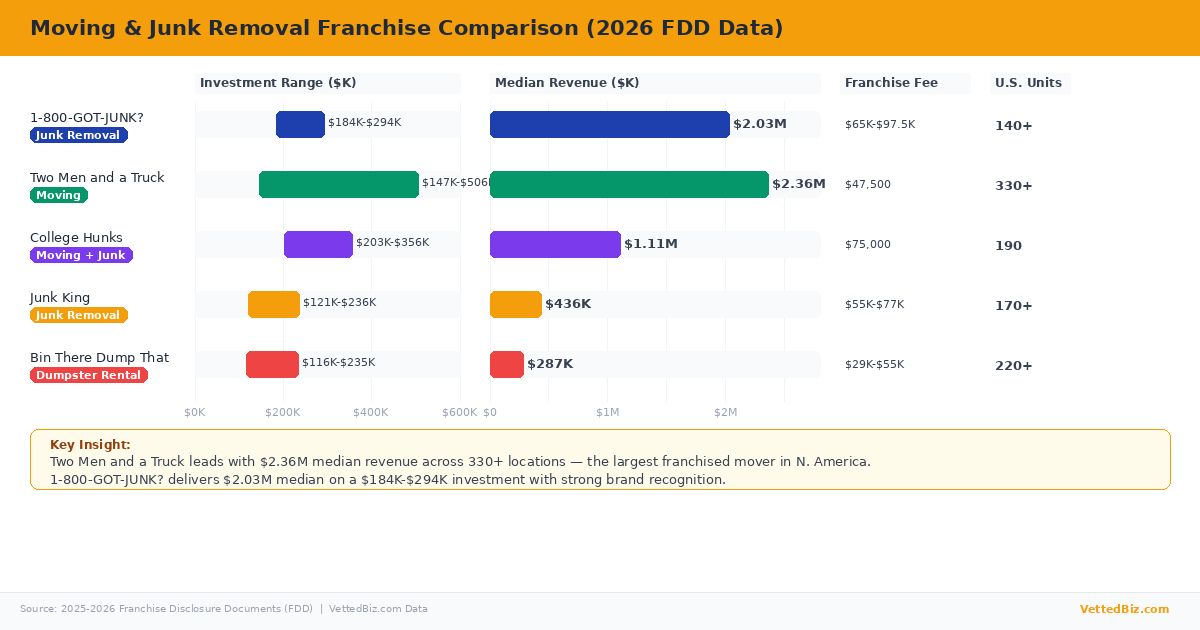
The moving and junk removal sector offers distinct business models, each with different capital requirements and operational demands. Junk removal franchises (1-800-GOT-JUNK?, Junk King) typically require lower startup capital and fewer trucks, but job revenue is smaller and volume-dependent. Moving franchises (Two Men and a Truck) generate higher per-job revenue but require more crew, larger trucks, and higher insurance costs. Dual-model operators (College Hunks) capture both revenue streams but face more complex operations.
Consider three factors: your available capital, your tolerance for operational complexity, and your local market dynamics. In markets with heavy renovation activity, junk removal and dumpster rentals thrive. In markets with high population turnover (college towns, military bases, growing suburbs), moving franchises see consistent demand. In markets with aging populations, the downsizing wave favors dual-model operators who can handle both the move and the cleanout.
Conclusion
Moving and junk removal franchises offer some of the most attractive unit economics in service-based franchising. 1-800-GOT-JUNK?'s $3.06-$3.29 million average revenue on a sub-$315,000 investment is hard to match in any franchise category. Two Men and a Truck delivers $2.314 million in average revenue with owner earnings exceeding $330,000. College Hunks's dual-model approach generates $1.55 million on average with $3 million-plus upside for top performers. And for investors seeking a lower entry point, Junk King and Bin There Dump That offer viable paths into the sector starting around $120,000.
The fundamentals are strong: demand is structural rather than cyclical, technology is reducing operating costs, and the market is growing at nearly 10% annually. As with any franchise investment, the FDD is your most important tool, review Item 19 carefully, talk to current franchisees, and match the business model to your capital, market, and operational style.
Get insider access to franchise insights
Subscribe to receive expert tips, franchise rankings, and exclusive data straight to your inbox, trusted by thousands of aspiring business owners and investors.
Franchise resources & insights
Explore expert guides, data-driven articles, and tools to help you make smarter franchise decisions, whether you're just starting out or ready to invest.