Pet Franchises in 2026: Why Investors Are Pouring Money Into a $261 Billion Industry
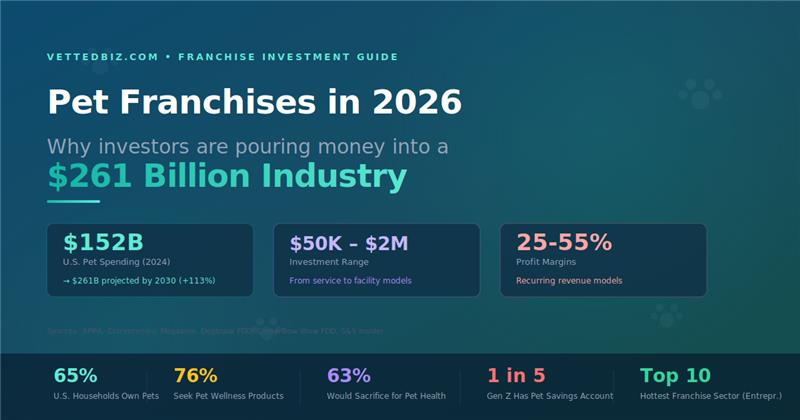
Americans spent an estimated $152 billion on their pets in 2024, and total industry spending is projected to reach $261 billion by 2030, a 113% increase from 2019 levels. It's no surprise that Entrepreneur magazine named "pets" one of the 10 hottest franchise sectors heading into 2026.
But this isn't just about puppy love. The pet care franchise category is being reshaped by powerful demographic shifts, evolving consumer expectations, and a business model built on recurring revenue. From dog daycare and boarding to training, today's pet franchises offer investors a rare combination: recession resistance, strong margins, and a consumer base that shows no signs of cutting back.
In this guide, we break down the forces driving the pet franchise boom, compare the top brands by investment and performance, and help you determine whether this category belongs in your franchise portfolio.
The Forces Behind the Pet Franchise Boom
Pet Humanization Is the Dominant Trend
The single most powerful force in pet spending is humanization, pet owners increasingly treat their animals as full family members. A 2024 study found that 63% of pet parents would give up years of their own life to make their pets live longer, and 76% actively seek out products that improve their pet's health and wellness.
This mindset directly translates into higher spending on premium services. Pet owners aren't just buying kibble, they're investing in daycare socialization programs, spa treatments, behavioral training, GPS-enabled health monitoring collars, and customized nutrition plans.
Millennials and Gen Z Are Driving Spending
Millennials currently make up the largest segment of pet owners in the United States, and Gen Z ownership is rising rapidly, including a higher likelihood of owning multiple pets. Pet owners between ages 18 and 34 spend more on their animals than any other age group. One in five Gen Z pet owners maintains a dedicated savings account specifically for their pet's needs.
Recurring Revenue Models Attract Investors
What makes pet franchises especially attractive from an investment perspective is the recurring revenue structure. Dog daycare customers typically book three to five days per week, creating highly predictable income streams. Boarding services add seasonal revenue during holidays and vacations. Training subscriptions generate consistent monthly income. This combination creates a financial profile that many franchise investors find more attractive than single-transaction business models.
Top Pet Franchise Categories and What They Cost
Dog Daycare and Boarding (Facility-Based)
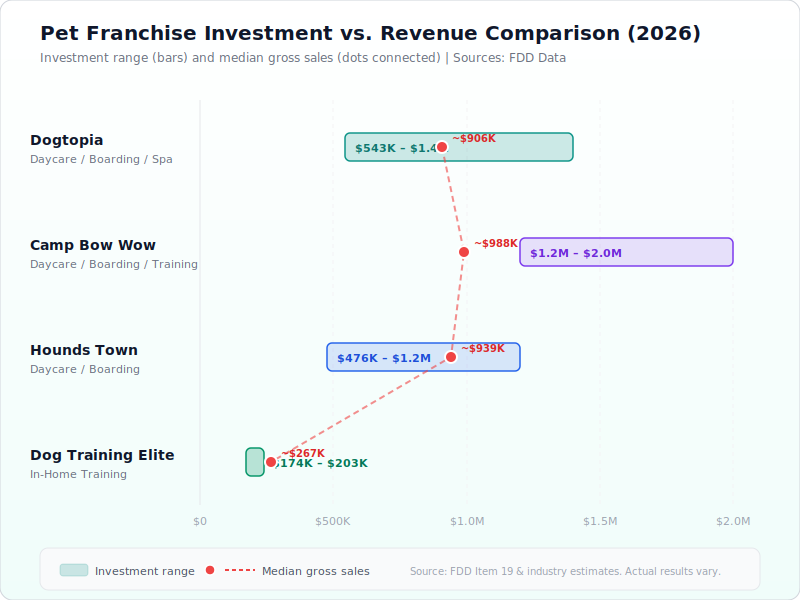
Dogtopia is the largest dog daycare franchise in North America, with facilities typically occupying 4,000 to 7,000 square feet. The total initial investment ranges from approximately $543,095 to $1,399,180, including a franchise fee of $40,095 to $49,500. Dogtopia locations report median yearly gross sales of approximately $905,798. Mature locations operating at 60% to 80% capacity can generate $1M to $1.5M in annual revenue.

Camp Bow Wow combines daycare with a strong boarding component, requiring a total initial investment of $1,216,577 to $2,037,471. According to its 2025 FDD, the median gross sales across all 197 reporting locations was $988,140 in 2024, with the top 25% generating a median of $1,381,072. The franchise fee is $50,000 and the royalty rate is 7%.

Hounds Town USA offers a more affordable facility-based option, with total investments ranging from approximately $476,000 to $1,280,000 and a median gross sales of $939,409 across their 75 franchised units, with a franchise fee of $49,000.

Service-Based Concepts
Dog Training Elite is one of the lowest-investment pet franchise options available, with investment ranges of just $174,000 to $203,000. The franchise generates $75,000 to $150,000 in annual revenue, and its latest median gross sales registered is around $267.000.

Comparison
Key Trends Shaping Pet Franchises in 2026
Technology and AI Integration
Leading brands now offer mobile app booking, real-time webcam feeds, AI-powered health monitoring, and automated communication systems. The pet wearable technology market is projected to grow from $4.16 billion in 2025 to $10.43 billion by 2032, with a 14% CAGR.
Wellness and Preventative Care
The pet wellness market is expanding beyond traditional grooming into holistic services like supplements, probiotics, dental care, and mental stimulation programs. The global pet fitness market alone was valued at $6.65 billion in 2024, growing at 6.7% annually.
Private Equity and Institutional Interest
Major investment firms have taken notice of the pet franchise sector. Institutional capital is fueling faster expansion, improved technology platforms, and stronger franchisee support systems.
How to Evaluate a Pet Franchise Investment
- Match the model to your capital and lifestyle. Service franchises suit hands-on entrepreneurs with limited capital who want fast returns. Facility franchises suit well-capitalized investors comfortable with longer ramp periods and team management.
- Review the FDD thoroughly. Focus on Item 7 (total investment), Item 19 (financial performance representations), and Item 20 (franchisee directory). Not all franchisors disclose Item 19 data, those that do are demonstrating greater transparency.
- Interview at least 10 current franchisees. Ask about actual startup costs versus FDD projections, time to profitability, quality of franchisor support, and whether they would invest again.
- Evaluate your local market. Confirm at least 100,000 population within your territory with favorable demographics, high pet ownership rates, dual-income households, and limited existing competition.
- Budget for the full ramp period. Facility-based franchises typically need 12 to 18 months of working capital beyond the initial investment. Service-based concepts need three to six months.
The Bottom Line
Pet franchises represent one of the most compelling investment categories in 2026. The industry is powered by deep, structural consumer trends, pet humanization, millennial and Gen Z spending patterns, and growing demand for professional pet services, that show no signs of reversing.
For investors with $50,000 to $80,000, service-based concepts like Dog Training Elite offer fast ROI and low risk. For those with $500,000 to $2 million, facility-based brands like Dogtopia and Camp Bow Wow deliver strong absolute profits with proven business models and recurring revenue.
The pet industry isn't a trend, it's a structural shift in how Americans spend their money. And the franchise models built to serve this demand are among the best-positioned in the entire franchise landscape.
Get insider access to franchise insights
Subscribe to receive expert tips, franchise rankings, and exclusive data straight to your inbox, trusted by thousands of aspiring business owners and investors.
Franchise resources & insights
Explore expert guides, data-driven articles, and tools to help you make smarter franchise decisions, whether you're just starting out or ready to invest.