Best Home Repair & Maintenance Franchises to Own in 2026: Plumbing, Electrical & HVAC Investment Guide
Homeowners can put off a kitchen remodel. They cannot put off a burst pipe, a dead HVAC system in July, or a electrical panel that won't stop tripping. That distinction is why home repair and maintenance franchises just had their moment in the spotlight: five brands built around plumbing, electrical, HVAC, and restoration services landed on Entrepreneur's 2026 Franchise 500, each one prized for the same reason, demand that shows up whether the economy is booming or bracing.
The U.S. home services and maintenance sector is on pace to generate $143.3 billion in 2026, according to International Franchise Association data, growing 3.2% year-over-year even as consumers pull back on discretionary spending elsewhere. For prospective franchisees, that combination of recession resilience and recurring demand is increasingly hard to find in other categories.
This guide breaks down what it actually costs to open a plumbing, electrical, or HVAC franchise in 2026, how much these businesses can realistically earn, and the industry shifts, from subscription pricing to AI-powered dispatch, reshaping how they compete.
Why Home Repair & Maintenance Franchises Are Having a Moment in 2026
Three forces are converging to make this one of the steadiest categories in franchising right now.
Aging housing stock. Only about 2% of U.S. homes were built after 2020, per IFA research, which means the vast majority of the housing supply is old enough to need plumbing, electrical, and HVAC work on a predictable replacement cycle. Combine that with elevated mortgage rates keeping owners from moving, and the incentive shifts firmly toward maintaining the home you already have rather than buying a new one.
The shift from DIY to "DIFM." A 2026 Housecall Pro survey of homeowners found that 96% plan to spend on home projects this year, and 79% expect at least one system repair or replacement. The willingness to outsource that work is climbing fast: 57% of homeowners said they'd hire a professional for a job costing $500 or more, and that number jumps to 75% at the $1,000 mark. Dual-income millennial and Gen Z households, in particular, are driving the "do-it-for-me" trend, prioritizing time savings and licensed expertise over a weekend DIY project.
Emergencies don't wait for a good time. The same Housecall Pro data found that 72% of homeowners would pay a premium to get an emergency, a flooded basement, a dead AC unit, a electrical outage, resolved within 24 hours. That pricing power is a big part of why Entrepreneur's franchise editors described maintenance brands as generating "steady, year-round demand that is far less sensitive to economic swings than many consumer sectors."
The 2026 Franchise 500's Top Maintenance Brands
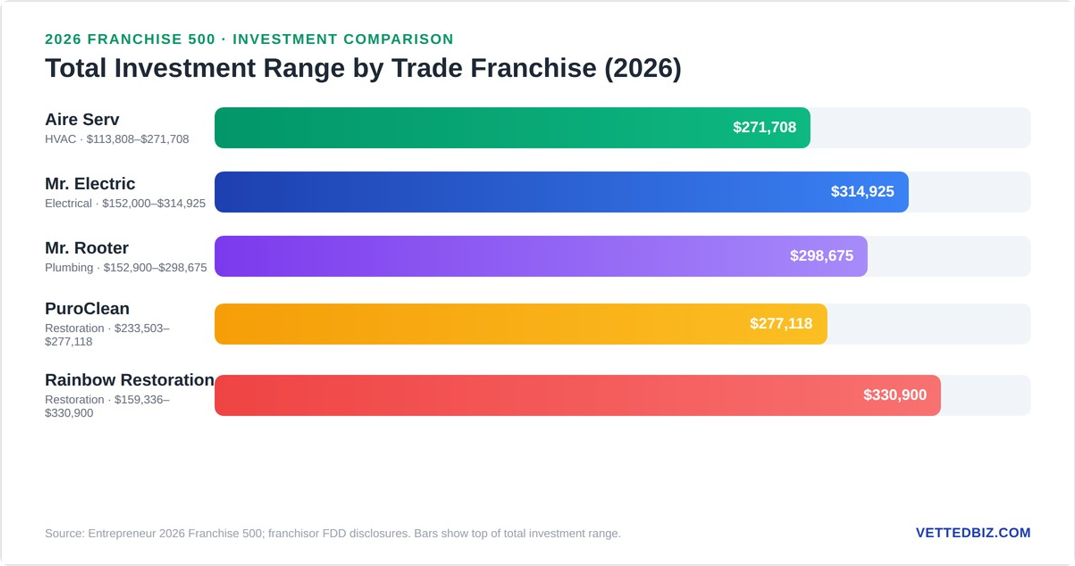
Five brands built around home repair and restoration cracked Entrepreneur's 2026 Franchise 500, each with a different specialty inside the broader maintenance category.
Restoration brands like PuroClean and Rainbow Restoration deserve a category of their own, VettedBiz covered water damage, fire cleanup, and mold remediation franchises in depth in a previous weekly guide on restoration and disaster recovery franchises. This article focuses on the three trade-based franchises that keep homes running day to day: plumbing, electrical, and HVAC.
Plumbing: Mr. Rooter
Mr. Rooter, part of the Neighborly family of brands, charges an initial franchise fee starting at $42,500 (plus $425 per 1,000 in additional territory population above the minimum), with total investment landing between $152,900 and $298,675 before real estate.
Ongoing fees include a 6% license fee on gross sales, a 2% marketing/advertising/promotion fee, and up to 3% for participation in local marketing groups, meaning franchisees should budget roughly 11% of revenue for brand and marketing costs combined.
Electrical: Mr. Electric
Mr. Electric, Mr. Rooter's sister brand under Neighborly, posted the fastest unit growth of the five, up 24.6% over three years, with a total investment range of $152,000 to $314,925. Like other Neighborly concepts, it follows a similar royalty structure built around a percentage of gross sales plus a separate brand fund contribution.
HVAC: Aire Serv
Aire Serv, the most accessible entry point of the three at $113,808 to $271,708 in total investment, charges a $45,000 franchise fee and a 7% royalty on gross revenue. It was also the only one of the five to see a slight unit decline (-1%) over three years, a reminder that even in a hot category, individual brand performance and territory saturation still matter more than category-level tailwinds.
What Revenue Actually Looks Like
Franchise fees and investment ranges only tell half the story, Item 19 performance data shows just how wide the earnings gap can be within a single brand. Mr. Rooter's most recent disclosure, covering 193 reporting units, shows an average of $2.09 million in gross sales across the system. But the top 10% of franchises averaged $8.16 million, while the bottom 10% averaged roughly $148,000, a more than 55x spread between the highest and lowest performers.
That gap is a function of territory size, local competition, tenure, and, critically, how well an owner manages a technician workforce rather than personally turning wrenches. Home repair and maintenance franchises reward operators who can hire, train, and retain skilled tradespeople, not just those who are skilled tradespeople themselves.
💡 Pro Tip: Item 19 of the FDD shows performance ranges, not guarantees. Ask the franchisor for a list of Item 20 franchisee contacts in your target territory and ask specifically about first-year and third-year revenue, not just system-wide averages.
The Subscription & Recurring Revenue Shift
One of the more significant structural changes in home services right now is the move toward subscription-style pricing. IFA's 2026 industry outlook notes that franchisors in cleaning, landscaping, and pest control are increasingly rolling out membership or maintenance-plan offerings, a fixed monthly or annual fee for recurring service, specifically to smooth out revenue and improve customer retention. Expect this model to keep expanding into plumbing and HVAC, where annual system tune-ups and priorityscheduling memberships are already becoming standard offerings rather than upsells.
For franchisees, recurring revenue reduces the seasonal swings that have historically made HVAC in particular a feast-or-famine business, concentrated around summer cooling and winter heating emergencies.
Technology Is Becoming a Competitive Moat
Franchisors are also leaning harder into technology as a differentiator against independent, unbranded competitors. AI-assisted dispatch, IoT-connected HVAC and plumbing systems that flag failures before they happen, and app-based scheduling and customer communication platforms are increasingly bundled into the franchise system rather than left to individual owners to build.
IFA data suggests this is becoming one of the clearest advantages franchised operators hold over independent contractors, who typically lack the scale to invest in comparable software. It's also part of why new franchise concept launches in home services rose sharply in 2025, with more than 11% of that year's new franchise brands entering the category.
Pros and Cons of Investing in a Home Repair & Maintenance Franchise
Advantages
✅ Recession-resistant, non-discretionary demand tied to home repair needs, not consumer sentiment
✅ Strong recurring and emergency-service pricing power
✅ Established brands (Neighborly's Mr. Rooter, Mr. Electric, and Aire Serv) offer shared marketing, national account relationships, and cross-brand referrals
✅ Multiple entry points, from roughly $114,000 (Aire Serv) to $330,000+ (Rainbow Restoration)
✅ Growing subscription/membership revenue reduces seasonality
Challenges
❌ Heavy reliance on hiring and retaining licensed, skilled tradespeople in a tight labor market
❌ Wide performance variance between top and bottom-performing territories
❌ Some trades (electrical, plumbing, HVAC) carry state licensing requirements that vary by market and can slow expansion
❌ Emergency-driven, technician-heavy operations require strong scheduling and dispatch systems from day one
❌ Flat-to-declining unit counts at some brands (Aire Serv, Rainbow Restoration) signal territory saturation in certain markets
How to Choose the Right Home Services Franchise for You
- Match the trade to your background, or your hiring plan. Electrical and plumbing franchises typically require a licensed tradesperson on staff, even if the owner isn't the one holding the license. Confirm your state's specific requirements before signing.
- Compare Item 19 data across brands, not just headline averages. A brand with a lower system-wide average but a tighter performance range may be a safer bet than one with a higher average and enormous variance.
- Ask about territory availability and saturation. Brands with flat or declining unit counts, like Aire Serv, may still be excellent businesses, but confirm whether that reflects market saturation in your target area specifically.
- Look for veteran and military incentives. Home services trades are a popular landing spot for veterans transitioning to business ownership, and several IFA VetFran member brands, including some in this category, offer franchise fee discounts for qualifying veterans.
- Model your ongoing fee load, not just the entry price. Combined royalty, marketing, and local co-op fees can run 8–11% of gross revenue across these brands, factor that into any earnings projection before comparing brands side by side.
Financing and Veteran Incentives
Total investment figures above are before financing, and most home repair franchise owners aren't paying cash. SBA 7(a) loans remain the most common financing route for this category, since brands like Mr. Rooter, Mr. Electric, and Aire Serv are already SBA-registered franchise systems, which speeds up the lender approval process compared with newer or unregistered concepts.
Veterans make up an outsized share of new owners in the trades. The International Franchise Association's VetFran program, which counts several home services brands among its members, connects transitioning military members with franchisors offering reduced franchise fees, typically in the 10–20% range, for qualifying veterans. Given how often plumbing, electrical, and HVAC work overlaps with skills learned in military trade roles, it's worth asking any franchisor directly whether a VetFran discount applies before finalizing your investment numbers.
Liquid capital requirements also vary meaningfully by brand. Expect most Neighborly-affiliated concepts to require somewhere between $75,000 and $100,000 in liquid capital on top of a net worth minimum, though exact figures should always be confirmed in Item 7 of the current FDD rather than assumed from prior-year data.
Frequently Asked Questions
Do I need to be a licensed plumber or electrician to own one of these franchises?
Not necessarily. Most brands are built around an owner-operator or executive-owner model where the franchisee manages the business and hires licensed technicians. However, state licensing rules vary, and some states require the business itself, not just individual employees, to hold a trade license, which can affect your setup timeline.
Which of these franchises has the lowest barrier to entry?
Among the five 2026 Franchise 500 maintenance brands, Aire Serv has the lowest total investment ceiling at $271,708, with a floor around $113,808, making HVAC the most accessible of the three core trades covered here.
Is now a good time to buy into this category, or has it peaked?
Unit growth is uneven across brands, Mr. Electric grew 24.6% over three years while Aire Serv slipped slightly, which suggests the category overall is expanding, but success increasingly depends on territory selection rather than riding a rising tide. Due diligence on local market saturation matters more than ever.
Conclusion
Home repair and maintenance franchises occupy a rare spot in 2026: a category growing steadily, insulated from discretionary-spending pullbacks, and still fragmented enough that branded, tech-enabled operators can take share from unbranded local competitors.
Plumbing, electrical, and HVAC brands each offer a different entry price and risk profile, but all three benefit from the same underlying trend, an aging housing stock and a homeowner base that increasingly wants the work done by a professional, not a weekend project.
As with any franchise investment, the brand name and category tailwinds matter less than the specific territory, fee structure, and support system you're buying into. Review the FDD closely, talk to current franchisees in your target market, and use Item 19 data to set realistic expectations before you invest.
Get insider access to franchise insights
Subscribe to receive expert tips, franchise rankings, and exclusive data straight to your inbox, trusted by thousands of aspiring business owners and investors.
Franchise resources & insights
Explore expert guides, data-driven articles, and tools to help you make smarter franchise decisions, whether you're just starting out or ready to invest.