Best Education and Tutoring Franchises to Own in 2026: A Data-Driven Investment Guide
The education franchise sector is experiencing a surge that few industries can match. With the global after-school program market estimated at $34.46 billion in 2026 and projected to reach $62.38 billion by 2033, investors are paying close attention to the learning centers, STEM academies, and tutoring brands reshaping how families approach supplemental education.
What makes this moment particularly compelling is the convergence of several forces: post-pandemic learning gaps that persist years later, a parental shift toward specialized enrichment over generic homework help, and the explosion of STEM and AI-related curricula. For franchise investors seeking recession-resistant models with recurring revenue, education and tutoring franchises offer a rare combination of social impact and financial upside.
In this guide, we break down the top education and tutoring franchise opportunities in 2026, comparing investment requirements, average revenues, royalty structures, and growth trajectories using the latest FDD data and industry research.
Why Education Franchises Are Booming in 2026
The U.S. education franchise market stands at an estimated $70–$80 billion, with more than 11,000 education center franchise units operating nationwide. Several macro trends are fueling this growth.
The Learning Gap Effect
Years after the pandemic disrupted classroom instruction, standardized test scores remain below pre-2020 levels in both math and reading. The National Assessment of Educational Progress (NAEP) has documented persistent declines, and parents are responding by investing in supplemental learning. This has created sustained demand for tutoring services that shows no sign of slowing.
STEM and Enrichment Demand
Parents are no longer satisfied with basic homework assistance. The demand for STEM learning, coding, robotics, AI exposure, and engineering programs, continues to grow rapidly in 2026. The U.S. Computing Education Franchise Market alone was valued at $2.5 billion in 2024 and is projected to reach $4.5 billion by 2033, exhibiting a CAGR of 6.5%. Franchises that offer specialized cognitive development, math enrichment, or technology-focused curricula are capturing a growing share of parental spending.
Recurring Revenue Model
Unlike many franchise categories that depend on one-time transactions, education franchises benefit from monthly enrollment fees and multi-semester commitments. This creates predictable, recurring revenue streams that improve cash flow stability and business valuation. A single enrolled student may generate $200–$400 per month over 12–24 months, making retention the primary driver of profitability.
Top Education and Tutoring Franchises: Investment Comparison
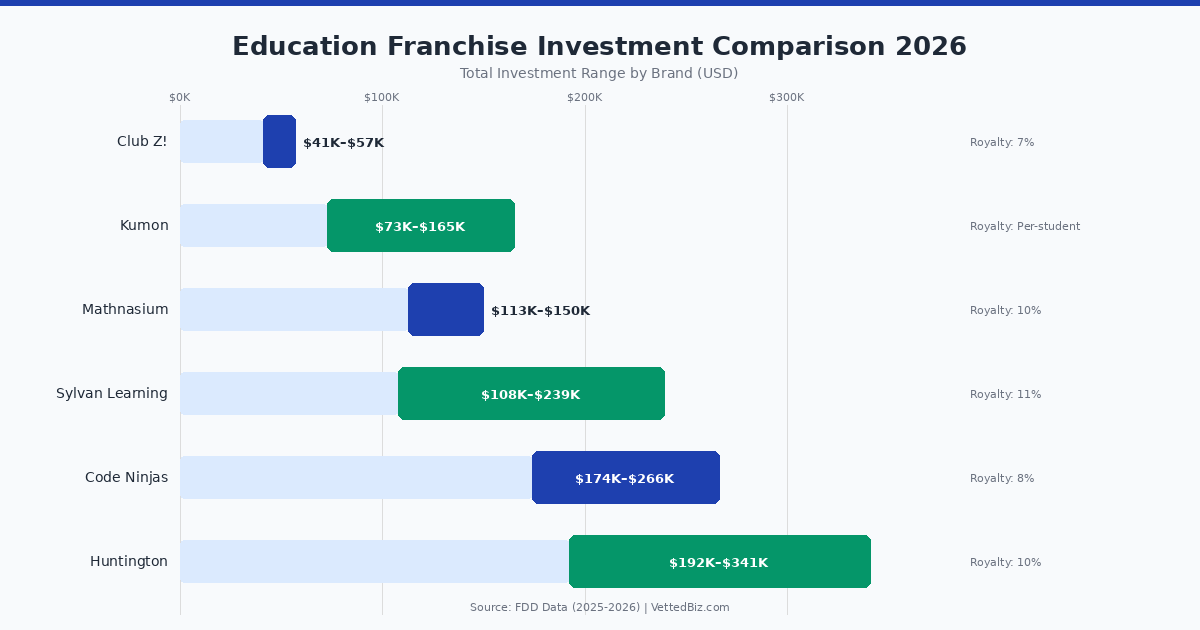
Understanding the full cost picture is essential before committing to any franchise. Below is a side-by-side comparison of the leading brands based on their most recent Franchise Disclosure Documents.
Franchise Deep-Dives: What Sets Each Brand Apart
Mathnasium: The Math Specialist With Scale
Mathnasium has built the largest math-focused tutoring network in the United States with over 900 locations. The franchise uses a proprietary teaching method called the Mathnasium Method, which assesses each student's skill level and creates a customized learning plan.
Investment highlights: The total investment ranges from $113,000 to $150,000, with a franchise fee of $49,000. Mathnasium charges a 10% royalty on gross sales advertising fund contribution, bringing the total ongoing fee burden to 12% of revenue.
Financial performance: The median Average Unit Volume across the system is $294,000, based on FDD Item 19 data. Typical owner earnings are approximately $44,000 per year, though top-performing centers significantly exceed this figure.
Best for: Investors who want a specialized niche with strong brand recognition and a proven curriculum. Prior teaching experience is not required.
Kumon: The Global Giant With the Lowest Entry Point
Kumon is the world's largest after-school education program, operating in over 60 countries. Its self-learning methodology emphasizes daily worksheet practice in math and reading, building discipline alongside academic skill.
Investment highlights: Kumon's initial franchise fee of just $1,000 is by far the lowest in the education franchise space. Total investment ranges from $73,000 to $165,000. Instead of a percentage-based royalty, Kumon charges a per-student monthly fee of $36–$42.75.
Financial performance: Kumon does not make a Financial Performance Representation in their FDD, which means prospective franchisees should conduct independent due diligence by speaking with existing franchise owners.
Best for: Investors seeking a globally recognized brand with a low barrier to entry who are comfortable with a hands-on, instructor-led model.
Sylvan Learning: The Full-Service Tutoring Institution
Sylvan Learning Centers have been a household name in tutoring for over four decades, offering comprehensive tutoring across subjects including reading, math, writing, study skills, and test preparation.
Investment highlights: Total investment ranges from $108,000 to $239,000, with a franchise fee of $37,000. The royalty is 11% of gross sales generated from core services.
Financial performance: Sylvan reports an average gross revenue of $341,000, which falls below the sub-sector average of $624,329 but reflects a mature, stable system with consistent enrollment.
Best for: Investors who want a diversified subject offering under a well-established brand with four decades of market presence.
Club Z! In-Home Tutoring: The Low-Cost Home-Based Model
Club Z! operates a home-based tutoring model that sends tutors directly to students' homes, offering the lowest total investment in the education franchise space at $41,000 to $57,000.
Investment highlights: With no physical learning center required, Club Z! eliminates the overhead of commercial rent, build-out, and facility maintenance. The franchise fee is at $27,000 to $40,000 with an 8% royalty.
Best for: First-time franchise owners seeking a low-overhead, home-based business model with flexible scheduling and minimal staffing requirements.
Huntington Learning Centers: The Premium Full-Service Option
Huntington Learning Centers has been operating since 1977, offering subject tutoring, test preparation for SAT, ACT, and state exams, and programs for students with learning differences.
Investment highlights: Total investment ranges from $192,000 to $341,000. The franchise fee is $42,000 with an 10% royalty on gross sales.
Best for: Investors who want a premium positioning serving both the remedial and test-prep segments, broadening the addressable customer base significantly.
Code Ninjas: Riding the STEM Wave
Code Ninjas teaches children ages 7–14 to code through game-based learning. With over 200 locations, it is one of the fastest-growing STEM education franchises in North America.
Investment highlights: Total investment ranges from $174,000 to $266,000, reflecting the need for a dedicated learning center with technology infrastructure. The franchise fee is $45,000 with an 8% royalty.
Best for: Investors who want to capitalize on the booming STEM education market and are comfortable with a higher initial investment for a technology-focused concept.
How Education Franchises Compare to Other Franchise Categories
Education franchises generally require lower initial investments than restaurant concepts, a single McDonald's location can cost over $1 million, while most tutoring franchises fall in the $75,000–$250,000 range. Operating costs are also typically lower, with no inventory of perishable goods, simpler equipment needs, and smaller physical footprints.
On the revenue side, education franchises tend to produce more modest top-line numbers than QSR or fast-casual concepts, but the margins can be attractive. A well-run tutoring center with strong enrollment can achieve 15–25% net margins once established. The recurring revenue structure also provides more predictable cash flow compared to transaction-based businesses.
The trade-off is that education franchises often take longer to ramp up. Building enrollment is a gradual process that depends on word-of-mouth referrals, school partnerships, and community reputation. Most franchisors estimate 12–18 months to reach breakeven, compared to 6–12 months for some food concepts with built-in foot traffic.
Key Factors to Evaluate Before Investing
Territory Availability and Market Saturation
Education franchises are highly territory-dependent. Always request the franchise's territory map and analyze local demographics, including median household income, number of children ages 5–17, and the presence of competing tutoring services, before committing.
Staffing and Instructor Quality
Recruiting and retaining qualified instructors is one of the most underestimated challenges. Brands that offer robust instructor training programs, standardized teaching materials, and competitive compensation guidance tend to have lower turnover and higher student satisfaction.
Owner-Operator vs. Semi-Absentee Models
Some education franchises, like Kumon, typically require owner-operator involvement. Others, like Mathnasium or Sylvan, may offer semi-absentee models once the center is established and staffed.
Seasonality and Enrollment Cycles
Most tutoring franchises experience enrollment peaks in September–October and January–February, with potential dips of 15–30% during summer months. Ensure you have sufficient working capital to cover 3–4 months of operating expenses during your first year.
Industry Outlook: What the Data Says About 2027 and Beyond
The after-school program market is expected to expand at a CAGR of 10.4% through 2033, driven by continued demand for supplemental education, STEM programs, and cognitive development services. North America holds a dominant 35.9% share of the global market.
AI-enhanced tutoring platforms are being integrated into franchise curricula, allowing personalized learning at scale. Hybrid models combining in-person and online instruction are expanding addressable markets. And the growing emphasis on "enrichment over remediation" is creating premium pricing opportunities for specialized programs. The franchise industry as a whole projects the addition of over 20,000 new units and approximately 210,000 new jobs in 2026.
Pro Tip: Always review Item 19 (Financial Performance Representations) in the FDD carefully. Not all franchises disclose revenue data. Speak with at least 10 current franchisees listed in Item 20 to get unfiltered perspectives on earnings, support quality, and day-to-day operations.
Conclusion
Education and tutoring franchises represent one of the most compelling investment categories in 2026, combining recession-resistant demand, recurring revenue models, and meaningful social impact. Whether you are drawn to the low entry point of Kumon, the math-focused specialization of Mathnasium, the comprehensive offerings of Sylvan Learning, the STEM-forward approach of Code Ninjas, or the premium positioning of Huntington Learning Centers, the key is matching your investment capacity, operational style, and market opportunity to the right brand.
Start by requesting FDDs from your top three candidates, analyzing your local market demographics, and scheduling conversations with existing franchisees. The data supports the sector, now the question is which opportunity fits your goals.
Explore franchise opportunities on VettedBiz.com to compare brands, review FDD data, and connect with franchise advisors who can guide your investment journey.
Get insider access to franchise insights
Subscribe to receive expert tips, franchise rankings, and exclusive data straight to your inbox, trusted by thousands of aspiring business owners and investors.
Franchise resources & insights
Explore expert guides, data-driven articles, and tools to help you make smarter franchise decisions, whether you're just starting out or ready to invest.