Why Senior Care Franchises Are the Best Investment Opportunity in 2026
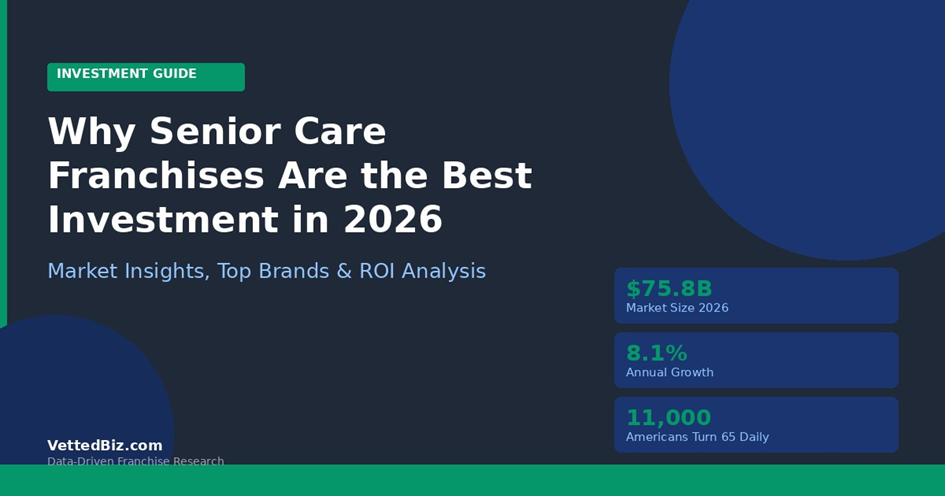
The search for a recession-resistant, high-demand franchise opportunity leads savvy investors to one sector that stands above the rest in 2026: senior care. With 11,000 Americans turning 65 every single day and the global senior care franchise market valued at $75.79 billion this year, the demographic tailwinds powering this industry are unlike anything the franchise world has seen before. Unlike trendy concepts that rise and fall with consumer preferences, senior care franchises are built on an irreversible demographic shift. The Baby Boomer generation, the largest in U.S. history, is aging into the prime service window, creating sustained demand that will only intensify through the next decade. By 2030, one in five Americans will be over age 65, and the market is projected to nearly double to $152.78 billion by 2035.
In this comprehensive guide, we break down why senior care franchises deserve a top spot on your investment shortlist, which brands offer the strongest unit economics, what it costs to get started, and how to evaluate whether this sector aligns with your goals as a franchise owner. Whether you are a first-time buyer exploring low-cost options or an experienced multi-unit operator looking to diversify your portfolio, the data paints a compelling picture.
The Demographic Opportunity: Numbers That Don’t Lie
The investment case for senior care franchises begins with demographics. According to the U.S. Census Bureau, approximately 11,000 Americans reach age 65 every day, a pace that will continue through at least 2030. This is not a short-term trend or a cyclical bounce; it is a structural transformation of the American population that has been building for decades and is now reaching its peak impact on the economy.
The International Franchise Association (IFA) published an Industry Spotlight on the Franchised Senior Care Industry in early 2026, confirming that the number of franchised locations across all senior care segments has grown at a compound annual growth rate (CAGR) of 5% to nearly 8,000 units by 2024. Average unit volumes (AUVs) for franchised senior care brands have climbed at a 4.6% CAGR, from approximately $1.1 million in 2020 to $1.3 million in 2024. These are not projections, they are realized results from existing franchise systems.
Business Research Insights projects the global senior care franchises market will grow from $75.79 billion in 2026 to $152.78 billion by 2035, reflecting an 8.1% CAGR. That kind of sustained, structural growth is exceedingly rare in franchising, and it is driven by factors no competitor can disrupt. People age regardless of economic conditions, consumer sentiment, or technological disruption.
Consider the contrast with other popular franchise categories. The fast-casual restaurant sector faces rising food costs, shifting dietary trends, and intense competition from delivery apps. Fitness franchises are grappling with the lasting impact of at-home workout technology. Senior care, by comparison, faces a demand curve that only points upward.
Why Senior Care Franchises Outperform Other Sectors
Recession Resistance
Senior care is classified as a necessity, not a discretionary purchase. When the economy contracts, families may cut dining out or cancel gym memberships, but they do not stop caring for aging parents. During the 2008–2009 recession and again during the COVID-19 pandemic, home care franchises demonstrated remarkable resilience compared to food service and retail concepts. This makes senior care an ideal hedge for investors concerned about economic cycles.
Recurring Revenue Models
Most senior care franchises operate on a recurring-revenue basis. Clients typically require ongoing weekly or daily assistance, generating predictable cash flows that make financial planning and scaling much easier. Unlike project-based businesses such as home renovation or event planning franchises, senior care builds a cumulative client base where each new customer adds to a growing revenue stream rather than representing a one-time transaction. This recurring nature also makes senior care franchises more attractive to lenders, as the predictable revenue supports stronger debt service coverage ratios.
Lower Startup Costs Than You Might Expect
Many aspiring franchise owners assume healthcare-adjacent businesses require enormous capital outlays. In reality, the majority of non-medical senior care franchises are home-based or office-based models with total investments ranging from $55,000 to $160,000, significantly less than a quick-service restaurant ($250K–$2M+) or a fitness center ($150K–$500K+). Because caregivers travel to the client’s home, there is no need for expensive retail real estate, heavy equipment, or large inventories. Your primary costs are labor, insurance, licensing, and marketing, all of which are manageable with proper planning.
Diversifying Service Lines
The senior care franchise model has evolved well beyond basic companionship. Today’s leading brands offer diversified services including home healthcare aide coordination, senior placement advisory, move management and downsizing, estate sales, medical transportation, technology installation for aging-in-place, and even specialized memory care programs. This diversification helps franchisees capture a larger share of each client’s spending and reduces dependency on any single revenue source.
Top Senior Care Franchises to Consider in 2026
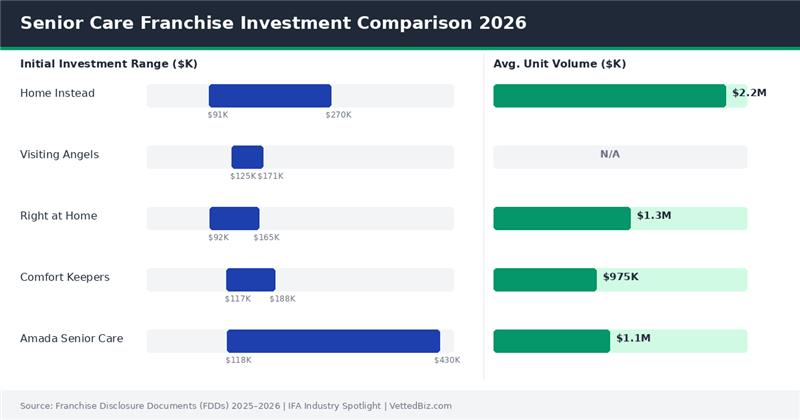
Below is a comparison of five leading senior care franchise brands based on publicly available FDD data and industry reports. Investment figures represent total estimated initial investment ranges; actual costs vary by territory and market. We encourage prospective investors to request the most current FDD directly from each franchisor.
What to Look for When Evaluating a Senior Care Franchise
Territory Protection and Market Density
Not all territories are created equal. A franchise with exclusive territory rights in a market with a high concentration of adults over 65 will have a fundamentally different growth trajectory than one in a younger, less dense area. Request demographic reports for your target territory and compare the 65-plus population density against the number of existing competitors. The best franchisors provide this analysis as part of their discovery process. States like Florida, Arizona, and Pennsylvania consistently rank among the highest in senior population concentration, making them prime markets for new franchise locations.
Training and Caregiver Recruitment Support
The biggest operational challenge in senior care is recruiting, training, and retaining qualified caregivers. Labor shortages in home care are well-documented, the Bureau of Labor Statistics projects that home health and personal care aide positions will grow 22% between 2022 and 2032, far outpacing the average for all occupations. The franchisors who invest most heavily in caregiver recruitment technology, competitive benefits guidance, and retention programs will give franchisees a meaningful operational advantage. Ask every franchisor you evaluate: what is your average caregiver turnover rate, and what specific systems do you have in place to reduce it?
Technology and Compliance Infrastructure
Leading senior care franchises are integrating technology at every level: CRM systems that automate client communications, scheduling platforms with GPS-verified check-ins, electronic visit verification (EVV) to satisfy state Medicaid requirements, and AI-driven matching engines that pair caregivers with clients based on personality and skill compatibility. The recent IFA Convention in Las Vegas highlighted digital engagement as a defining theme for franchise growth in 2026. Franchisors that provide a robust technology stack reduce your administrative burden and help you stay compliant with evolving state and federal regulations, a critical advantage in a sector where compliance failures can lead to license revocation.
Brand Reputation and Franchisee Satisfaction
In senior care, trust is the currency that drives referrals. Families entrusting the care of a loved one to your business are making one of the most emotionally weighted decisions they will ever face. A franchisor with strong brand recognition, positive online reviews, and high franchisee satisfaction scores will give you a significant head start in building that trust. Review Item 20 of the FDD to contact current franchisees and ask about their experience with corporate support, marketing effectiveness, and overall satisfaction. Franchise Business Review and the Franchise Times Top 400 are additional resources for benchmarking franchisee sentiment.
Pro Tip: Always speak with at least 10 current franchisees before making your decision. Item 20 of the FDD provides a complete list of current and former franchisees with contact information. Pay special attention to operators who have been in the system for 3+ years, they can give you the most realistic picture of unit economics and franchisor support quality.
Financing Your Senior Care Franchise Investment
Many senior care franchises qualify for SBA 7(a) loans, which offer favorable interest rates and repayment terms for franchise businesses listed on the SBA Franchise Directory. Several franchisors also maintain relationships with franchise-focused lenders who understand the unit economics of the model and can expedite the approval process. ROBS (Rollover for Business Startups) is another popular mechanism that allows investors to use retirement funds to capitalize a franchise without early withdrawal penalties, though it carries its own risks and requires careful structuring with a qualified ROBS provider.
Given total investments typically ranging from $55,000 to $160,000, most senior care franchises are accessible to investors with $30,000 to $60,000 in liquid capital and a net worth of $150,000 or more. This accessibility, combined with strong unit economics, is one reason senior care consistently ranks among the most attractive sectors for first-time franchise owners. Some brands, like CarePatrol and Amada Senior Care, position themselves specifically as entry-level franchise investments, making them ideal for entrepreneurs transitioning from corporate careers.
Industry Outlook: What the Experts Are Saying
The IFA’s 2026 Franchising Economic Outlook projects more than 12,000 new franchised businesses across all sectors this year, with total franchise economic output exceeding $920 billion and nearly 8.9 million jobs supported. Within this broader expansion, senior care is positioned as one of the highest-growth verticals, buoyed by the demographic tailwinds described above and increasing consumer preference for in-home care over institutional settings.
The recent IFA Annual Convention, held February 22–26 in Las Vegas, spotlighted technology adoption and digital engagement as key themes shaping franchise growth. For senior care operators, this translates to better client acquisition tools, more efficient scheduling software, and improved caregiver communication platforms, all of which directly impact profitability and service quality.
Meanwhile, the Trump Administration’s proposed joint-employer rule, praised by the IFA in April 2026, aims to provide regulatory clarity that protects franchise small business independence. IFA President Matt Haller called it “a clear and commonsense approach for America’s 832,000 franchised businesses to operate and grow.” For senior care franchisees who employ caregivers through the franchisor’s operational model, this regulatory stability is a welcome development that reduces compliance uncertainty and shields the independent business structure that makes franchising attractive in the first place.
Risks and Challenges to Consider
No investment is without risk, and senior care franchises are no exception. The most significant operational challenge remains caregiver recruitment and retention. With demand for home health aides projected to far outstrip supply through at least 2032, labor costs may rise faster than billing rates in some markets. Franchisees should model conservative wage growth assumptions into their financial projections.
Regulatory complexity is another factor. Senior care is governed by a patchwork of state-level licensing requirements, Medicaid reimbursement rules, and federal labor laws. While strong franchisors provide compliance support, the ultimate responsibility rests with the franchisee. Additionally, the emotional weight of the work, caring for vulnerable populations, demands a genuine commitment to service quality that goes beyond financial motivation.
Conclusion: A Purpose-Driven Investment With Strong Returns
Senior care franchises offer something rare in the investment world: the intersection of strong financial returns and meaningful social impact. You are not just building a business, you are providing essential services that help families navigate one of life’s most challenging transitions. That sense of purpose is something many franchise owners cite as the most rewarding aspect of their work.
With a $75.79 billion market growing at 8.1% annually, average unit volumes exceeding $1 million, startup costs well below most franchise categories, and demographic demand that is mathematically guaranteed to increase for the next decade, senior care is the franchise sector best positioned for long-term, resilient growth in 2026 and beyond.
Ready to explore senior care franchise opportunities? Visit VettedBiz.com to compare brands, review FDD data, and connect with franchise advisors who can help you find the right fit for your investment goals and lifestyle.
Get insider access to franchise insights
Subscribe to receive expert tips, franchise rankings, and exclusive data straight to your inbox, trusted by thousands of aspiring business owners and investors.
Franchise resources & insights
Explore expert guides, data-driven articles, and tools to help you make smarter franchise decisions, whether you're just starting out or ready to invest.