Private Equity and Franchising in 2026: What the M&A Boom Means for Franchise Investors

How record deal volume, billion-dollar transactions, and multi-brand platforms are transforming franchise ownership, and the due-diligence questions every investor should consider.
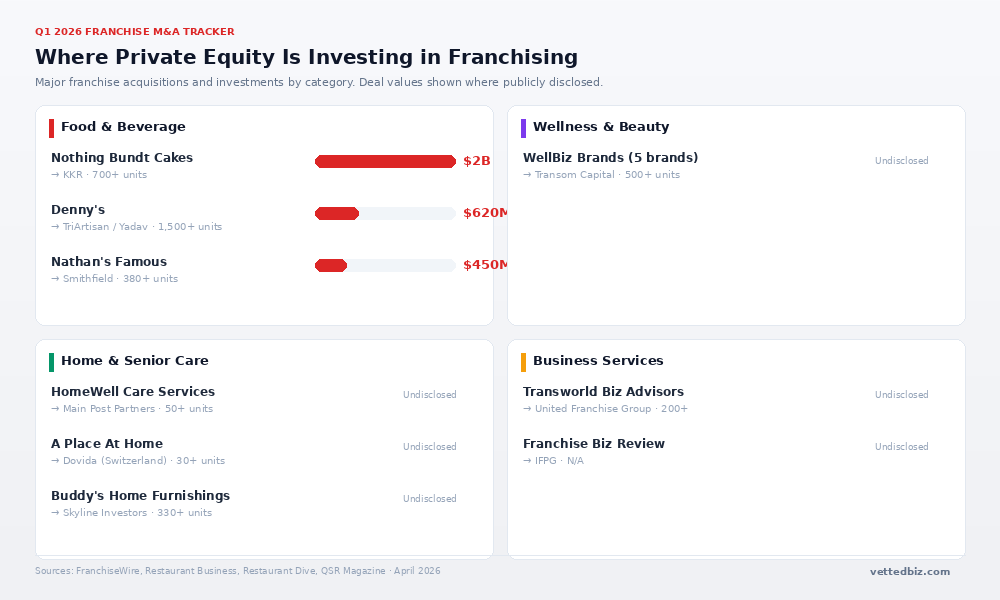
KKR acquired Nothing Bundt Cakes for $2 billion. Smithfield Foods purchased Nathan’s Famous for $450 million. Transom Capital Group brought WellBiz Brands, the parent of Drybar, Elements Massage, Amazing Lash Studio, and Fitness Together, under new ownership in a single transaction. And that was just Q1 2026.
Private equity’s involvement in franchising has been growing for years. In 2026, that pace is accelerating significantly.
According to FRANdata, PE-backed investments now encompass roughly 31,000 franchise businesses, and analysts at the firm have described 2026 as shaping up to be “an active and possibly crowded year” for transactions. Goldman Sachs cited a 40% industrywide jump in deal volume heading into 2026, and a Citizens Financial survey found that 58% of executives at middle-market firms and PE shops are optimistic about M&A this year.
For prospective franchise investors, these trends have practical implications. Private equity ownership can influence the franchise you’re buying into, from the fee structure and support model to the franchise agreement itself. Understanding how PE operates inside franchising has become an important part of the due-diligence process.
Why Private Equity Is Drawn to Franchising
The franchise model aligns well with what private equity investors typically look for.
Franchisors generate recurring, royalty-based revenue, typically 5% to 8% of gross sales, with relatively low capital requirements on the franchisor side. Franchisees invest in the real estate, buildouts, equipment, and staffing, while the franchisor earns royalties, marketing fees, and in many cases supplier-related revenue from a growing network of operators.
For PE firms with approximately $3.2 trillion in dry powder (uninvested capital) globally, franchise platforms offer an attractive combination: predictable cash flows, asset-light balance sheets, and a proven model for geographic expansion. A franchise system with strong unit economics, typically 15% to 20% EBITDA margins at the unit level, can become a compelling acquisition target.
Nothing Bundt Cakes illustrates the model well. The chain’s 700-plus locations are mostly franchised. Mature stores average about $1.4 million in annual revenue with four-wall EBITDA margins of approximately 21.6%, according to franchise disclosure documents reported by Restaurant Business.
Roark Capital acquired the brand in 2021, supported its growth to nearly double the unit count, and sold to KKR for a reported $2 billion.
The Q1 2026 Deal Tracker
What to Know When a Franchisor Changes Ownership
A franchise agreement typically spans 10 to 20 years. During that period, the franchisor’s ownership may change, sometimes more than once. Understanding the dynamics of ownership transitions can help investors make more informed decisions.
Potential Benefits
Private equity ownership can bring meaningful advantages to a franchise system. Well-capitalized firms often invest in technology platforms, marketing infrastructure, and operational systems that can strengthen the brand and support franchisees. They may bring professional management, standardized performance tracking, and the resources to accelerate brand awareness.
For example, WellBiz Brands announced plans to award 150 new franchise agreements in 2026 following the Transom Capital acquisition, a growth trajectory that requires significant capital and infrastructure investment.
Nothing Bundt Cakes nearly doubled its store count under Roark’s ownership, opening over 100 locations in 2024 without any permanent closures, according to its FDD.
Considerations for Investors
As with any ownership transition, there are factors that prospective investors should evaluate carefully. Industry observers and franchise associations have noted several areas worth examining when a PE firm acquires a franchisor:
- Fee structure changes. New ownership may update franchise agreements to include additional fees, such as technology fees, platform fees, or required vendor programs. Reviewing any recent changes to the FDD’s fee disclosures (Items 5 and 6) is important.
- Investment horizon alignment. PE firms typically operate on a 3- to 7-year hold cycle, which may differ from a franchisee’s 10- to 20-year commitment. Understanding the owner’s timeline can help investors assess how growth strategy and resource allocation may evolve.
- Leadership transitions. Ownership changes may bring new management teams with different priorities. Talking to current franchisees about their experience during transitions can provide valuable perspective.
- Support model evolution. The structure of franchisee support, including field staff, area developers, and training resources, may be restructured under new ownership. Evaluating the current state of support infrastructure is a standard part of due diligence.
- Operational standardization. New owners may introduce updated compliance requirements, supply chain programs, or operational standards. These can bring consistency benefits but may also require franchisees to adapt existing practices.
Multi-Brand Platforms: Consolidation at Scale
One of the notable trends of 2026 is the continued growth of multi-brand franchise platforms.
Roark Capital is a leading example. Through Inspire Brands, it operates Arby’s, Baskin-Robbins, Buffalo Wild Wings, Dunkin’, Jimmy John’s, and Sonic Drive-In, more than 33,000 locations globally. Roark also owns Subway and, until the recent sale, Nothing Bundt Cakes.
According to Bloomberg, the firm has been exploring a potential Inspire Brands IPO in 2026.
Other multi-brand platforms continue to expand as well. Authority Brands (home services), Neighborly (28+ brands), Empower Brands, and BELFOR Franchise Group are consolidating fragmented service categories under unified ownership structures.
For franchise investors, joining a brand within a multi-brand platform means being part of a larger portfolio. This can offer advantages such as shared technology, vendor leverage, and cross-brand marketing. It also means that resource allocation across the portfolio may shift over time based on the platform’s strategic priorities.
How PE Activity Informs Your Due Diligence
If you’re evaluating a franchise opportunity in 2026, understanding the ownership structure, whether currently PE-backed or potentially subject to future acquisition, is a valuable part of the research process.
Review Items 2 and 3 of the FDD
Item 2 discloses the franchisor’s business experience, including parent companies and affiliated entities. Item 3 covers litigation history. Together, they reveal the franchisor’s ownership history and any relevant legal matters that followed ownership changes.
Talk to Franchisees Who Have Experienced Ownership Transitions
During your validation process, ask franchisees about their experience before and after any ownership changes. What evolved in terms of fees, support, vendor requirements, and the franchise agreement?
First-hand perspectives from current operators are among the most valuable data points available.
Look for a Franchise Advisory Council (FAC)
Brands with active franchise advisory councils tend to manage ownership transitions more effectively. FACs provide a structured channel for franchisee input on policy changes, fee structures, and operational decisions.
Evaluate Item 19 Across Cohorts
PE-owned brands may publish detailed Item 19 financial performance representations. Analyze unit-level economics across different cohorts: new stores versus mature stores, company-owned versus franchised units, and geographic variations.
Stress-Test Your Financial Model
When building your pro forma, consider modeling scenarios where fees may evolve over time. A prudent stress test might include 1% to 2% of gross revenue in potential additional fees over a 5-year horizon to account for possible changes in the fee structure.
Understand the Ownership Timeline
Ask the franchisor about its ownership history: Who owns the brand? When was it acquired? What is the anticipated hold period?
This context helps you understand where the brand is in its ownership cycle and how that may influence strategic decisions.
Where Capital Is Flowing in 2026
The Q1 deal data reveals clear patterns about which franchise categories are attracting the most investment:
- Home services and trades: Strickland Brothers, BELFOR Franchise Group, and Authority Brands continue to attract investment due to consistent demand, essential-service characteristics, and fragmented local markets with consolidation potential.
- Health, wellness, and beauty: WellBiz Brands, and similar concepts benefit from growing consumer spending on personal wellness and membership-based recurring revenue models.
- Senior care and home care: HomeWell Care Services and A Place At Home both changed ownership in Q1, reflecting the demographic tailwinds of an aging population and growing demand for in-home services.
- Specialty food and beverage: Nothing Bundt Cakes and Nathan’s Famous highlight investor interest in brands with strong identity, streamlined operations, and consistent unit economics.
- Business services: IFPG’s acquisition of Franchise Business Review shows that investment activity extends to the franchise ecosystem’s own infrastructure, the consultants, data providers, and brokers that support franchise development.
The Bottom Line
Private equity’s growing role in franchising creates both opportunities and considerations for franchise investors. The outcomes for franchisees depend on the specific PE firm’s approach, its investment timeline, and how it balances brand growth with franchisee profitability.
What matters most in 2026 is that prospective investors include ownership structure analysis as part of their due diligence. Who owns the brand? When did they acquire it? What changes have been made since the acquisition? What is their track record with other franchise investments? These are questions that belong alongside financial analysis and market research in every investor’s checklist.
The franchise industry is projected to generate over $921 billion in economic output this year, support nearly 8.9 million jobs, and add over 12,000 new establishments. Private equity capital is one of the engines driving that growth, bringing scale, professional management, and resources to franchise systems across the country.
For investors who do their homework, the current environment offers meaningful opportunities.
Ready to research franchise opportunities with transparent data?
Visit www.vettedbiz.com to compare franchise costs, FDD data, and ownership structures side by side.
Disclaimer: This article is for informational and educational purposes only. It does not constitute financial, legal, or investment advice. All data referenced is sourced from publicly available reports, franchise disclosure documents, news publications, and industry research organizations. VettedBiz does not endorse or recommend any specific franchise, investment firm, or transaction. Prospective investors should conduct independent due diligence and consult with qualified financial and legal professionals before making any investment decisions. Brand names and trademarks mentioned in this article are the property of their respective owners and are used solely for identification and informational purposes.
Get insider access to franchise insights
Subscribe to receive expert tips, franchise rankings, and exclusive data straight to your inbox, trusted by thousands of aspiring business owners and investors.
Franchise resources & insights
Explore expert guides, data-driven articles, and tools to help you make smarter franchise decisions, whether you're just starting out or ready to invest.