Pilates and Boutique Fitness Franchises in 2026: Costs, Growth and Risks

Why Pilates and Boutique Fitness Franchises Are Booming in 2026
Few franchise categories have grown as visibly as Pilates and boutique fitness. Reformer Pilates studios have spread across suburban strip centers, and investors are asking whether the boom still has room to run or whether the best markets are already taken.
The answer depends on the brand, the market and the operator. Pilates and boutique fitness franchises combine recurring membership revenue with a wellness trend that appeals to a broad demographic, but they also carry high build-out costs, instructor shortages and a growing risk of local oversaturation.
This guide compares the main fitness franchise tiers, breaks down investment ranges and royalty structures from recent FDD analyses, examines unit growth and closures, and explains the risks to weigh before you sign. Figures come from third-party analyses of Franchise Disclosure Documents and industry research, so confirm every number against the current FDD of any brand you evaluate.
What Is Driving Demand for Pilates and Strength-Based Fitness
An industry outlook from investment advisory firm MMCG estimates that the broader U.S. Pilates and yoga studio sector generated about $19.2 billion in revenue in 2025, and that roughly 11.86 million Americans practiced Pilates in 2023, a 15 percent increase year over year. The same report expects U.S. reformer Pilates studios to grow from about 1,800 at the end of 2025 to about 2,600 by 2030.
Low-impact strength and an aging population
The analysis points to an aging population that prefers low-impact resistance training, and to a wider shift in discretionary wellness spending away from traditional cardio toward joint-friendly strength work. These are gradual demographic trends rather than fads, which supports long-term demand.
Social media and new customer groups
Social media has helped convert trial visitors into members, particularly among Gen Z and Millennials. According to the report, roughly 72 percent of members are women aged 25 to 55 with household incomes above $65,000, although male participation is rising.
Weight-management trends
The analysis also cites growing interest in strength training among people using GLP-1 weight-loss medications, because preserving lean muscle is a concern. It is an emerging driver and should be treated as a tailwind rather than a proven revenue source for any individual studio.
Pro Tip: Trend-driven demand can fade. Evaluate a fitness franchise on its membership retention, same-store sales and unit-level economics, not on social media buzz.
Three Tiers of Fitness Franchises
Budget and specialty boutiques
Concepts such as 9Round, Exercise Coach and DRIPBaR sit at the lower end, with investments reported at roughly $150,000 to $416,000. They typically need less space and equipment, but revenue per location is also lower.
Mid-market studios
This tier includes Club Pilates, Anytime Fitness and B3 Franchising, with investments roughly between $403K and $1.03M according to one 2026 comparison. Studios in this category usually rely on monthly memberships and on specialized instructors or classes.
Full-scale gyms
Crunch Fitness, AFC Fitness and Planet Fitness operate large-format clubs with investments from under $1 million to several million dollars. The same comparison lists Crunch at about $928,000 to $3.7 million. Real estate and build-out drive those numbers, and the returns depend on high member volume.
Fitness Franchise Investment and Royalty Comparison
A separate analysis of nine fitness FDDs provides Item 7 investment ranges and Item 6 royalty structures. The table below summarizes six of them. Figures differ slightly between sources and FDD years, so use them as a planning guide.
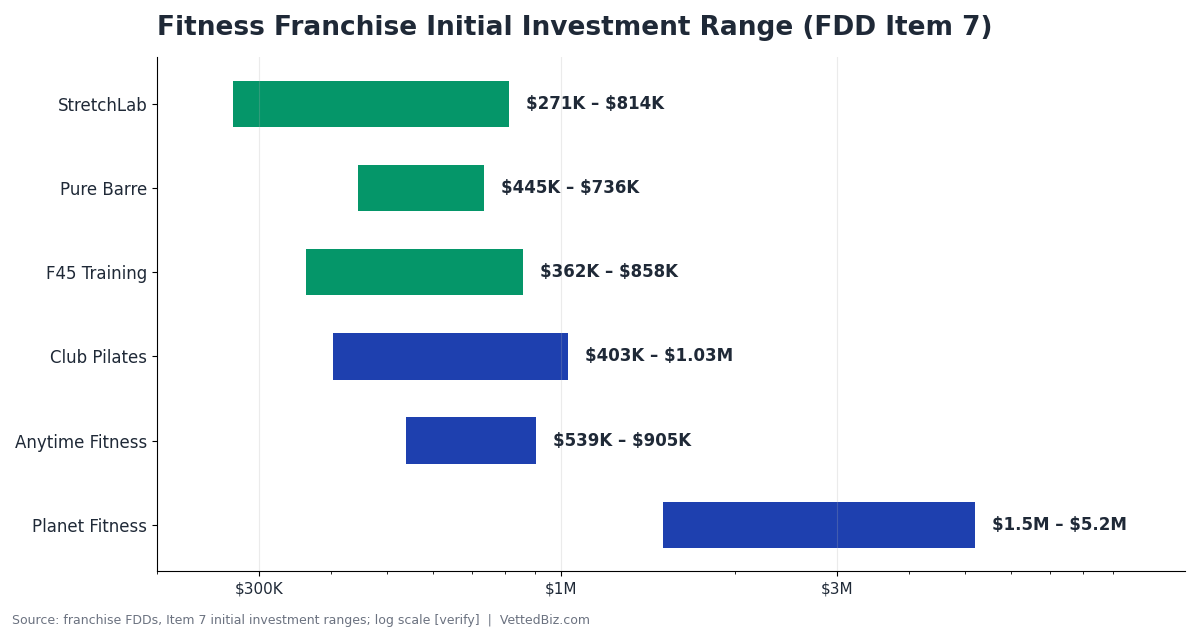
Planet Fitness requires several times the capital of boutique concepts such as StretchLab or Pure Barre.
The spread is striking. The analysis notes that Planet Fitness requires roughly 6.4 times the capital of StretchLab at the upper end of the range.
Royalty structure matters as much as the percentage
Brands use percentage royalties, flat monthly fees or hybrids that charge the greater of two amounts. A flat fee can be attractive when revenue is high, while a percentage royalty protects you during slow periods. Hybrid minimums can hurt in the early months, when membership is still building. Model each structure against your own ramp-up assumptions.
Revenue, Margins and Payback: What the Data Shows
The MMCG outlook estimates that top-quartile mature Pilates studios can exceed $1.3 million in annual revenue, while studios in saturated coastal markets may land closer to $850,000 to $950,000. It reports typical pricing of $199 to $359 per month for unlimited memberships, revenue per active member of roughly $200 to $260 per month at maturity, and EBITDA margins of around 22 percent for standard franchised concepts.
Another comparison says break-even often occurs within 12 to 24 months, with most revenue coming from recurring monthly memberships. Treat both as third-party estimates rather than guarantees. Only a franchisor's Item 19 can tell you what franchisees actually reported, and in the FDD analysis above only three of nine brands disclosed median average unit volume, which means most prospective buyers must rely on franchisee interviews for performance information.
Growth, Closures and Warning Signs
Item 20 is where unit growth shows up. In the nine-FDD analysis, Club Pilates, StretchLab and Planet Fitness all posted strong net growth, while Snap Fitness lost about 119 units, or roughly 19 percent, and Gold's Gym declined slightly. Orangetheory and F45 each grew to a peak and then contracted modestly.
Those patterns show why growth stories need context. Rapid expansion can reflect real demand, but it can also precede saturation. The MMCG report says same-store sales slowed late in 2025, including a decline in the fourth quarter at the large Pilates operator it tracks, which it reads as a sign of a demand ceiling at current prices in mature markets.
Saturation risk by market
The outlook identifies coastal metros such as Los Angeles, Phoenix, Dallas and Austin as showing overlapping trade areas and cannibalization, while secondary metros such as Salt Lake City, Boise, Madison, Des Moines, Greenville and Tulsa are described as whitespace with lower instructor labor costs and rent-to-revenue ratios in the 9 to 13 percent range. Whatever the brand, ask the franchisor for a trade-area analysis and verify how close the nearest existing studios are.
Regulatory and disclosure risk
The same report notes a federal consumer-protection settlement and a franchisee class action involving a major fitness franchisor over claims about build-out costs and time to opening. The lesson for buyers is practical: confirm opening timelines and build-out estimates with recent franchisees, and have a franchise attorney review Items 7 and 11.
Operational Challenges: Instructors, Insurance and Retention
Labor is the biggest constraint. The MMCG outlook reports instructor compensation of roughly $48,000 to $86,000 per year, and projects annual wage inflation of 5 to 8 percent in major metros. It also notes insurance premium increases of 15 to 30 percent per year in some states, including Florida, Texas and Louisiana.
Member retention is the other level. A studio that keeps members for years can absorb higher costs, while one with high churn must constantly spend on acquisition. Ask every franchisee about retention, class fill rates and how they recruit and keep instructors.
Pro Tip: Call franchisees who opened in the last two years, not only the long-established ones. Their build-out costs, ramp-up timelines and early membership numbers are the best indicator of what a new owner will face.
A practical way to use this information is to treat each market as its own investment case. Two studios from the same brand can perform very differently depending on household density, local competition and lease terms, so ask the franchisor how many existing locations fall within your proposed trade area and how those units have performed since the newest neighbor opened.
Financing a Fitness Franchise
Because total costs often run into the hundreds of thousands of dollars, most buyers use financing. The outlook describes typical SBA 7(a) loans for a large Pilates franchise covering roughly 80 percent of project cost with a 20 percent equity injection and 10-year terms, and reports that its SBA default rate is well below the all-franchise average. Lenders will scrutinize your liquidity, your experience and the franchisor's track record, so prepare a conservative business plan.
Who Should Consider a Fitness Franchise?
These models suit people who enjoy managing staff and building a community. Owner-operators can run a studio day to day, while multi-unit investors typically hire a general manager. If you prefer a passive investment, be realistic about the management layer and its cost.
Potential drawbacks
Fitness concepts have high fixed costs, long leases and sensitivity to the economy, since memberships are discretionary. A recession can drive cancellations quickly, and competition from independent studios and other franchises is intense in many markets.
Also consider your exit. Ask whether studios in the system have resold, what buyers paid relative to earnings, and how the franchisor handles transfers. Resale values depend heavily on a unit's trailing earnings and lease, so a strong operating record protects your options if your plans change.
Step-by-Step: How to Evaluate a Fitness Franchise
- Choose a tier. Decide whether you want a small boutique, a mid-market studio or a full-scale gym.
- Read the FDD with a franchise attorney. Focus on Items 5, 6, 7, 11, 19, 20 and 21.
- Study the trade area. Map existing studios, demographics and rent levels.
- Interview franchisees. Talk with at least ten, including recent openings and former owners.
- Stress-test the model. Assume slower membership growth, higher labor costs and a longer ramp-up than the franchisor shows.
Conclusion: Real Momentum, Real Risk
Pilates and boutique fitness franchises benefit from genuine demand for low-impact strength training and a strong recurring-revenue model. For the right operator in the right market, they can be attractive investments.
But costs are high, labor is tight, and several indicators suggest mature markets are filling up. The best approach is to compare brands on Items 7, 19 and 20, verify everything with franchisees, and choose a location where demand exceeds supply rather than following the crowd.
Ready to compare fitness franchise opportunities? Explore VettedBiz franchise resources and talk with an advisor to build your shortlist.
This article is for general information only and is not legal, financial, or investment advice. Consult a qualified franchise attorney and accountant before purchasing any franchise.
Get insider access to franchise insights
Subscribe to receive expert tips, franchise rankings, and exclusive data straight to your inbox, trusted by thousands of aspiring business owners and investors.
Franchise resources & insights
Explore expert guides, data-driven articles, and tools to help you make smarter franchise decisions, whether you're just starting out or ready to invest.