How Tariffs Are Reshaping Franchise Investment in 2026
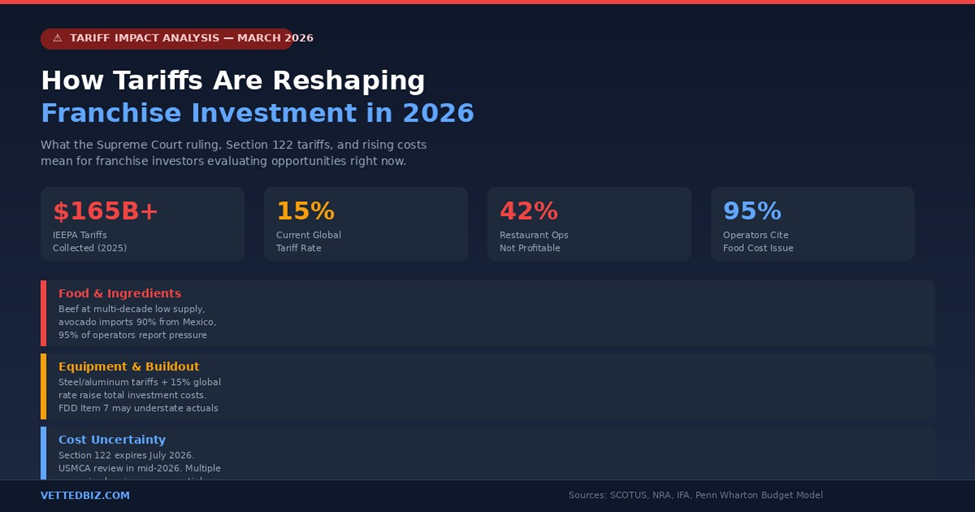
The franchise industry entered 2026 expecting stability. Instead, it got a constitutional crisis over trade policy, a Supreme Court ruling that struck down the legal foundation for the most sweeping tariffs in nearly a century, and a president who responded within hours by imposing new tariffs under a different law. For franchise investors, the result is a landscape where food costs are elevated, equipment prices are volatile, and the ability to forecast profitability has become genuinely harder than at any point since the pandemic.
This isn't a story about politics. It's a story about money, specifically, your money, and how the ongoing tariff environment directly affects the economics of owning a franchise in 2026. Whether you're evaluating a restaurant concept, a home services brand, or a retail franchise, understanding how tariffs flow through the franchise supply chain is now essential due diligence.
In this guide, we'll break down what happened with tariffs, how they're hitting franchise businesses in real terms, which sectors are most exposed, and what smart investors should factor into their analysis before committing capital.
What Happened: A Quick Timeline of the 2026 Tariff Landscape
The tariff story of 2026 centers on one landmark event and its immediate aftermath.
On February 20, 2026, the Supreme Court ruled 6-3 that the International Emergency Economic Powers Act (IEEPA) does not authorize the president to impose tariffs. The ruling in Learning Resources, Inc. v. Trump invalidated the legal foundation for the sweeping 'reciprocal tariffs' that had been in effect since early 2025, including tariffs on goods from China (as high as 145%), Canada, Mexico, the European Union, and dozens of other trading partners.
The IEEPA tariffs had generated an estimated $165 billion in collected duties between February 2025 and January 2026, according to the Penn Wharton Budget Model. At their peak, they represented over half of all U.S. customs duties collected, the highest effective tariff rate since the early 1930s.
Within hours of the ruling, the administration imposed new tariffs under Section 122 of the Trade Act of 1974, initially set at 10% and quickly raised to 15%, the maximum allowed under that statute. These tariffs apply globally and are temporary, expiring after 150 days (around late July 2026) unless Congress votes to extend them. Tariffs under Section 232 (steel, aluminum, automobiles) and Section 301 (China-specific) remain in effect independently.
Key Takeaway: Tariffs didn't disappear after the Supreme Court ruling. They changed form. And the uncertainty surrounding what comes next, whether Congress extends, modifies, or replaces current tariffs, is itself a cost that franchise investors need to account for.
How Tariffs Hit Franchise Businesses: The Three Pressure Points
Tariffs don't arrive as a single line item on a franchise P&L. They work through the supply chain in ways that are sometimes obvious and sometimes invisible.
1. Food and Ingredient Costs
For restaurant franchises, which represent over 26% of all franchise businesses in the United States, according to the International Franchise Association, food cost inflation driven by tariffs is the most immediate concern.
The National Restaurant Association's 2026 State of the Industry report found that 95% of full-service restaurant operators and 94% of limited-service operators identified food costs as a significant challenge. Of those, 65% of full-service and 61% of limited-service operators said tariff impacts specifically were making operations more difficult.
The categories most affected include beef (cattle inventory at a multi-decade low, with supply tightness expected to persist through at least 2027), produce from Mexico and Canada (the United States sources nearly 90% of its avocados from Mexico), dairy and cheese from Europe, and specialty items like olive oil, coffee, and spices.
Even domestic sourcing doesn't fully insulate operators. When tariffs raise demand for domestic alternatives, those prices rise too. The result is what economists call 'second-order effects', price increases that cascade through supply chains regardless of where individual ingredients originate.
For franchise investors evaluating restaurant concepts, the critical question is: how well does this brand manage food cost volatility? Franchises with strong purchasing cooperatives, diversified supply chains, and flexible menu engineering are better positioned than those locked into fixed-cost supplier agreements.
2. Equipment and Buildout Costs
This pressure point affects every franchise category, not just restaurants. Kitchen equipment, HVAC systems, point-of-sale hardware, signage, furniture, and construction materials all have significant import components.
The 15% global tariff under Section 122, combined with ongoing Section 232 tariffs on steel and aluminum, means that the cost of building out a new franchise location is measurably higher than it was two years ago. Steel tariffs alone add meaningful cost to any franchise that requires a commercial kitchen, warehouse, or retail space buildout.
The practical impact is twofold. First, total initial investment figures in current Franchise Disclosure Documents may understate actual costs if they were prepared before the latest round of tariffs took effect. Second, equipment replacement costs during the life of a franchise agreement will be higher than historical averages, affecting long-term profitability calculations.
FDD Alert: When reviewing Item 7 (Estimated Initial Investment), ask the franchisor directly whether these estimates reflect current tariff-adjusted pricing. If the FDD was filed before February 2026, the numbers may not capture the current cost environment.
3. Operational Cost Uncertainty
Perhaps the most insidious tariff impact is the uncertainty it creates. When operators don't know what their costs will be six months from now, they can't plan effectively.
The Section 122 tariffs expire in late July 2026 unless Congress acts. If Congress doesn't extend them, the administration has signaled it will pursue tariffs through other statutory authorities, Section 301 investigations, Section 338 (unused since 1949 but newly relevant), or potentially new legislation. Each pathway has different timelines, rates, and coverage.
For franchise investors, this uncertainty translates directly into financial planning risk. A franchise pro forma built on today's cost assumptions may look very different six months from now, in either direction. Conservative investors should model multiple scenarios: current tariff levels, a return to higher rates, and a potential reduction.
Which Franchise Sectors Are Most Exposed?
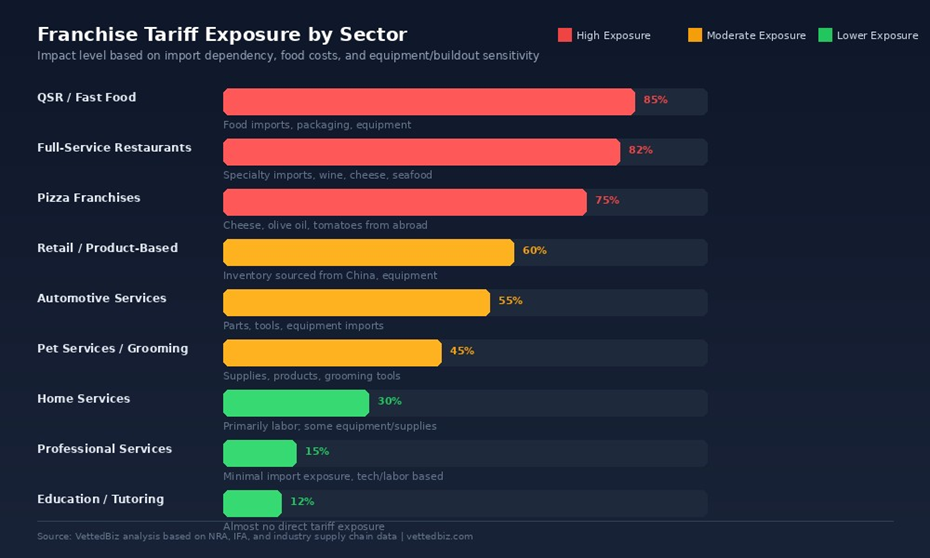
Not all franchise categories face equal tariff risk. Here's how the exposure breaks down.
High Exposure: Restaurant and Food-Service Franchises
Restaurant franchises face the most direct tariff impact because food is their primary cost of goods sold. Brands that rely heavily on imported ingredients, seafood-heavy concepts, Mexican food franchises dependent on avocado and produce imports, pizza chains using imported cheese and olive oil, are especially vulnerable.
The National Restaurant Association reported that 42% of restaurant operators were not profitable in 2025, and margin pressures will remain in 2026. For franchise investors, this means scrutinizing Item 19 financial performance data even more carefully. Ask: what were food cost percentages during 2025, and how have they changed in early 2026?
However, some restaurant franchises are better insulated. Brands with primarily domestic supply chains, flexible menus that can substitute ingredients, and strong purchasing cooperatives (where hundreds of franchisees buy collectively) have more tools to manage cost volatility.
Moderate Exposure: Retail and Service-Based Franchises
Franchises that sell physical products, automotive parts, pet supplies, beauty products, home improvement materials, face tariff exposure on inventory costs. Brands that source products from China are particularly affected, even with the shift from IEEPA tariffs to the 15% Section 122 rate.
Service-based franchises have lower direct exposure because their primary costs are labor and marketing rather than imported goods. However, they're not immune. Equipment, uniforms, cleaning supplies, and vehicles all carry tariff-related price increases.
Lower Exposure: Home Services and Professional Services
Franchises in categories like consulting, staffing, real estate, financial services, and education have the least direct tariff exposure. Their cost structures are dominated by labor, technology, and marketing, none of which are directly subject to import duties.
For investors seeking tariff-resistant franchise opportunities, these sectors offer more predictable cost structures in the current environment.
SectorExposurePrimary Tariff RiskInvestor ActionQSR / Fast FoodHigh (85%)Food imports, packaging, equipmentVerify food cost % in Item 19; ask about purchasing co-opsFull-Service RestaurantsHigh (82%)Specialty imports, wine, cheese, seafoodModel food cost scenarios at +10% and +20%Retail / ProductModerate (60%)China-sourced inventory, equipmentAsk about supplier diversification strategyHome ServicesLower (30%)Primarily labor; some equipmentMinimal tariff concern; focus on labor costsProfessional SvcsLower (15%)Minimal import exposureMost tariff-resistant category
Source: VettedBiz analysis based on NRA, IFA, and industry supply chain data. Exposure scores are illustrative estimates.
What Smart Franchise Investors Should Do Right Now
The tariff landscape doesn't mean franchise investment is a bad idea in 2026. It means you need to adjust your analysis to account for a variable that wasn't this significant two years ago.
Build tariff sensitivity into your financial models. When building pro formas for any franchise investment, create at least three scenarios: current tariff levels maintained, tariffs increased to pre-SCOTUS levels, and tariffs reduced or eliminated. Your decision should be viable under the moderate scenario, not just the best case.
Ask the franchisor directly about tariff exposure. Specifically, ask: What percentage of your supply chain relies on imported goods? Have you adjusted Item 7 estimates to reflect current tariff-adjusted costs? What purchasing strategies are in place to mitigate tariff volatility? Has the brand secured any alternative supplier relationships in response to tariff changes?
Talk to current franchisees about real-world cost changes. FDD data may lag behind actual market conditions. Franchisees operating today can tell you what food costs, equipment costs, and buildout costs actually look like in 2026, not what the FDD projected.
Factor in the USMCA renegotiation. The United States-Mexico-Canada Agreement is scheduled for review in mid-2026. The National Restaurant Association is actively lobbying for continued tariff exemptions on USMCA products. The outcome of this review could significantly affect food costs for restaurant franchises. Monitor this development closely.
Prioritize franchises with pricing power. In a tariff environment, brands that can raise menu prices without significant customer attrition are better positioned. Look for franchises with strong brand loyalty, limited direct competition, and value propositions that aren't purely price-driven.
The Bigger Picture: What Tariffs Mean for Franchise Industry Growth
Despite the tariff headwinds, the franchise industry continues to grow. The IFA projects over 12,000 new franchise establishments in 2026, with total economic output exceeding $921 billion. Restaurant and foodservice sales are expected to reach $1.55 trillion, a 4.8% increase from 2025.
The tariff environment is creating a natural selection effect. Stronger franchise systems with diversified supply chains, flexible operations, and disciplined cost management are gaining competitive advantage over weaker systems that can't absorb or manage cost volatility. For investors, this is actually useful information, it helps separate the well-managed franchise systems from the ones that are struggling.
Franchise industry leaders are cautiously optimistic that the worst of the tariff uncertainty may be subsiding. As one multi-unit franchisee for several major brands observed, the industry is still working through the lingering effects of the pandemic era, and the combination of tariff stabilization and improving consumer confidence should help operators gradually restore margins.
The key word is 'gradually.' Franchise investors who expect an immediate return to pre-tariff cost structures will be disappointed. Those who plan for a sustained period of moderately elevated costs, with the possibility of further adjustments in either direction, will make better decisions.
The Bottom Line
Tariffs have become a permanent feature of the franchise investment landscape in 2026. The Supreme Court's landmark ruling on IEEPA tariffs didn't eliminate tariffs, it shifted them to different legal authorities and created a new layer of uncertainty about what comes next.
For franchise investors, the practical implications are clear. Food and ingredient costs are elevated and will remain so. Equipment and buildout costs are higher. And the ability to forecast costs six to twelve months into the future is more limited than usual.
None of this makes franchise investment a bad idea. But it makes due diligence more important than ever. The investors who succeed in 2026 will be the ones who build tariff scenarios into their financial models, ask tough questions about supply chain exposure, and prioritize franchises with the operational resilience to manage cost volatility.
Ready to explore your franchise options? Start by requesting FDDs from multiple brands, comparing the real-world cost data from current franchisees, and modeling your investment under realistic, not optimistic, cost assumptions. For detailed franchise data, risk scores, and tools to support your due diligence, explore www.vettedbiz.com.
Get insider access to franchise insights
Subscribe to receive expert tips, franchise rankings, and exclusive data straight to your inbox, trusted by thousands of aspiring business owners and investors.
Franchise resources & insights
Explore expert guides, data-driven articles, and tools to help you make smarter franchise decisions, whether you're just starting out or ready to invest.