Franchise Resales in 2026: What Existing Units Actually Sell For
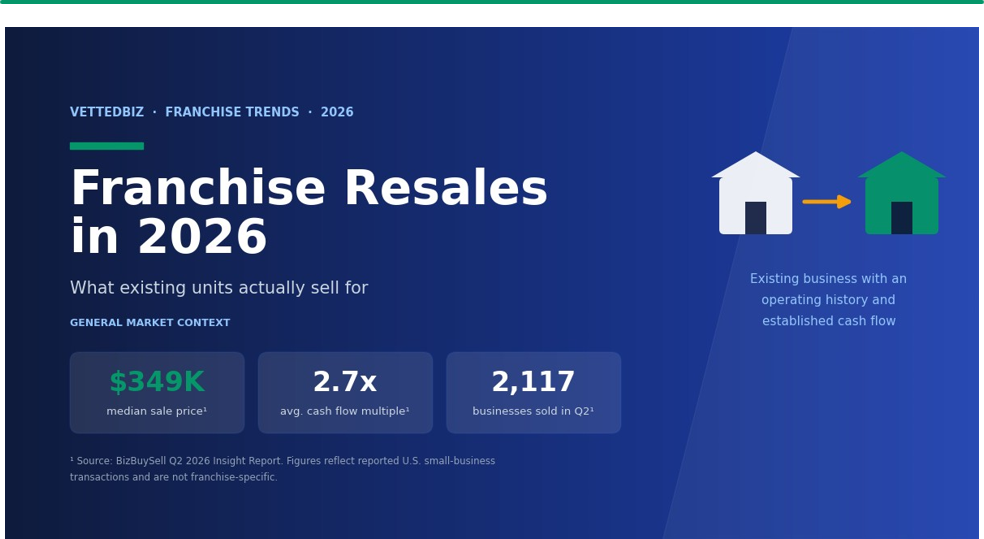
Buying an existing unit means acquiring a business with an operating history and established cash flow, rather than a projection.
Most people researching franchise ownership start in the same place: a franchisor's development page, an Item 7 investment range, and a projection of what the business might do once it is open. That path is well documented.
The other path gets far less attention. Every year, thousands of existing franchise units change hands, owners retire, relocate, or simply decide they are done. Those units come with something no new build has: a real profit-and-loss statement.
The trade is straightforward. You pay more upfront for a resale than you would for a new unit's franchise fee, and in exchange you acquire revenue that already exists. Whether that trade is worth it depends on the multiple you pay and the quality of what you are buying.
This guide covers what the broader business-for-sale market looks like in 2026, how resale valuation math works, and the specific diligence that applies to a resale but not to a new unit.
The 2026 Market: Fewer Deals, Steadier Prices
The business-for-sale market has cooled in volume without cracking on price. According to BizBuySell's Q2 2026 Insight Report, roughly 2,117 businesses changed hands at a median sale price of $349,250, with an average cash flow multiple of 2.7x.
One important caveat before using any of these numbers: BizBuySell reports on all reported U.S. small-business transactions, not franchise resales specifically. Franchised units are a subset of that pool. Treat these figures as market context that frames the environment you are buying in, not as franchise benchmarks.
The interpretation still holds. Falling transaction counts alongside broadly stable pricing is not a market in distress. It is a market where financing is tighter and buyers are more selective, so weaker listings sit unsold rather than clearing at a discount. Deals are being scrutinized harder on earnings durability, not repriced downward.
Supply Is Rising
A demographic shift is adding inventory. A large cohort of owners who built their businesses over the last three decades is now reaching retirement age, and business brokers consistently report that these sellers make up a growing share of listings.
For a buyer, more listings combined with stricter lending is a reasonable combination: more to choose from, and less competition from buyers who cannot get financed.
Pro Tip: When a broker quotes you a market multiple, ask what data set it comes from and whether it is franchise-specific. General small-business averages include thousands of independent operators with no brand, no system, and no transfer approval process. A franchised unit is a different asset and should be valued on its own comparables.
How Resale Valuations Work
Small businesses are priced off earnings, not revenue. The two terms you will encounter are Seller's Discretionary Earnings (SDE), net profit with the owner's salary, personal expenses, interest, depreciation and one-time costs added back, and cash flow, which marketplace data typically uses to mean the same thing.
A rough sanity check: cash flow of $200,000 at a 2.7x multiple implies a $540,000 asking price.
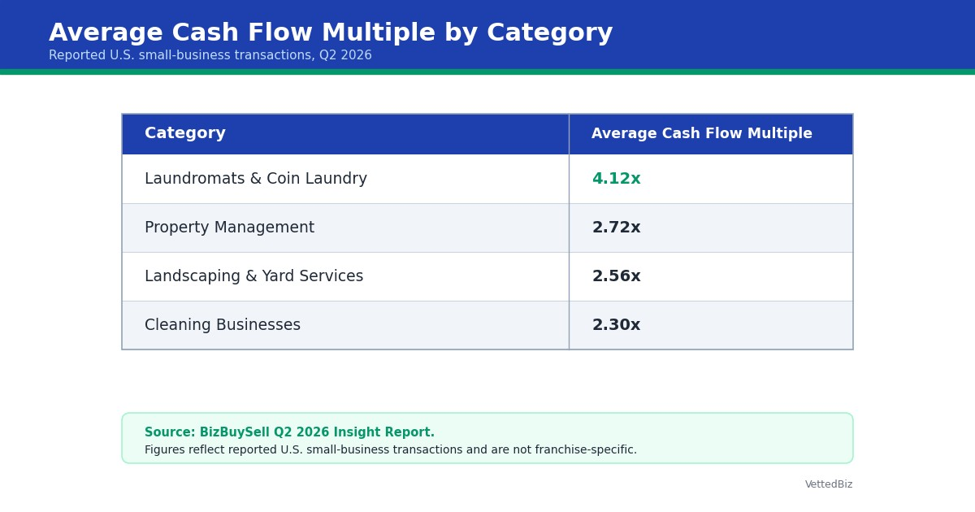
Multiples vary widely by what kind of business is being sold. The categories below are drawn from reported transaction data and illustrate the spread.
Why the Spread Is So Wide
The gap between laundromats at 4.12x and cleaning businesses at 2.30x is not arbitrary. It tracks how transferable the earnings are.
A laundromat is largely equipment and location. The machines run whether or not the previous owner is standing there, so the earnings survive the handover intact and buyers pay a premium for that. A cleaning business is contracts, crews and relationships, more of which can walk out with the seller. Property management sits in between: recurring contracted revenue, but relationship-dependent.
That principle is the single most useful thing to carry into a resale negotiation: the less the business depends on the person selling it, the higher the multiple it deserves.
What Moves a Specific Unit
- Remaining lease term. A unit with two years left on the lease is a different asset than one with ten plus options. This is often the single largest swing factor.
- Remaining franchise agreement term. If the agreement expires in 18 months, you are buying a renewal negotiation, and renewal often triggers current-form terms and remodel requirements.
- Revenue trend. Three years of growth versus three years of decline moves the multiple materially.
- Owner dependence. If the seller is the business, the relationships, the technical skill, the sales, the earnings do not fully transfer.
- Territory and multi-unit rights. Exclusivity and the option to expand carry real value.
A Worked Example
Consider a property management unit with $220,000 in reported cash flow. At the 2.72x category average, that implies an asking price near $598,000.
Now run the diligence. Suppose $35,000 of the add-backs turn out to be expenses a new owner will keep paying: a vehicle actually used in the business, and a family member on payroll who does real work. Real cash flow is $185,000, not $220,000.
At the same 2.72x multiple, the defensible price is about $503,000, roughly $95,000 below asking. That gap did not come from negotiating harder. It came from reading the add-back schedule line by line.
This is why resale diligence pays for itself. Every dollar of overstated earnings costs you the full multiple in purchase price.
How Resale Deals Get Structured
Very few resales are all-cash at closing. Two structures come up repeatedly and both are worth asking for.
- Seller financing. The seller carries a note for part of the price, paid out over several years. This is common in SBA-financed deals and often required by the lender. It also aligns incentives, a seller carrying paper has a stake in a clean handover.
- Earnouts and holdbacks. Part of the price is contingent on the business hitting agreed performance after closing. Useful when the parties disagree on whether recent results are sustainable, or when earnings are heavily owner-dependent.
Also negotiate a transition period. Thirty to ninety days of the seller's involvement post-closing, introductions to key accounts, vendor relationships, staff handover, costs the seller little and materially reduces your risk of losing the earnings you just bought.
Average cash flow multiples by category from reported Q2 2026 transactions. Equipment-and-location businesses command the highest multiples; relationship-dependent service businesses the lowest.
Resale vs. New Unit: The Actual Trade-Off
Time to Cash Flow
This is the core of the case for a resale. A new unit takes time to reach system-average volume, franchise brokerages commonly cite ramp periods measured in years for build-out concepts, with the failure profile concentrated in the earliest period. A resale generating $180,000 in cash flow generates it the month you take over.
You are paying a premium precisely to skip the riskiest period of the business's life.
Financing Is Materially Easier
This is the most underappreciated advantage. SBA 7(a) underwriters evaluating a resale work from three years of actual tax returns and P&Ls for that specific location. A new build is underwritten against the franchisor's Item 19 averages and your projections.
Real historical financials for the exact unit are a stronger credit file. In a tighter lending environment, that difference can decide whether a deal gets funded at all.
Where New Units Win
- Lower entry price. A franchise fee plus buildout is often less total capital than acquiring a performing unit.
- You choose the site. A resale comes with a location and lease someone else negotiated.
- No inherited problems. No staff issues, no deferred maintenance, no damaged local reputation.
- Current-form agreement. You are not stepping into a legacy contract or an imminent renewal.
Pro Tip: The franchisor must approve you as a transferee, and most systems charge a transfer fee. Some also require the unit to be brought to current image standards at transfer, a remodel obligation that can add six figures. Get this in writing from the franchisor, not the seller, before you agree on price.
Diligence That Applies Only to a Resale
Standard franchise diligence, Item 19, Item 20 calls, territory analysis, still applies. These are the additional items.
Verify the Earnings, Do Not Accept Them
Ask for three years of tax returns, not just P&Ls, and reconcile the two. Then interrogate every add-back individually. Sellers routinely add back expenses that a new owner will actually keep paying.
Read the Lease Before the Financials
Confirm the remaining term, renewal options, rent escalations, assignment rights and whether the landlord must consent to transfer. A great business on a lease expiring in 24 months is a much weaker asset than the P&L suggests.
Understand Why the Owner Is Selling
Retirement, relocation and burnout are ordinary. A new competitor opening nearby, a franchisor-mandated remodel, or a lost key account are not. Cross-check the stated reason against the trend in the numbers.
Test Owner Dependence Directly
Ask what happens operationally if the owner leaves for a month. Ask who holds the customer and referral relationships. Ask how long the staff has been there and whether they intend to stay through a transfer.
Earnings that walk out with the seller are not earnings you are buying.
Confirm the Transfer Terms With the Franchisor
Transfer fee, approval criteria, required training, remaining agreement term, renewal conditions, and any upgrade or remodel obligation triggered by the transfer. All of it belongs in your model before you sign anything.
Who Resales Suit
- Buyers who need income immediately and cannot absorb a long ramp period
- First-time owners, who are stepping into a business with a demonstrated operating history rather than an unproven one
- Buyers relying on SBA financing, where real historical financials materially improve approval odds
- Operators seeking a turnaround, who can buy an underperforming unit at a discount and fix what is broken
They suit poorly anyone who wants a specific unproven market, or who lacks the financial literacy to audit a seller's add-backs. In a resale, the diligence is the deal.
Conclusion
The 2026 market favors prepared buyers: transaction volume is down, pricing is broadly stable, retirements are adding supply, and tighter underwriting is thinning the competition.
Where a specific unit lands on multiple comes down to how transferable its earnings are, lease term, revenue trend, and how much of the business walks out the door with the seller.
The advantage of a resale is that you are buying something that already exists rather than a projection. That advantage only holds if you verify what you are buying, which means auditing add-backs, reading the lease, and confirming transfer terms with the franchisor directly.
Next step: Browse current franchise resale listings and compare them against Item 19 data for the same brand on VettedBiz.
Data sources: BizBuySell Q2 2026 Insight Report (figures reflect reported U.S. small-business transactions and are not franchise-specific); U.S. Small Business Administration 7(a) program guidance; 2026 Franchise Disclosure Documents. This article is informational and is not investment, legal, or tax advice.
Get insider access to franchise insights
Subscribe to receive expert tips, franchise rankings, and exclusive data straight to your inbox, trusted by thousands of aspiring business owners and investors.
Franchise resources & insights
Explore expert guides, data-driven articles, and tools to help you make smarter franchise decisions, whether you're just starting out or ready to invest.