Best Fitness Franchises in 2026: From Budget Gyms to Boutique Studios

The fitness industry has fully recovered from the pandemic—and then some. In 2026, the U.S. fitness market generates over $35 billion in annual revenue, with gym memberships exceeding 70 million nationwide. For franchise investors, the sector offers something rare: a business model built on recurring revenue, strong brand loyalty, and demographic tailwinds that show no signs of slowing.
But not all fitness franchises are created equal. The investment range spans from under $100,000 for a compact boutique studio to over $5 million for a full-scale Planet Fitness build-out. Revenue per unit, profit margins, and break-even timelines vary just as dramatically. Choosing the right model depends on your capital, your market, and how involved you want to be in day-to-day operations.
This guide breaks down the five major fitness franchise categories, compares the leading brands in each, and gives you the financial data you need to make a smart investment decision.
Why Fitness Franchises Are Outperforming in 2026
Recurring revenue is the foundation. Unlike restaurants that depend on daily transactions, gym franchises collect monthly membership fees via automated billing. This creates predictable cash flow and reduces the constant pressure of customer acquisition. Once a member signs up, the revenue continues month after month.
The K-shaped economy favors fitness. Recent earnings from Life Time and Planet Fitness illustrate a split in the market. Life Time, which targets affluent consumers with premium offerings, reported record revenue in 2025. Planet Fitness, which serves value-conscious members, saw strong growth but a softer 2026 outlook as lower-income consumers tighten spending. For investors, this means choosing the right positioning matters more than ever.
Consolidation is creating scale opportunities. The 2024 merger of Orangetheory Fitness and Self Esteem Brands (parent of Anytime Fitness) created Purpose Brands, a fitness empire with over 7,000 combined locations. Private equity activity is intensifying across the sector, validating the franchise model as a scalable asset class.
Technology is a profit lever. The most profitable gyms in 2026 use software to manage access, billing, scheduling, and retention. Automation reduces staffing costs while heart-rate monitors, AI-driven workout recommendations, and app-based engagement boost member retention. Franchises that integrate technology effectively are seeing 15–30% net profit margins.
The Five Fitness Franchise Models: Know Your Options
1. High-Volume, Low-Price (HVLP) Gyms
Brands like Planet Fitness and Crunch Fitness dominate this category, targeting the casual gym-goer with membership fees as low as $10–$25 per month. The business model depends on volume: a typical Planet Fitness location serves 6,000–8,000 members, and profitability comes from the sheer scale of recurring dues.
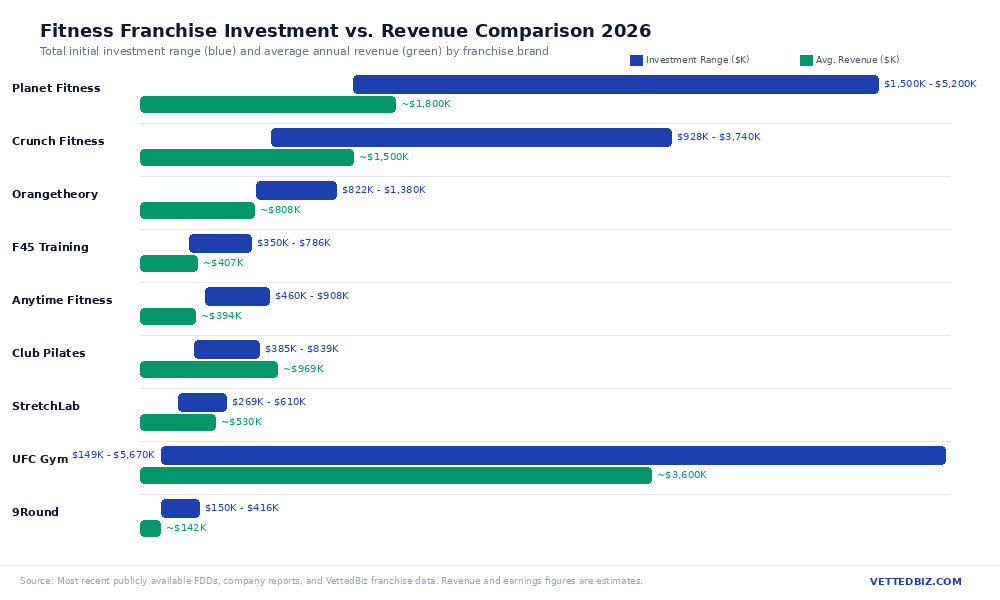
Planet Fitness requires a total investment of $1.5M to $5.2M, with average annual revenue of approximately $1.8M per franchised unit. Estimated annual owner earnings range from $215,000 to $270,000, with a payback period of approximately 15–17 years. The franchise has over 2,560 locations and a 2% failure rate, making it one of the most stable investments in the fitness space. However, Planet Fitness is projecting slower 2026 revenue growth of 9% and is testing price increases scheduled for summer 2026.
Crunch Fitness is emerging as a strong HVLP competitor, with CR Fitness Holdings (the largest Crunch franchisee) pacing toward 100 gyms by 2026. Crunch benefits from second-generation commercial real estate becoming available as traditional retail shrinks, offering favorable lease terms for large-format fitness facilities.
2. Boutique HIIT and Interval Studios
Orangetheory Fitness and F45 Training lead this segment, offering premium group workout experiences at higher price points ($100–$200+ monthly). These studios operate in smaller footprints (1,800–4,000 sq ft) with specialized equipment and technology-driven workouts.
Orangetheory requires a total investment of $822,000 to $1.38M, with a franchise fee of $59,950, an 8% royalty, and a 3% marketing fee. Average annual revenue is approximately $808,000, with estimated owner earnings of $121,000–$145,000. The brand operates 1,500+ studios across 25 countries and benefits from strong member retention driven by its heart-rate-based training technology.
F45 Training, founded in Australia, has over 3,300 studios across 67 countries, in the U.S., with a franchise fee of $60,000. Its 45-minute functional training format appeals to busy professionals, though the brand has faced financial challenges at the corporate level that investors should evaluate carefully.
3. 24-Hour Access Gyms
Anytime Fitness and Snap Fitness pioneered the unstaffed, key-fob access model. Anytime Fitness operates over 5,500 locations worldwide, making it one of the largest fitness franchises globally. The model appeals to investors who want a semi-passive ownership experience, as clubs can operate with minimal staffing during off-peak hours.
Average Anytime Fitness locations generate approximately $394,000 in annual revenue with 15–16% profit margins. The lower revenue per unit is offset by lower investment requirements and operating costs compared to full-service gyms. Multi-unit ownership is common and often necessary to build meaningful cash flow.
4. Specialty and Wellness Studios
Xponential Fitness operates ten distinct studio brands under one corporate umbrella, including Club Pilates, StretchLab, CycleBar, Row House, and YogaSix. This portfolio approach allows franchisees to capture multiple niche markets within a single development agreement.
These studios typically require investments of $150,000–$1,000,000 and target affluent demographics willing to pay premium pricing for specialized experiences. Recovery-focused modalities like infrared saunas and stretch therapy are emerging as core value drivers in 2026, with franchise operators reporting strong demand for add-on wellness services.
5. Combat and MMA-Inspired Gyms
UFC Gym leads this niche with multiple formats: Signature facilities (20,000–40,000+ sq ft full-service clubs), Core mid-size gyms, Class boutique studios (2,200–3,500 sq ft), and Jiu Jitsu-focused locations. The royalty structure varies by format, with 6% for Core/Class/Jiu Jitsu and 4% for Signature/UFC Fit.
9Round, a kickboxing circuit franchise, offers a lower-cost entry point with a focus on 30-minute full-body workouts. The growing popularity of combat sports and self-defense training, fueled by the UFC brand's mainstream appeal, gives this category strong cultural tailwinds heading into 2026.
What to Evaluate Before Investing in a Fitness Franchise
Match the model to your market. HVLP gyms thrive in suburbs with high population density and available commercial real estate. Boutique studios perform best in urban areas with higher-income demographics. Understanding your local competitive landscape is critical. Successful operators keep rent at 12–15% of revenue, and overpaying for a location is one of the most common mistakes.
Evaluate the pre-sale pipeline. Opening with 200–500 members already signed up is the difference between struggling and being profitable from day one. Top operators run pre-sales 4–8 weeks before opening, building hype through founding memberships, community events, and targeted digital marketing.
Understand the retention equation. A gym with high churn will never hit strong margins regardless of the brand. The most profitable franchises in 2026 invest heavily in onboarding, progress tracking, community building, and software-driven churn alerts to catch at-risk members before they cancel.
Plan for multi-unit from the start. In most fitness franchise models, a single location provides a comfortable income but not wealth-building returns. The real money is in multi-unit ownership, where fixed costs like management overhead and marketing can be spread across multiple locations. Many franchisors now require multi-unit development agreements for new territories.
Read the FDD carefully. Item 19 (Financial Performance Representations) is where the real data lives. Not all franchisors disclose this information, but those that do demonstrate confidence in their unit economics. Look at median performance, not just averages, and pay attention to the variance between top and bottom performers.
Fitness Franchise Trends Shaping 2026
Recovery and wellness add-ons are booming. Infrared saunas, cryotherapy, red light therapy, and stretch services are becoming core revenue drivers rather than optional extras. Planet Fitness is investing in red light therapy and additional classes to increase revenue per member and attract younger demographics.
AI is transforming operations. From personalized workout recommendations to predictive churn models, artificial intelligence is helping franchise operators run leaner operations with better member outcomes. The most forward-thinking franchisors are integrating AI into their technology stack, and operators who leverage it effectively gain a meaningful competitive advantage.
Second-generation real estate is a windfall. As traditional retailers close, large-format commercial spaces are becoming available at favorable terms. HVLP operators like Crunch Fitness are capitalizing on this trend, securing premium locations that would have been inaccessible five years ago. Shopping center landlords are lifting restrictions on fitness tenants as they recognize the foot traffic benefits.
The Orangetheory–Anytime Fitness merger is reshaping the competitive landscape. The creation of Purpose Brands gives the combined entity over 7,000 locations and the ability to cross-sell between boutique and 24-hour models. Competitors will need to differentiate more aggressively or consolidate to keep pace.
The Bottom Line
The fitness franchise sector in 2026 offers something for nearly every investor profile. If you have $1.5M+ and want a proven, high-revenue model with institutional-grade brand recognition, Planet Fitness and Crunch Fitness are the benchmarks. If you prefer a smaller footprint with premium unit economics, Orangetheory and the Xponential portfolio offer compelling options. And if you want a lower entry point with semi-passive potential, 24-hour access models like Anytime Fitness remain a reliable choice.
Whatever your investment thesis, the fundamentals of the fitness business remain strong: recurring revenue, growing consumer demand, and a model that rewards operational discipline. The investors who succeed will be the ones who match the right franchise model to the right market and execute with consistency.
Ready to compare fitness franchise opportunities side by side? Use VettedBiz's franchise analytics platform to access FDD data, risk scores, and financial performance metrics for hundreds of franchise brands.
Get insider access to franchise insights
Subscribe to receive expert tips, franchise rankings, and exclusive data straight to your inbox, trusted by thousands of aspiring business owners and investors.
Franchise resources & insights
Explore expert guides, data-driven articles, and tools to help you make smarter franchise decisions, whether you're just starting out or ready to invest.